
WHERE THE
INDUSTRY
CHANGES TRAINS
For 97 years, the people who run news media have left their own lines once a year to meet on one platform. The World Congress is where a year of the industry’s experiments gets compared, challenged and — often enough — copied. This page is the why: why the Congress exists, why New York, who is behind it, and whether it is for you.
The Congress
Why we still put everyone in one room.
Every news media company is running its own experiment — a new bundle in one market, an AI desk in another, a creator partnership in a third. Most of what is learned stays inside the building that learned it. The industry moves more slowly than it needs to, not for want of ideas but for want of a place to compare them.
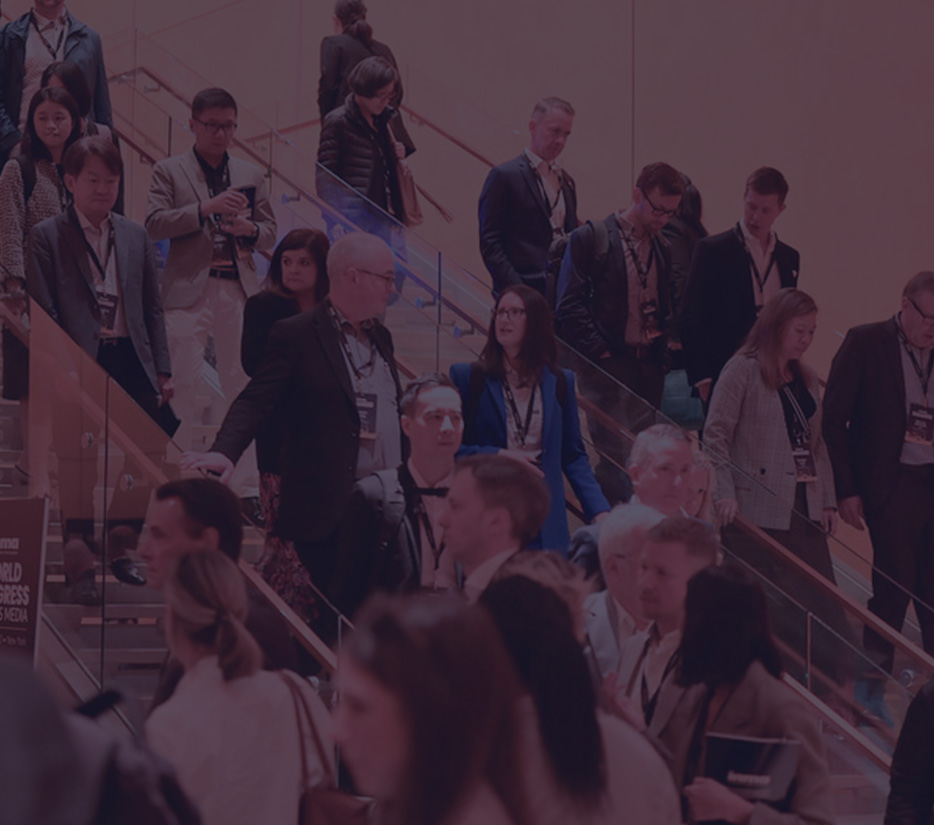
The World Congress is that place. Once a year since 1930, INMA puts the people making company-level decisions in one room — chief executives, editors, the heads of product, revenue, data and technology — and asks them to show their work. A decision they made. What it cost. What happened.
The agenda is chosen by the INMA community. No vendor pitches. Speakers are expected to take questions, and some sessions run off the record so the numbers can be real. Two days of study tours take forty people at a time inside the companies rewriting the rules; six seminars on the Friday turn the week into decisions; and the Global Media Awards put the year’s best work on one stage, judged by peers.
The format has changed with every technology that was supposed to finish the news business — radio, television, the Internet, the smartphone, and now AI. The purpose has not. You arrive on your own line. You leave knowing where everyone else is heading.
New York
The busiest station on the map.
The TimesCenter’s nearest stop is Times Square–42nd Street, the busiest station in the New York subway. That is not why we chose it — but it is a fair picture of why the Congress keeps coming back to this city.
Nowhere else puts as much of the news business within a fifteen-minute ride. Many of the world’s most influential news brands are headquartered here — The New York Times, The Wall Street Journal, Hearst, Bloomberg, the Associated Press — alongside the advertising groups that set the market, the technology platforms deciding how journalism is found and paid for, the capital that decides which media companies get to try again, and the deepest pool of journalistic talent anywhere. Finance, technology, journalism, talent: four lines, one interchange.
In New York, the case study is a train ride away. The study tours go inside the companies you have been reading about — media and technology alike — with forty people per route and the executives who made the calls in the room. The conference itself convenes inside The New York Times Building, in Renzo Piano’s 378-seat auditorium: the house of the most closely studied transformation in our industry.

It is also the easiest city in the world for a global membership to reach: New York’s airports are the largest international gateway in the Americas, the time zone works for both sides of the Atlantic, and every Congress venue sits within four stops of the next. After Berlin in 2026, the Congress returns to its most frequent stop of recent years. You will not need a cab.
See the venues and travel times →INMA
The network behind the week.

The International News Media Association is a not-for-profit association of news media companies, founded in 1930 and governed by a board of executives from around the world. Today it counts more than 27,000 members at 1,000+ companies in nearly 100 countries — chief executives, publishers, editors, and the people running subscriptions, advertising, product, data and technology.
Fifty-one weeks a year, INMA works as the industry’s ideas-sharing network: benchmark services, research reports, master classes, Webinars, and practice-area initiatives in subscriptions, advertising, product and technology, newsrooms, young audiences and AI, run by a staff working from Dallas to Antwerp, Nairobi and New Delhi. The World Congress is the fifty-second week — the one time the whole network is in one room.
You do not have to be a member to attend. Members pay less — often by enough to cover joining — so if you are on the fence, ask us to run the numbers for your team.
Who rides
The test is not your title.
Chief executives and publishers. Editors-in-chief. The heads of product, revenue, marketing, subscriptions, data and technology. And the people building the tools they are about to buy or replace. What they have in common is not seniority. It is that they will be the ones deciding.
If you make or influence company-level decisions about where your business goes next, you are in the right room. If you are looking for a product demo, book one at home — this week is for the questions a demo cannot answer: what it cost your peer to change, and what happened when they did.
Tell us what you are working on and we will point you at the two or three delegates you should meet.
Talk to a person, not a form →