

Briefly News’ custom-built editorial GPT increases output while safeguarding journalistic integrity
Content Strategies Blog | 20 May 2026


There is a version of AI adoption in newsrooms that looks impressive from the outside but quietly hollows out journalism from the inside: content farms powered by generative AI, headlines written entirely by algorithms, and stories published without a human ever exercising genuine editorial judgement.
That version of AI exists, and it is spreading. However, that is not what we have built at Briefly News.
When we set out to integrate AI into our newsroom, we made one decision early that shaped everything following: We would not use AI to produce content. We would use it to protect the quality of the content our journalists produce.
That distinction sounds simple, but it carries enormous implications for how you design the tool, train your team, and measure success. It is also, we believe, a distinction the global news media industry needs to talk about far more openly.
The problem we were actually trying to solve
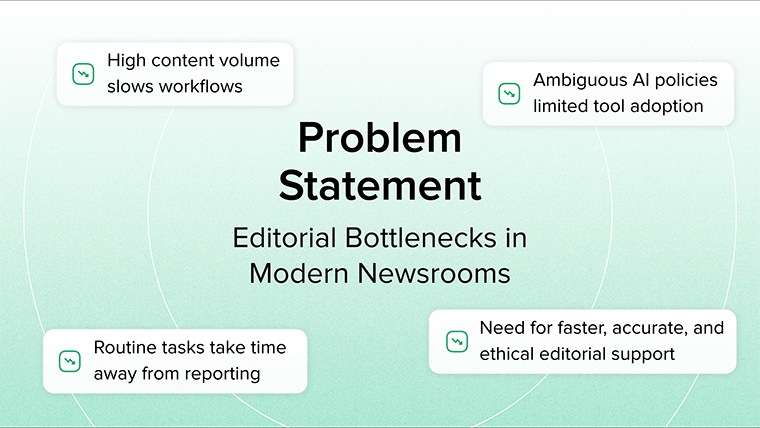
Before we built EditorialEye, our newsroom was facing a pressure familiar to many editors reading this: volume.
Briefly News operates in one of the most competitive digital news markets on the continent. South Africa’s mobile-first, social-first audience expects fast, accurate, and relevant content delivered across multiple platforms simultaneously. That means a high daily output is not optional; it is structural.
But the editorial team responsible for maintaining quality had become impeded by the sheer volume of routine checks, including proofreading, restructuring articles, rewriting headlines, and verifying SEO compliance. As necessary as these tasks are, they are also time-consuming in ways that compound quickly at scale.
Furthermore, an internal survey revealed a second layer of challenge: Many of our journalists were cautious about using AI tools at all. They did not fully understand where the line was between acceptable AI assistance and AI use that would compromise their journalistic independence.
In the absence of clear policy and a purpose-built tool, the default was avoidance. EditorialEye was built to solve both problems at once.
What is EditorialEye?
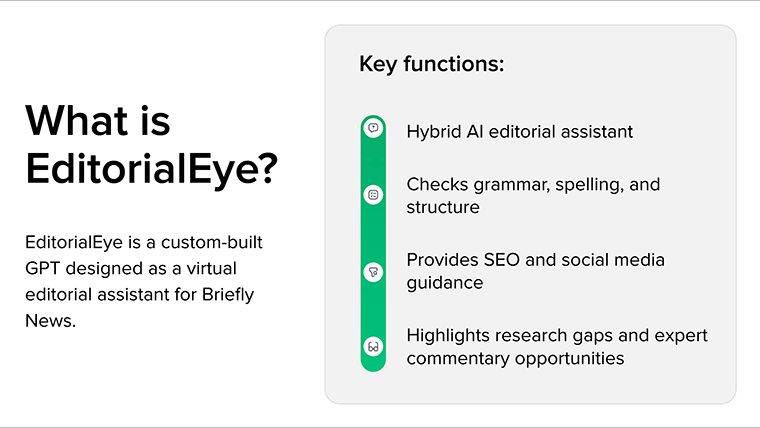
EditorialEye is Briefly News’ custom-built editorial GPT, designed to serve as a virtual editorial assistant rather than a content-creation tool. It is built on ChatGPT Pro and trained using our internal editorial guides, SEO standards, and ethical frameworks.
Choosing the right model was itself a deliberate process. We tested multiple large language models, including Claude and Gemini, evaluating them across different editorial tasks. ChatGPT proved strongest in grammar accuracy, clarity, and structured editorial feedback, and was selected as the foundation.
The tool operates through a seven-step editorial workflow:
A writer submits a draft article; EditorialEye conducts structured checks across spelling, grammar, punctuation, article structure, coherence, and completeness (including verification of the five Ws: who, what, when, where, and why, plus how); SEO improvements across headlines, meta-data, and key phrases; identification of gaps where expert commentary or deeper research could strengthen the article; and flagging of potential ethical or media law risks for editorial review. It also evaluates social media text and preview image options for each piece.
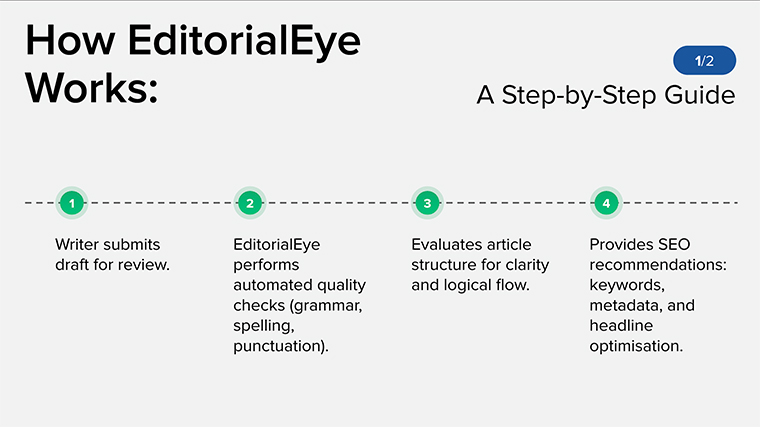
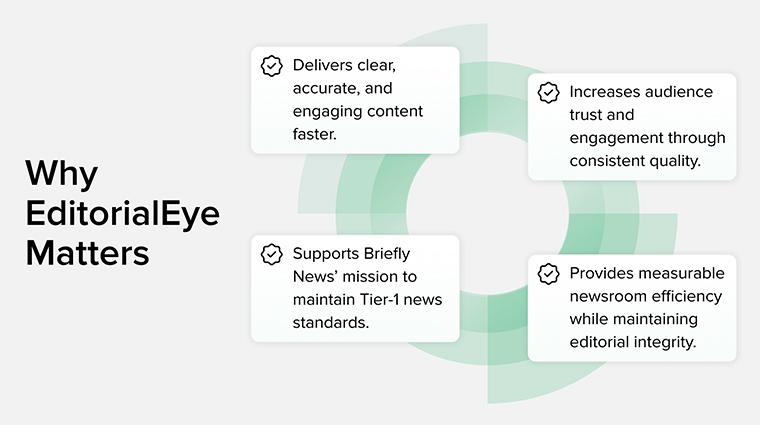
Critically, EditorialEye does not generate publishable copy. It provides diagnostic feedback and recommendations. Writers and editors review those recommendations and decide what to accept, reject, or adapt. Final editorial decisions remain entirely with human editors.
What changed in the newsroom
The results were measurable, and they arrived faster than we expected.
Our daily output grew from 80-90 articles to 150-200 per day. That increase happened because we removed the friction from processes that did not require editorial judgement in the first place, freeing editors to focus on the work genuinely demanding their expertise.
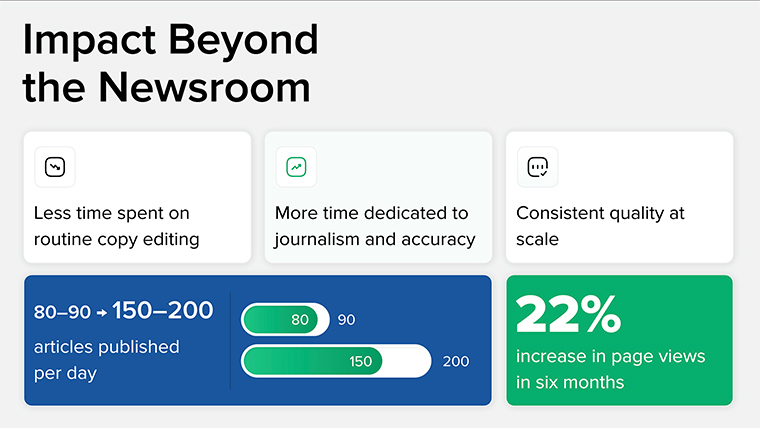
Over six months, pageviews increased by 22%. Editorial consistency improved across all our platforms. Post-publication correction rates dropped. And, perhaps most meaningfully, the editorial team reported having more time for deeper reporting feedback and coaching conversations with writers.
We also saw a shift in how journalists related to AI tools. Once EditorialEye gave them a clear, policy-aligned framework for what AI assistance looked like in practice, skepticism gave way to confidence. They knew exactly what the tool was for, what it was not for, and how to use it without compromising editorial standards.
Governance: the part most newsrooms skip
The technology behind EditorialEye matters far less than the governance framework around it. Any newsroom can build or license an AI editing tool. What is harder, and what most newsrooms delay or underinvest in, is the policy layer.
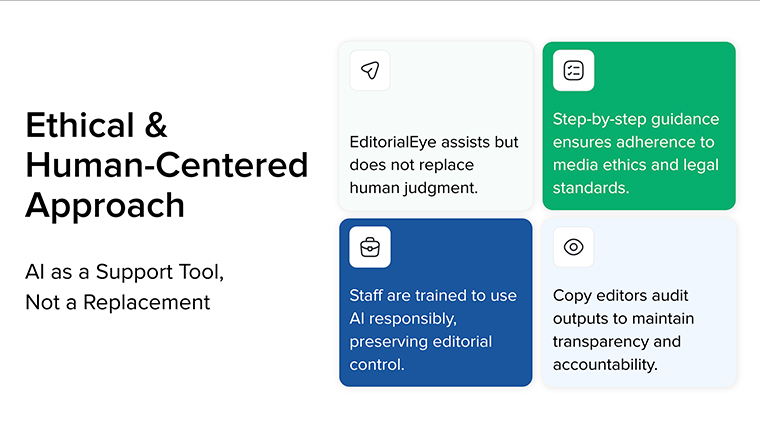
Our governance framework includes several non-negotiables. An AI usage policy explicitly bans fully AI-generated content. Clear definitions of permissible AI assistance (for example, proofreading, structural analysis, and SEO optimisation) sit alongside equally clear definitions of what AI must never do.
An EditorialEye Ethical Usage Guide outlines limitations, accountability mechanisms, and review processes. Regular training sessions reinforce that AI supports, but does not replace, human editors. Copy editors run ongoing audits to ensure compliance.
This framework did not emerge fully formed. It was built iteratively, shaped by what we learned during the pilot phase, refined through team feedback, and strengthened with each update.
The point we want to make to other news organisations considering similar paths is this: Do not build the tool and then worry about the policy. The policy needs to come first. It is what makes the tool trustworthy to both your team and your audience.
What this means for African newsrooms specifically
Most news organisations operating across Africa are mid-sized by global standards, carry significant resource constraints, operate in multi-platform environments with mobile-first audiences, and face intense competition for both readership and advertising revenue.
The AI solutions working for The New York Times or The Guardian are not automatically applicable here, and the road maps they publish often fail to acknowledge this.
EditorialEye was built for a South African newsroom, in response to the specific pressures of operating at volume in a fast-moving, mobile-first market. It is not a repurposed enterprise tool. It is a newsroom-native solution, trained on our own editorial standards and refined by our own journalists. That context is part of what makes it relevant to other African and emerging-market newsrooms considering similar moves.
EditorialEye is not finished just yet. The tool has evolved into direct integration of the AI bot in the administrative platform.
But the foundation it rests up — an ethical framework, human-centred design, and a clear editorial purpose — is one we are confident in. And we believe it is a foundation any newsroom, anywhere in Africa or beyond, can build from.
Related Articles
-

Stuff builds a “liquid content CMS” to free journalists for big...
26 October 2026 -

Why publishers are doing less, but better, to win in the AI era
22 October 2026 -
How to market news subscriptions in the era of AI content
20 October 2026 -

VG turned AI video into discovery engine for premium content
14 September 2026 -

The front door is gone — and Asia-Pacific publishers are rebuil...
26 August 2026 -

WSJ Japan finds AI translation is “not a one-and-done deal”
24 August 2026 -

Punch builds an AI-ready newsroom without sacrificing trust
6 August 2026 -

Infobae embeds AI into newsroom while keeping journalists in co...
21 July 2026
Upcoming Events
-

Subscriber Acquisition Master Class
10-17 November 2026
-

Media Advertising Summit
New York, United States
07-10 December 2026
-

AI-Native News Product Master Class
18-25 February 2027
-

Media Subscriptions Summit
Oslo, Norway
08-12 March 2027
-

World Congress of News Media
New York, United States
25-30 April 2027
-

Branded Content & Partnerships Master Class
20-27 May 2027
-

Subscriber Retention Master Class
17-24 June 2027
-

Conferencia Latinoamericana
15-16 July 2027
-

South Asia News Media Festival
New Delhi, India
19-22 July 2027
-

Asia/Pacific News Media Summit
19-20 August 2027
-

CEO Roundtable at Kilkenny
Kilkenny, Ireland
24-26 August 2027
-

Media Innovation Week
Amsterdam, The Netherlands
27 September - 01 October 2027








