

Bonnier News, News Corp Australia share advertising transformation strategies
Advertising Initiative Blog | 26 May 2026

I’m still decompressing from an incredible week in Berlin at INMA’s World Congress of News Media.
For five days inside the Frank Gehry-designed Axica Convention Center, 750+ news media executives from around the world sat together and worked through what feels like the most consequential transformation any of us have lived through in this industry.
I wrote here about that transformation in advertising. Today I want to share what two people who sit in those rooms have to say on the topic.
Alexander Lydecker (Bonnier News): The funnel that fixes the silo
Alexander walked the room through Bonnier News at a glance — 14 countries across Europe, 1 billion in revenue, 60% digital, 2.6 million subscriptions, and a starting position I want every publisher reading this to sit with: 31% of people in Sweden pay for online news, according to the Reuters Digital News Report. Only Norway is higher. That’s world-leading.
Bonnier has roughly doubled in size over the last decade, driven by acquisition. And while the rest of the industry has been bleeding traffic to social algorithm changes and AI search, Bonnier is growing pageviews — with 70% of share coming from direct traffic. That’s the moat Alexander is defending.
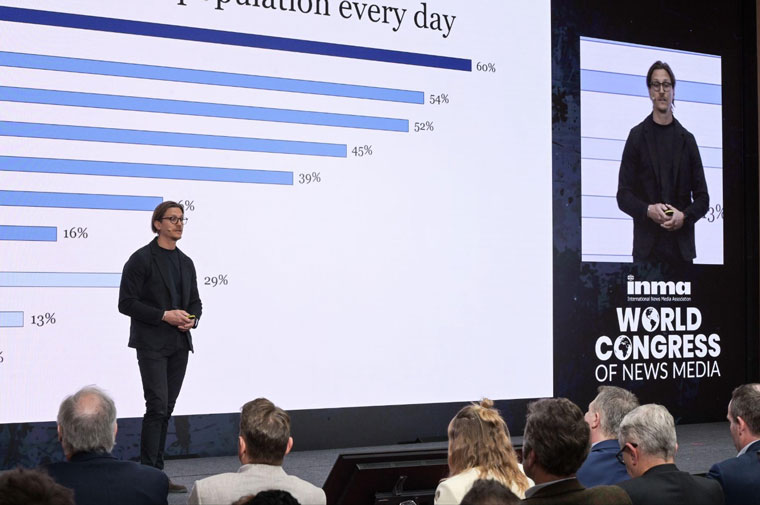
Then he showed the Bonnier News Funnel, which runs the Swedish addressable population through four stages: reach → registered → logged-in → subscriber. The whole point is that there is no longer a separate advertising strategy and a separate subscription strategy. There is one strategy. Subscription and advertising and product development are built into the same engine.
What that looks like in practice:
Reach is fueled by journalism and attractive products. Still the bulk of ad revenue today.
Registered/logged-in users are the high-leverage middle. First-party data lets Bonnier charge significantly higher prices — Alexander cited a roughly 100% uplift in ad pricing at this stage. Registration isn’t just a subscription tactic; it’s an advertising product.
Subscribers are the best customers. Not just for subscription revenue — they generate four times more ad revenue and four times more pageviews than non-subscribers.
This was Alexander directly answering my “ads vs. no-ads” provocation. In Bonnier’s operating model, subscribers are not an ad-free zone. They are the most valuable ad audience the company has. The strategy isn’t to turn ads off for the best customers — it’s to build a better product for them.
His parting note to the room was simple: Don’t chase that much external data. Build products people engage with. Engagement is how you produce your own data in your own ecosystem.
Pippa Leary (News Corp Australia): From empty reach to Engaged Reach
Pippa runs what News Corp Australia affectionately calls its “Fast and Free” titles — the Web sites that are 100% advertiser-funded, not linked to a newspaper masthead, with no subscription revenue to lean on. The largest, news.com.au, reaches 12 million Australians a month. About half of her traffic is direct. The other half is exposed to every disruption everyone in that room had been talking about for two days.
By 2024, Pippa’s team realised they were caught in what she called a “race to the bottom of empty reach” — publishers gaming search and social with clickbait to chase one-and-done audiences, just to put up bigger unique audience numbers. As a client-funded business with no subscription revenue, that math doesn’t work. Their digital revenue was falling even as UAs were rising because clients were chasing real outcomes elsewhere.
The organisational challenge was sharp: You can’t just swap reach for engagement — scale still matters when clients are choosing where to spend. So find a metric that does both.
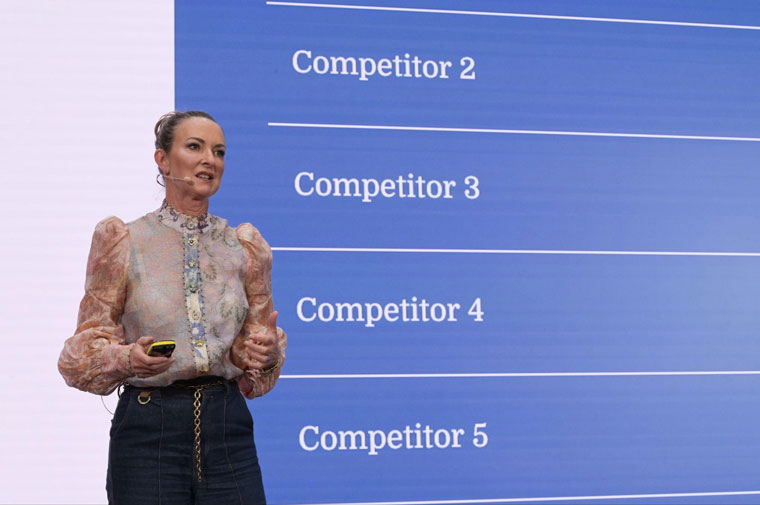
What they came back with is one of the cleanest KPI shifts we’ve seen through the Advertising Initiative. They call it Engaged Reach, and it’s just pageviews divided by unique audience.
Five reasons it works:
Pageviews link directly to ad inventory.
Audiences have to take an action to count — the next pageview.
Minutes-per-UA gets inflated by passive scroll time. Engaged Reach doesn’t.
It’s simple. Editorial teams can hold it in their heads.
Pageviews and UA are publicly available — clients and competitors can verify it.
The chart Pippa showed the room made the case. Competitors that had been beating News Corp Australia on the old reach league tables showed up with much lower Engaged Reach because they’d been gaming search or social. Their audiences weren’t sticking around. They weren’t producing client outcomes.
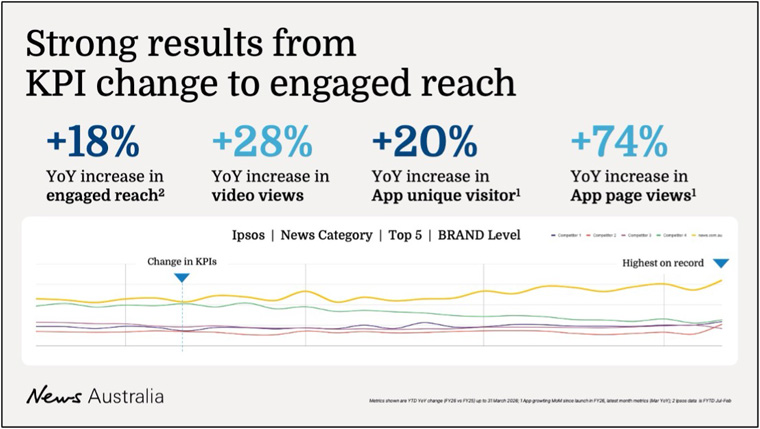
The Taste recipe site example was the proof point. Taste has 5x the recipes of any rival. A competitor had been creeping up the league table using SEO and niche lifestyle stories. Pippa’s team was able to walk a major supermarket client — whose ingredients are linked in every recipe — through the Engaged Reach chart and show, plainly, that audiences were engaging far more deeply with Taste.
Reading stories about someone’s dog will never compete with the ability to scroll through multiple recipes, save favourites, and buy ingredients. Crisis averted. Strategy held.
Once Engaged Reach cascaded through the org, the editorial strategy shifted with it. Teams that had been chasing clickbait and search optimisation pivoted back to stories that deeply engage Australian audiences. Pippa said her journalists were relieved. Despite the AI- and algorithm-driven pressure flattening everyone else’s reach, News Corp Australia is the only commercial brand in the country growing both reach and engagement.
The second move was direct traffic, and the lever was the app. Direct traffic, they worked out, is worth 10x social and 5x search. App engagement was 10x Web. But Apple’s targeting constraints had historically made app ads worth almost nothing — that’s why News Corp Australia, like most publishers, had underdeveloped its app.
Their fix was Webview: Serve ads out of the app using their first-party data, recreating a targeted mobile-Web experience inside the app. Since the shift: 600% increase in app downloads per month, 800% increase in yield. App audiences now consume 300 pageviews per month vs. 30 on Web. They’re moving audiences off Web and onto app as fast as they can.
And then her last beat, which I want every publisher reading this to pay close attention to: high-impact advocacy campaigns. This is what tech platforms cannot replicate. By leveraging the collective power of the whole network — every masthead and digital site running a headline in unison — News Corp Australia has run campaigns that produced real societal change:
Fire Up: the hidden cost of menopause.
Serial Killer: heart disease.
Think Again: dementia prevention.
Help Our Highway: born of a boardroom lunch with a leading insurer, ended with hundreds of millions in government funding to fix Queensland’s Bruce Highway.
Let Them Be Kids: Mel Pilling and the Courier Mail’s campaign on the harms of social media to children, picked up across every News Corp masthead, which culminated in Australia’s world-first social media age-gating legislation in December last year.
To Pippa’s point: this is not cash for comment. Not all of these are commercially sponsored. But many do align with client outcomes. And because the funding often comes from PR budgets, not regular marketing budgets, these campaigns can raise tens of millions of dollars. When editorial, commercial, and CEOs design together, we create outcomes that are good for society and good for business.
If you’d like to subscribe to my bi-weekly newsletter, INMA members can do so here.
Related Articles
-

The next business is brand partnerships, not ad inventory
25 October 2026 -

As the traffic ad model ends, publishers need a new advertising...
14 October 2026 -

In moving from an attention to an intention economy, who gets p...
16 September 2026 -

What’s really defensible in the age of AI?
30 August 2026 -

Latin American publishers must rewrite ad strategies around out...
20 July 2026 -

ABP’s Anandabazar.com makes Durga Pujo more accessible to audie...
22 April 2026 -

News companies translate measurement into commercial results
2 April 2026 -

3 Swedish publishers support decision to expel Meta from IAB Sw...
18 March 2026
Upcoming Events
-

Subscriber Acquisition Master Class
10-17 November 2026
-

Media Advertising Summit
New York, United States
07-10 December 2026
-

AI-Native News Product Master Class
18-25 February 2027
-

Media Subscriptions Summit
Oslo, Norway
08-12 March 2027
-

World Congress of News Media
New York, United States
25-30 April 2027
-

Branded Content & Partnerships Master Class
20-27 May 2027
-

Subscriber Retention Master Class
17-24 June 2027
-

Conferencia Latinoamericana
15-16 July 2027
-

South Asia News Media Festival
New Delhi, India
19-22 July 2027
-

Asia/Pacific News Media Summit
19-20 August 2027
-

CEO Roundtable at Kilkenny
Kilkenny, Ireland
24-26 August 2027
-

Media Innovation Week
Amsterdam, The Netherlands
27 September - 01 October 2027








