

News industry is rebuilding advertising around real audience value
Advertising Initiative Blog | 25 May 2026

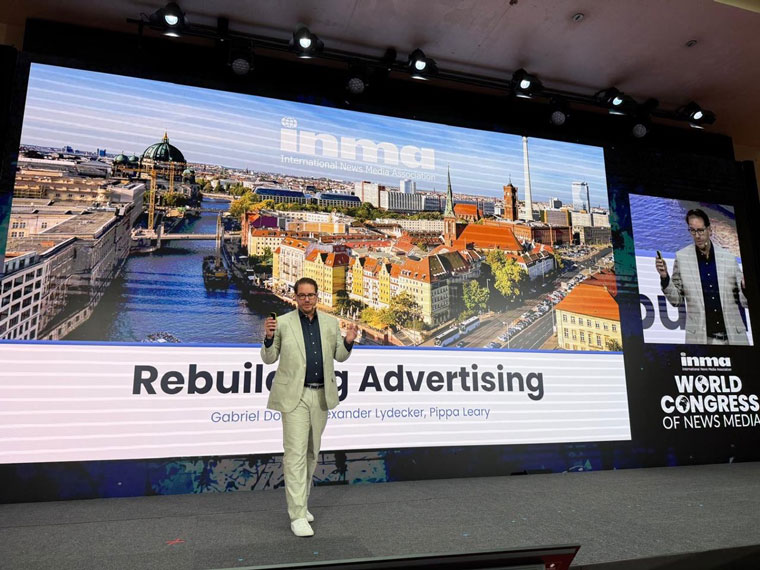
On day two of the recent INMA World Congress of News Media, in the late-afternoon slot, Pippa Leary (managing director/free news and lifestyle, News Corp Australia), Alexander Lydecker (chief operating officer, Bonnier News), and I walked onstage to make a case to the room: Advertising has its own version of the transformation everyone had been hearing about for a day and a half.
Setting the stakes
This entire week was about disruption and transformation. Wednesday’s theme, as co-moderators Jodie Hopperton and Robert Whitehead framed it, was “the world is on fire.” And I wanted to emphasise that while advertising has its own version, everything happening to the rest of the business is also happening to advertising.
Here’s how I set it up:
Less traffic means fewer impressions to monetise. We now have a thousand studies and they all say traffic is down and going to keep going down. As goes traffic, so goes the number of impressions you can sell.
On top of that, static display is already eroding at 10%-12% per year. Short-form video is the best offset, but video isn’t just an ad strategy. To win, editorial, product, brand, advertising and audience teams have to align around it. That’s not easy.
The pressure to diversify is real and growing. Up to 25% of commercial revenue across the industry is now “other” — events, licensing, B2B services, etc. Events are the hero format: 25% of The Atlantic’s commercial revenue is events; 40% of Globo’s in Brazil; 50% of Semafor’s in the U.S. Big opportunities, but much easier said than done.
AI and agentic are accelerating everything, everywhere. Everyone in advertising is using AI and building agents. This impacts how ads are created, where ad dollars flow, and how ads are bought and sold.
The overarching point: The existing publisher ad model is disintegrating. So what do we do?
Two strategic decisions we have to make
1. We need to see the market and the competition clearly.
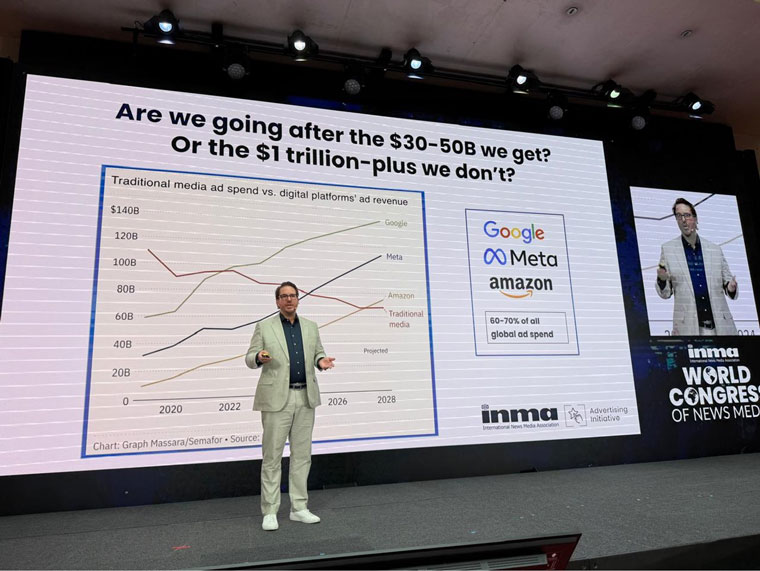
The global advertising market is roughly US$1 trillion today, heading toward US$1.3 trillion. Digital is 80% of that, heading to 85%. News publishers collectively get about 3%-5% of the total — US$30-US$50 billion or €25-€40 billion. That share is declining. Google, Meta, and Amazon alone take 60%-70% globally. That share is increasing.
So as we rebuild, we have to decide. Are we competing with each other for the US$30-$US50 billion we already get? Or are we going after the trillion-plus we don’t? And if the answer is the bigger part — and of course it should be — then we have to be honest about who the real competitors are. It’s not each other. It’s not other publishers.
2. I apologise for being a bit direct about this one: We have to stop turning ads off for the most valuable people.
We do this thing where we tell our readers that if they give us enough money, we’ll turn off the horrible ads. (See below for some examples, including my favourite: “Support the sites you love, avoid the ads you hate.”)
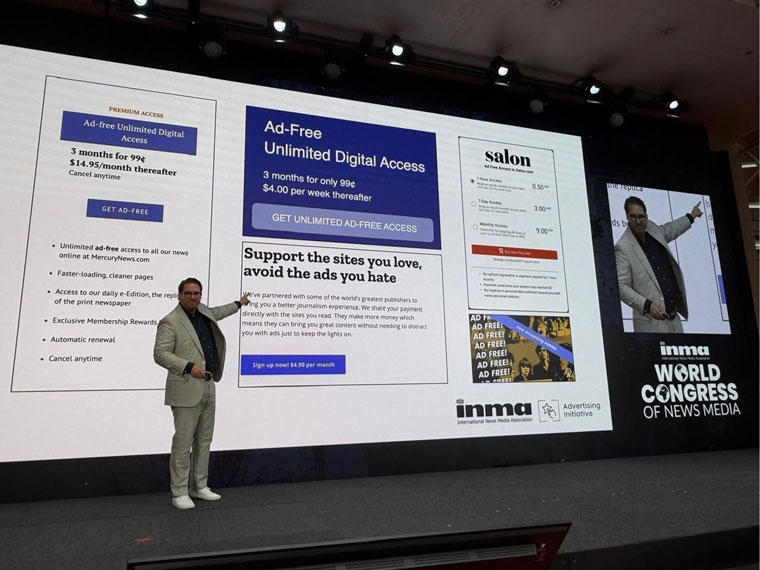
In a post-traffic era, that’s a very, very bad strategy. Here’s why.
Last year, INMA Readers First Initiative Lead Greg Piechota and I introduced INMA’s super-user findings: The same small group of people drives the vast majority of value across both subscriptions and advertising. They come to you most often. They generate most of your pageviews. They generate the vast majority of your revenue — in subs and ads.
At Clarín, 1% of subscribers generate 72% of subscription and advertising revenue. The New York Times has found its most engaged users are the most receptive to advertising and the most valuable consumers, full stop.
In other words, the people most valuable to advertisers are the people who are most valuable to you. They’re your subscribers.
So why are we turning ads off for the most valuable people? I don’t think we have that luxury anymore. And it doesn’t make business sense.
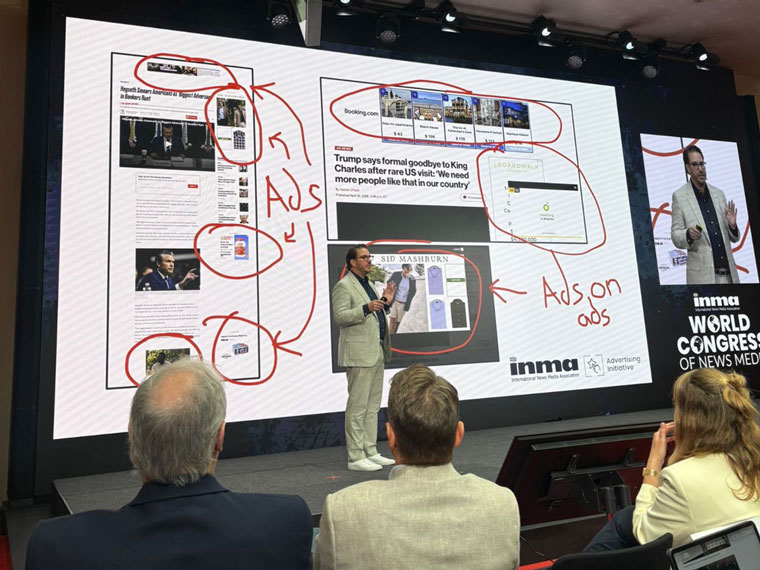
Now, I understand why it happens. The incentives of the digital display business have led publishers to create horrible user experiences filled with programmatic slop. We’ve slammed so many ads in that we put ads on top of other ads. It feels hostile to the audience (the same audience we’re trying to convert into subscribers.)
But here’s the thing everyone should understand about what's changing in the advertising business: Ad buyers don’t want to buy that anymore. They want to buy quality. (And in the INMA Measurement & Effectiveness Master Class, The Guardian showed us how lower ad density drives better user experiences and better results for advertisers.)
So I asked the room a question I’d been working up to:
What if the ads were good?
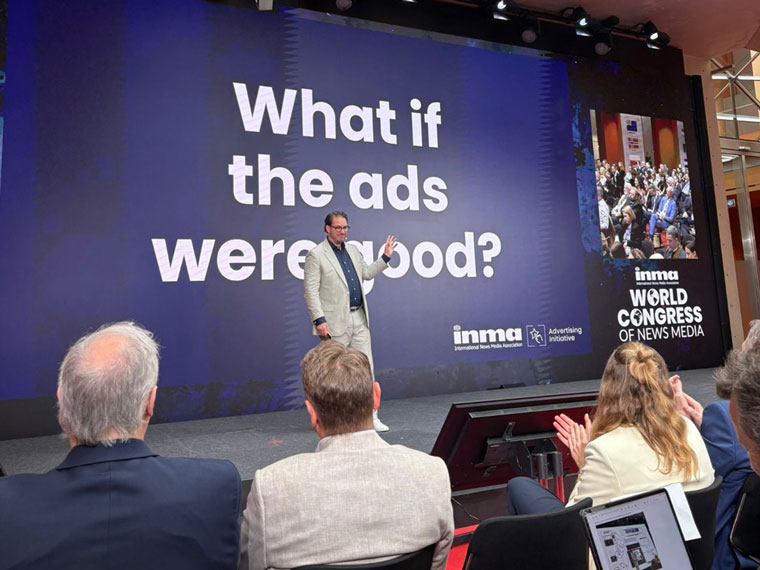
It got the laughs I wanted, but I also mean it very seriously as something we all ought to examine. Why don’t we aspire to unify the ambitions of both our journalism and our commercial strategies? Is this a viable business strategy? Can it be done?
Well, while we were sitting in the conference the day before, The New York Times announced 32% year-over-year digital advertising growth in Q1. That’s the fifth straight quarter of double-digit digital ad growth and the ninth straight quarter of digital ad growth overall.
Most of you aren’t The New York Times, of course. But it’s still worth examining some possible reasons why this is happening. And while there are many, I highlighted one that isn’t well understood: The New York Times has always been focused on the quality of the user experience, advertising included. You won’t find high ad density or ad loads. And the vast majority of NYT inventory isn’t programmatic and isn’t even standard IAB display. It’s the proprietary Flex Suite — larger, more immersive formats, that perform better. And with limited exception, those ads are shown to their subscribers.
The larger point I want to make is this:
It’s time we rethink the business we’re in. We have really valuable audiences that we have really valuable relationships with because of the entertainment and information value we provide them. All of that value transfers to advertising, and it should be mirrored in the way we approach our advertising business.
We can make the experience of the ads — and the standards of the ads — worthy of the journalism, and the product, and the brand, and the audience that the ads have the privilege to engage.
Three principles for what comes next
Make the ads good. Stop apologising. Build advertising worth of the journalism, that people don’t experience as “advertising” at all.
Reframe from the inventory business to the partnerships + outcomes business. Most publisher ad organisations think of themselves as selling space. The publishers winning think of themselves as building integrations, programmes, activations, partnerships. (There’s no perfect word for this idea, so choose whichever one works best for you.) This is why branded content and events are the categories growing fastest — they’re not ad units; they’re collaborations grounded in editorial trust and audience context. Some people don’t even call them “advertising.” You can’t get them anywhere else. This changes the entire business — the way you pitch, what you pitch, how you structure your departments. (See Publishers rewire sales teams for the outcomes era from Digiday.)
Bake advertising in. Don’t bolt it on. None of this works if advertising shows up after the product is built. That’s why we end up with interruptive formats, awkward placements, and reader experiences that degrade. Events work because they’re advertising-embedded flywheels. Video only succeeds if everyone works toward the same goal at the same time. The publishers getting this right have given advertising a seat at the table. Not symbolically — operationally.
If you’d like to subscribe to my bi-weekly newsletter, INMA members can do so here.
Related Articles
-

As the traffic ad model ends, publishers need a new advertising...
14 October 2026 -

In moving from an attention to an intention economy, who gets p...
16 September 2026 -

BCN, Time share lessons in selling ads to machines
9 September 2026 -

What’s really defensible in the age of AI?
30 August 2026 -

The media industry optimised buying, but it forgot to optimise ...
23 August 2026 -

Time is now selling ads to AI bots
17 August 2026 -

Latin American publishers must rewrite ad strategies around out...
20 July 2026 -

Platforms took the Croisette in Cannes, and the ad business is ...
6 July 2026
Upcoming Events
-

Subscriber Acquisition Master Class
10-17 November 2026
-

Media Advertising Summit
New York, United States
07-10 December 2026
-

AI-Native News Product Master Class
18-25 February 2027
-

Media Subscriptions Summit
Oslo, Norway
08-12 March 2027
-

World Congress of News Media
New York, United States
25-30 April 2027
-

Branded Content & Partnerships Master Class
20-27 May 2027
-

Subscriber Retention Master Class
17-24 June 2027
-

Conferencia Latinoamericana
15-16 July 2027
-

South Asia News Media Festival
New Delhi, India
19-22 July 2027
-

Asia/Pacific News Media Summit
19-20 August 2027
-

CEO Roundtable at Kilkenny
Kilkenny, Ireland
24-26 August 2027
-

Media Innovation Week
Amsterdam, The Netherlands
27 September - 01 October 2027








