

Collective Newsroom is rethinking its approach to young audiences
Conference Blog | 28 October 2026

Young audiences remain an elusive holy grail for many news media organisations. While global studies look at overall statistics for younger audiences, Collective Newsroom in India wanted to learn specifically what young Indian audiences want from the news.
During this week’s INMA South Asia Webinar, Sanjoy Majumder, co-founder and managing editor of Collective Newsroom, and Sushila Singh, lead/underserved audiences output, shared their findings from a recent pan-India survey conducted with the Centre for the Study of Developing Societies (CSDS), one of India’s most respected research institutions.
The six-month survey covered nine states — four Hindi-speaking and five non-Hindi-speaking — and respondents were between 15 and 29 years old. The sample mirrored each district’s rural-urban makeup, creating a more representative picture of India’s young audience.
“Much of what we understand about young audiences is based on assumption, anecdotes, received wisdom,” Majumder told INMA members. “What we really wanted was some hard evidence.”
Collective News set out to learn what drives young people in India to consume news, which platforms attract them, and —most importantly — how publishers can build lasting relationships with them.
Discovering new patterns
One of the first findings challenged the perception that young audiences ignore the news. Instead, 43% of respondents said they consume news daily, while another 27% engage with it weekly. Only 7% reported never consuming news.
“Indian youth engage with news,” Singh said.
The data also revealed differences across demographic groups:
- Daily news consumption increased with age, education, and income.
- Young men were more likely than young women to consume news daily.
- Rural youth reported slightly higher daily consumption than urban youth.
How young people consume news proved just as important as how often:
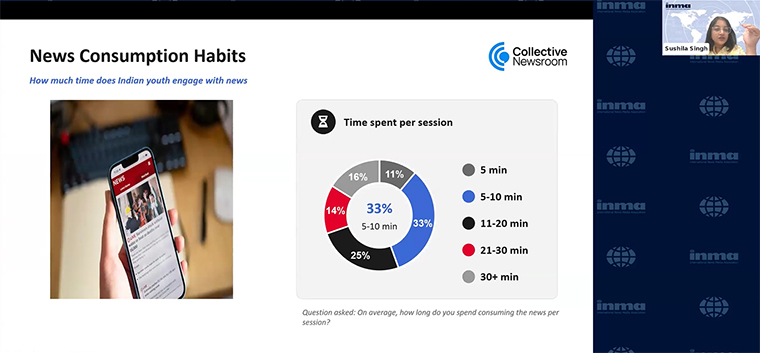
- More than one-third of respondents spent five to 10 minutes consuming news in a typical session, while many spent much longer.
- Education influenced engagement time, with more educated audiences tending to spend longer with news content.
- Rural audiences also reported longer news sessions than urban audiences.
Getting social
The survey examined the increasingly important role social platforms play in discovering and consuming news:
- On Instagram, Reels dominate, with nearly half of respondents watching news-related Reels daily. Stories and carousel posts also generated strong engagement.
- On YouTube, Shorts dominated consumption, with 45% watching them daily, although longer videos and livestreams continued to attract substantial audiences.
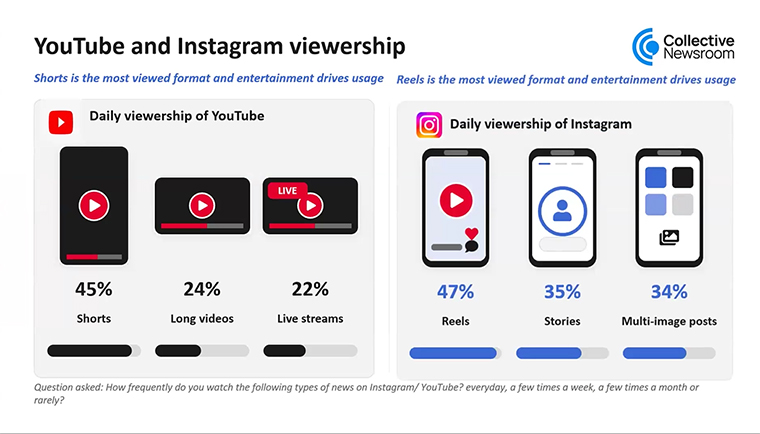
However, the findings showed different platforms serve different purposes. Through focus-group discussions, Singh learned that young people often turn to YouTube for a deeper understanding of a subject and use Instagram more for quick discovery and passive consumption.
“Youth across states reported a similar trend,” she said. “They will shift to longer-form YouTube videos only when they’re interested in the subject, often after watching short-format videos about it first.”
Another key takeaway was the context in which young people encounter news. Across both YouTube and Instagram, entertainment and relaxation were the main reasons for using the platforms; seven in 10 respondents said they primarily use these platforms for entertainment rather than for learning something new or staying informed.
“This may indicate that even though the youth are consuming news, it is often happening within a broader context of entertainment-seeking rather than deliberate information-seeking,” Singh said.
Social media has also become the primary gateway to breaking news:
- Nearly two-thirds of respondents said they first learn about breaking news through social-media feeds such as Instagram, Facebook, X, or Snapchat.
- 50% cited YouTube.
- 30% identified WhatsApp.
- Direct visits to news Web sites accounted for only 9% of responses.
Challenging assumptions
The findings were eye-opening and, Majumder said, encouraging:
“The assumption we hear so many times — that young people simply do not care or are not interested in news — isn’t actually what this evidence suggests,” hesaid.
The challenge instead lies in adapting delivery methods and storytelling formats: “We need to work on the mode and style of the delivery, and that’s actually a problem that we can solve.”
He found the use of YouTube interesting, explaining that while many people associate younger audiences with Instagram, the research showed they use Instagram for discovery and creator-led engagement, then turn to YouTube for more in-depth news consumption.
Such findings now influence Collective Newsroom’s editorial strategy.
Lessons learned
One lesson that stood out was the opportunity beyond India’s largest cities. The finding that rural audiences and those in Tier 2 cities spend more time consuming news aligned closely with the BBC’s long-term investment in regional-language journalism.
“What the research has told us, at least, is that we are already looking at the right place,” Majumder said. “The opportunity lies not only in the metros; it actually probably lies beyond that.”
As a result, Collective Newsroom intends to rethink where stories originate.
“We are all guilty of treating Delhi and, to a certain extent, Mumbai as India,” he said. “In reality, the story of India’s youth is being written in small towns, in district headquarters, in villages by people with smartphones and ambition.”
The newsroom plans to base more reporting in those communities and ensure those voices are reflected in coverage.
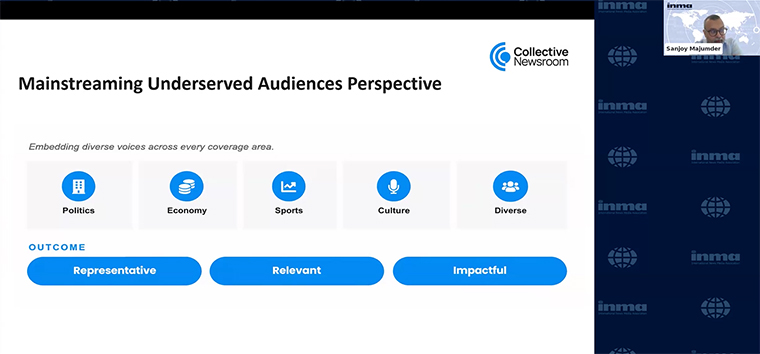
The second major shift involves topic selection. While politics and geopolitics remain important, the research underscored the need to cover subjects such as jobs, education, examinations, and health — all issues that directly affect younger audiences.
Publishers, he said, also need to explain major political and international developments through the lens of everyday life.
A third lesson centred on creators and influencers: “Don’t be afraid of content creators and influencers. Embrace them,” Majumder said.
Rather than treating creators as competitors, publishers should explore partnerships that combine trusted journalism with creator credibility and audience reach. He pointed to recent collaborations involving BBC Hindi and BBC Marathi as examples of that approach.
Finally, although young people discover news through social feeds and creator content, trust remains the industry’s most valuable asset: “The research confirms that young people do turn to trusted news outlets,” Majumder said.
“They may discover the news on a creator’s feed or in a short video, but we also know that when they need to know whether something is true, they need to go to a source they can rely on.”
News organisations must strike a balance: adapting formats, platforms, and storytelling styles while protecting the accuracy, impartiality, and fairness that establish credibility in the first place.
“The audience is there, the appetite is there,” Majumder said. “What needs to change is how we show up, where we report from, what and who we cover, who we work with, and how we tell the stories.”
Banner photo: Adobe stock by Davide Angelini.
Related Articles
-

5 lessons from the INMA Young Audiences Summit
28 September 2026 -

The 3 editorial pillars of Chile’s first streaming news channel
23 September 2026 -

AI’s effect on super user math
15 September 2026 -

What I told 40 CEOs (and won’t gatekeep from you)
30 August 2026 -

Economist launches subscription tier targeting younger audience...
20 July 2026 -

Grupo RBS builds social-first video operation to expand audienc...
20 July 2026 -

With Düsseldorf geht aus, Rheinische Post brings local gastrono...
14 July 2026 -

Bonnier News Local, Gota Media strike gold with their Core Mode...
21 June 2026
Upcoming Events
-

Subscriber Acquisition Master Class
10-17 November 2026
-

Media Advertising Summit
New York, United States
07-10 December 2026
-

AI-Native News Product Master Class
18-25 February 2027
-

Media Subscriptions Summit
Oslo, Norway
08-12 March 2027
-

World Congress of News Media
New York, United States
25-30 April 2027
-

Branded Content & Partnerships Master Class
20-27 May 2027
-

Subscriber Retention Master Class
17-24 June 2027
-

Conferencia Latinoamericana
15-16 July 2027
-

South Asia News Media Festival
New Delhi, India
19-22 July 2027
-

Asia/Pacific News Media Summit
19-20 August 2027
-

CEO Roundtable at Kilkenny
Kilkenny, Ireland
24-26 August 2027
-

Media Innovation Week
Amsterdam, The Netherlands
27 September - 01 October 2027








