

Google Search, Discover, AI, and YouTube redraw the news traffic map
Conference Blog | 26 August 2026

The traditional traffic model for digital news publishers is undergoing a profound transformation as audiences move away from relying primarily on Google Search and increasingly consume news through Google Discover, social media, AI chatbots and video platforms.
That was one of the central conclusions of a recent INMA Webinar, Discover, LLMs y YouTube: the new media traffic map, presented by Ignacio Zaccagnino, head of media growth at Spanish agency Nomadic.
News publishers should not interpret declining Web site traffic as evidence their audiences have simply disappeared, Zaccagnino said. Instead, audiences have been redistributed across a growing number of platforms, each with different algorithms, demographics, and consumption habits.
“Generally, they have been redistributed,” Zaccagnino said, emphasising the need for publishers to understand where those audiences have moved and how their behaviour has changed.
Google Search traffic has fallen sharply
The scale of the disruption is significant. According to data from Chartbeat and the Reuters Institute, Google organic search traffic fell by 33% globally between November 2024 and November 2025.
Zaccagnino described the decline as an industry-wide phenomenon rather than a problem affecting isolated publishers. The impact, however, varies according to the size of the outlet. He cited declines of around 22% for large publishers, 47% for medium-sized publishers, and as much as 60% for smaller ones.
The shift is also taking place within the search experience itself. By early 2026, 68% of searches ended without a click, illustrating the growing difficulty for publishers of converting visibility on search engines into visits to their Web sites, Zaccagnino said.
Reuters Institute research similarly points to an increasingly fragmented news environment, with Google incorporating AI-generated answers and other forms of content into search while audiences increasingly use social and video platforms to access news.
Pattern by the region
According to Zaccagnino, the United States has experienced a more sustained decline, while Spain entered the period with a higher dependence on search. Latin America has been considerably more volatile, with traffic rising and falling repeatedly rather than following a straightforward downward curve.
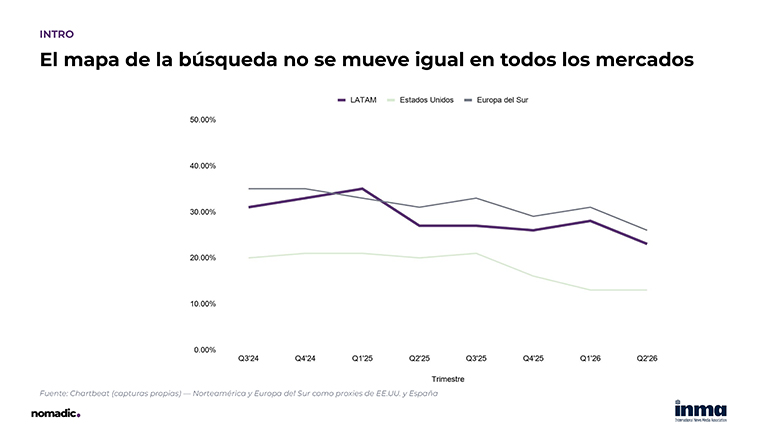
Some publishers have experienced temporary rebounds in Search traffic, but those increases have generally been followed by further declines.
Google Discover is no longer a publisher-only space
For years, Google Discover was one of the most valuable sources of external traffic for news organisations, particularly in markets with high Android penetration. Reuters Institute research has previously found that Discover could deliver more combined traffic to publishers than organic search.
Zaccagnino described Discover as an important gateway for publishers entering new markets and one of the fastest ways for news organisations to develop audiences around new topics.
But the ecosystem changed significantly in 2025.
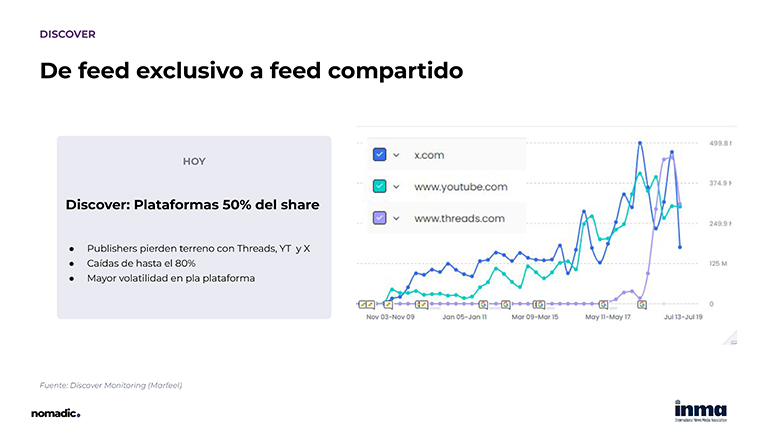
Until May 2025, Discover was largely a space associated with publisher content. Beginning in June, YouTube videos were increasingly incorporated into the feed, reflecting Google’s recognition that audiences were consuming more news in video format.
Publishers now effectively share the Discover environment with video platforms and social networks, including YouTube, X, and Threads, Zaccagnino said. He characterised the current distribution as roughly a 50-50 split between publishers and video or social content.
Another factor is demographics. According to Zaccagnino, Discover’s audience is significantly older, with people over 55 representing an important portion of its users. That contrasts sharply with platforms such as TikTok, which have much stronger penetration among younger audiences.
This helps explain why publishers cannot simply replicate their Discover strategy across other platforms.
“It is not the same thing to have an Instagram Reel, a YouTube Short, and a Facebook post,” Zaccagnino said, adding that publishers need to adapt content to each platform rather than simply distributing identical material everywhere.
AI chatbots are growing, but referral traffic remains tiny
Large language models are creating another challenge.
The share of people using chatbots to ask about news has increased globally from 7% to 10%, Zaccagnino said, with growth even stronger in Latin America. Yet the amount of traffic that returns from LLMs to publishers’ Web sites remains below 1%.
That creates a fundamental problem: Publishers may increasingly appear in AI-generated answers without receiving the Web site visit that traditionally accompanied a Google search.
Breaking news remains comparatively favourable territory for publishers, but Zaccagnino warned AI has already taken ground in areas where users seek depth, background, and evergreen information.
For publishers, he outlined two broad options: Allow AI systems to summarise their content while accepting that many users will not click through, or attempt to limit visibility to LLMs, as The New York Times has done.
But Zaccagnino stressed traffic is not the only measure of value.
Brand recognition, editorial authority, and subscriptions can all become strategic objectives. Appearing in an AI-generated answer can strengthen a publisher’s brand even if it does not generate a click. Editorial authority can help a media organisation become a reference for fact-checking, agenda-setting, and branded content.
Subscriptions are another opportunity. Zaccagnino said 42% of chatbot users use AI to deepen their understanding of a subject rather than replace premium content, suggesting publishers can potentially use AI-driven discovery as part of a broader conversion strategy.
Video is becoming a critical traffic and revenue channel
The shift toward video is perhaps the clearest sign that news consumption is moving away from publishers’ Web sites.
Latin America leads the world in news-video consumption, at 41%, compared with 24% in Europe, Zaccagnino said.
Facebook remains a major platform in terms of overall volume, but YouTube offers publishers a particularly attractive opportunity because videos can continue generating views months after publication.
“YouTube is the second-largest search engine in the world after Google,” Zaccagnino said, noting both platforms belong to the same company and publishers should treat YouTube as a search and discovery ecosystem rather than simply a video-hosting service.
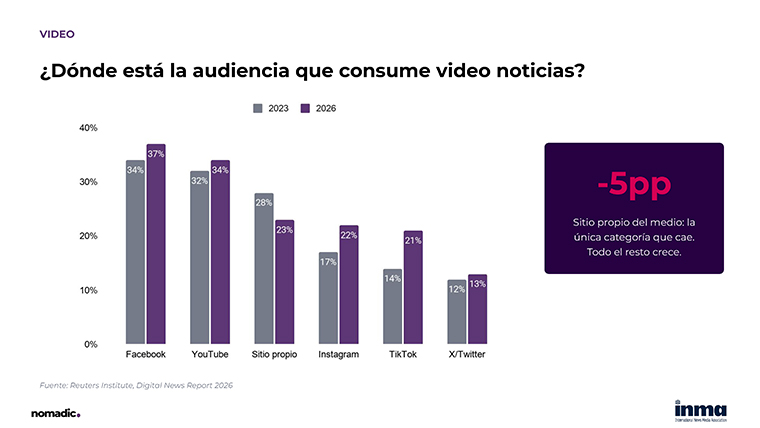
Contrary to the assumption that audiences no longer watch long-form video, Zaccagnino said YouTube videos longer than 20 minutes generate some of the highest revenues and attract substantial consumption.
Shorts, meanwhile, can be useful for attracting new audiences and encouraging subscriptions. YouTube also stands out because its audience is distributed relatively evenly across age groups, unlike Instagram and TikTok.
Interestingly, Zaccagnino said users over 45 tend to consume shorter videos than younger audiences.
YouTube raises the bar for monetisation
Publishers considering YouTube as a revenue diversification strategy will also face a higher entry barrier.
YouTube has announced that, starting February 1, 2027, new creators seeking full participation in its Partner Program will need 8,000 qualified public watch hours during the previous 365 days or 20 million qualified Shorts views over 90 days, in addition to 1,000 subscribers. The current long-form threshold is 4,000 watch hours. Existing members of the programme will not lose their status because of the change.
Zaccagnino linked the increase to the enormous volume of AI-generated video now flooding the platform. The higher threshold is intended to favour creators producing more substantial and consistent content.
He also cited the current revenue-sharing model as 55% for creators and 45% for YouTube for the relevant long-form advertising revenue.
The new traffic strategy for publishers
For Zaccagnino, the central lesson is that publishers need to stop thinking about traffic as a single funnel dominated by Google Search.
The new ecosystem has multiple entry points: Search, Discover, LLMs, YouTube, TikTok, Facebook, Instagram, X, and other platforms. Each has its own audience, format, and business potential.
The strategic challenge therefore involves three interconnected areas: reach and visibility, audience connection, and monetisation and business development.
The publishers most at risk are those that built their entire business around a traffic source that no longer rewards them in the same way. Zaccagnino noted that some digital media outlets with more than two decades of history have left the market after losing as much as 80% of their audiences, in some cases because 85% of their traffic had depended on Discover.
His warning is not that Discover has abandoned publishers. Rather, the lesson resembles the disruption caused years ago by Facebook’s Instant Articles: Platforms change, and publishers that fail to diversify become vulnerable.
The audiences, Zaccagnino’s analysis suggests, are still there. They have simply changed where, how, and when they consume news.
For media organisations, the future may therefore depend less on recovering the traffic they once had and more on building a presence across the new map of digital discovery — while turning visibility into brand strength, audience loyalty, and sustainable revenue.
Related Articles
-

Marketers should outsource tasks, not thinking
25 October 2026 -

WSJ executive councils show how publishers build communities th...
19 October 2026 -

AI’s effect on super user math
15 September 2026 -

At Mediacorp’s CNA, loyalty means giving audiences a reason to ...
20 August 2026 -

Tribun Network turns print “dots” into AI-powered insight
20 August 2026 -

Nation Media Group focuses editorial strategy on stories that m...
4 August 2026 -

Briefly News empowers journalists with AI tool suite Nova
4 August 2026 -

Indian Express builds a video-first future around trusted journ...
20 July 2026
Upcoming Events
-

Subscriber Acquisition Master Class
10-17 November 2026
-

Media Advertising Summit
New York, United States
07-10 December 2026
-

AI-Native News Product Master Class
18-25 February 2027
-

Media Subscriptions Summit
Oslo, Norway
08-12 March 2027
-

World Congress of News Media
New York, United States
25-30 April 2027
-

Branded Content & Partnerships Master Class
20-27 May 2027
-

Subscriber Retention Master Class
17-24 June 2027
-

Conferencia Latinoamericana
15-16 July 2027
-

South Asia News Media Festival
New Delhi, India
19-22 July 2027
-

Asia/Pacific News Media Summit
19-20 August 2027
-

CEO Roundtable at Kilkenny
Kilkenny, Ireland
24-26 August 2027
-

Media Innovation Week
Amsterdam, The Netherlands
27 September - 01 October 2027








