

JioStar’s sports playbook shows news publishers how to build audience habit
Conference Blog | 22 July 2026

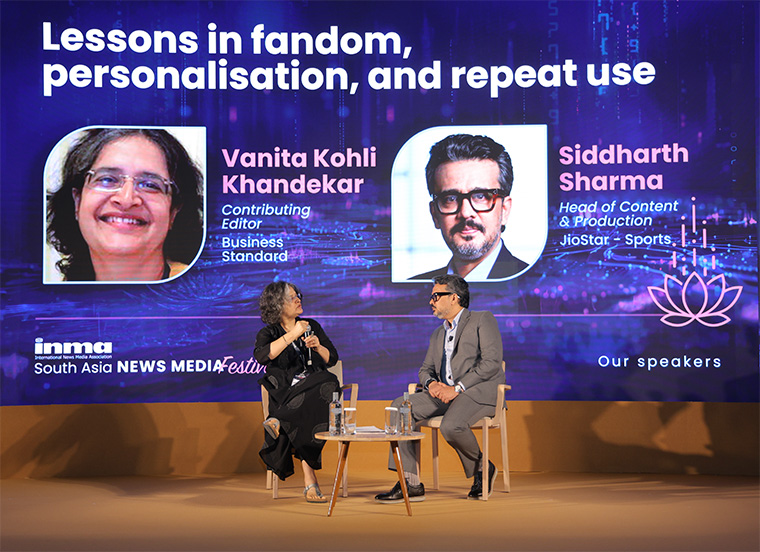
Sports audiences return because the experience extends far beyond the live event, according to Siddharth Sharma, head of content and production at JioStar, who urged news publishers to focus less on one-time transactions and more on building lasting habits through personalisation, localisation, and community.
Speaking during the INMA South Asia News Media Festival in New Delhi, Sharma described JioStar as a platform with more than 100 television channels and entertainment content from studios including HBO, Disney, 20th Century Studios, and FX.
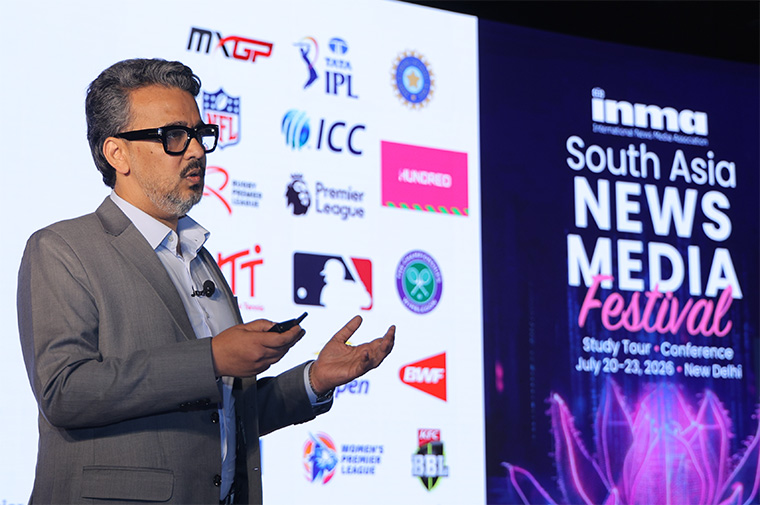
Its sports network carries major cricket competitions, including BCCI and ICC events, as well as sports such as kabaddi, rugby, and chess. Across television and digital platforms, JioStar delivers live sports almost every day of the year in as many as 12 languages.
That scale has grown dramatically. Sharma said peak digital concurrency rose from 10.3 million in 2018 to a global record of 72.5 million during the ICC Men’s T20 World Cup final. During the IPL, JioStar has also reached 1 billion screens across television and digital platforms.
“Live gives you a foot in the door, live gives you an appointment viewing opportunity,” Sharma said. The challenge, he said, is creating an experience that “forces them to come to us again and again.”
Sharma organised JioStar’s approach around a “RED” framework: recruit audiences, delight them, and give them reasons to return after the live event.
Build anticipation before the event
Using the 2026 ICC Men’s T20 World Cup as an example, Sharma explained how JioStar began promoting the tournament at the end of 2025 by connecting it to India’s Women’s ODI World Cup victory.
Historically, he said, broadcasters had used men’s cricket to promote women’s cricket. JioStar reversed that approach, featuring members of the women’s championship team encouraging the men to achieve the same success.
Sharma said the campaign culminated with Shafali Verma telling the men’s team: “Okay, fine, we’ve done it. Now it’s your turn.”
Closer to the tournament, the campaign shifted to the themes of “history repeat” and “history defeat.” Former India captain Rohit Sharma was integrated across television, digital programming, regional languages, and social media, including content examining how current captain Suryakumar Yadav could guide India to another title.
Give local audiences a distinct product
Another major lesson came from JioStar’s expansion into Bhojpuri and Haryanvi commentary.
Rather than simply translating its Hindi coverage, the company studied each region’s films, art, popular culture, idioms, and everyday language to develop a distinctive commentary style.
“We didn’t want it to be the B-team of the Hindi, but have its own unique identity,” Sharma said.
The result was threefold growth for both languages. Bhojpuri and Haryanvi are now among JioStar’s five leading regional sports languages, with Bhojpuri ranking third and overtaking Kannada, which had been offered on television for more than a decade.
Use personalisation to deepen the experience
Sharma said digital platforms allow JioStar to tailor sports coverage to different audience groups.
Viewers can choose languages, camera angles, highlights, and vertical viewing designed for mobile phones. JioStar also uses AI to make international personalities accessible in regional languages and uses behavioural data to distinguish between devoted sports fans, mixed sports and entertainment viewers, and more casual audiences.
“Consumer data is the real element of truth for us,” Sharma said.
That data informs specialised feeds, including detailed analysis from former IPL players and coaches for committed fans, and entertainment-led coverage featuring comedians for viewers with less knowledge of cricket.
The metrics that matter, Sharma said, include time spent, click-through rates, watch time, drop-off rates, and return frequency.
Move beyond transactional audiences
JioStar has also experimented with fan-led streams, interactive games, conversational search, contextual notifications, and services that allow viewers to order food without leaving a match.
But Sharma’s central lesson for news publishers was not about any individual feature. It was about replacing one-time engagement with a sustained relationship.
“We’ve become transactional, we consider our audiences transactional,” he said. “What gets a viewer back? How do you sustain that interest?”
Digital platforms also give news organisations an opportunity to explain complicated subjects through concise, accessible content, he said, rather than assuming audiences already understand the background or significance of a story.
“Habit is the business. Live is just a spark.”
Related Articles
-

Marketers should outsource tasks, not thinking
25 October 2026 -

WSJ executive councils show how publishers build communities th...
19 October 2026 -

AI’s effect on super user math
15 September 2026 -

At Mediacorp’s CNA, loyalty means giving audiences a reason to ...
20 August 2026 -

Tribun Network turns print “dots” into AI-powered insight
20 August 2026 -

Nation Media Group focuses editorial strategy on stories that m...
4 August 2026 -

Briefly News empowers journalists with AI tool suite Nova
4 August 2026 -

Indian Express builds a video-first future around trusted journ...
20 July 2026
Upcoming Events
-

Subscriber Acquisition Master Class
10-17 November 2026
-

Media Advertising Summit
New York, United States
07-10 December 2026
-

AI-Native News Product Master Class
18-25 February 2027
-

Media Subscriptions Summit
Oslo, Norway
08-12 March 2027
-

World Congress of News Media
New York, United States
25-30 April 2027
-

Branded Content & Partnerships Master Class
20-27 May 2027
-

Subscriber Retention Master Class
17-24 June 2027
-

Conferencia Latinoamericana
15-16 July 2027
-

South Asia News Media Festival
New Delhi, India
19-22 July 2027
-

Asia/Pacific News Media Summit
19-20 August 2027
-

CEO Roundtable at Kilkenny
Kilkenny, Ireland
24-26 August 2027
-

Media Innovation Week
Amsterdam, The Netherlands
27 September - 01 October 2027








