

South Asia’s media leaders are asking print to fund what comes next
Conference Blog | 29 July 2026

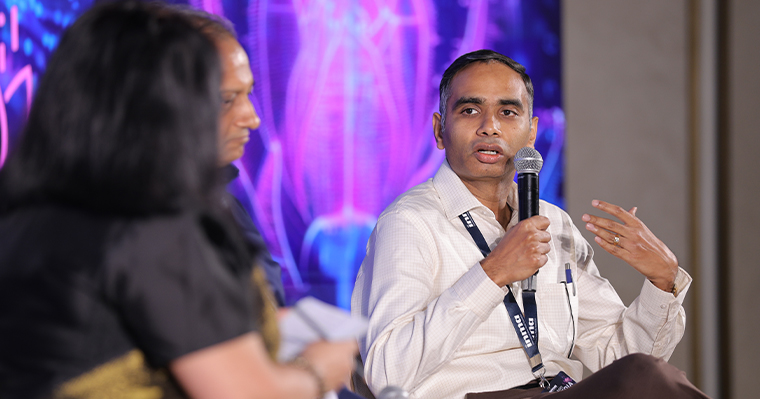
Closing the first day of INMA’s South Asia News Media Festival in New Delhi, Vanita Kohli-Khandekar, contributing editor at Business Standard, put a deliberately unglamorous question to three chief executives: What, right now, are your top priorities?
The answers came back almost identically shaped.
Sameer Singh, CEO and managing director of HT Media, named three pressures — the aging of the newspaper consumer, the dilution of digital traffic, and the cost of newsprint and other commodities.
Dhruba Mukherjee, CEO of ABP, sorted his into the same buckets: print-specific stress, audience development, and the treadmill of digital investment. “You’re almost at the pass of facing a storm without knowing what to do about it,” Mukherjee said of the volatility. “But that is part of life.”
The third, L V Navaneeth, CEO of The Hindu Group, answered by reorganising the question — and gave the festival the framing it kept returning to.
What separated the leaders who spoke across the week was not the diagnosis. It was how far each had got in building something that could absorb a bad year in the core.
The core and the moat
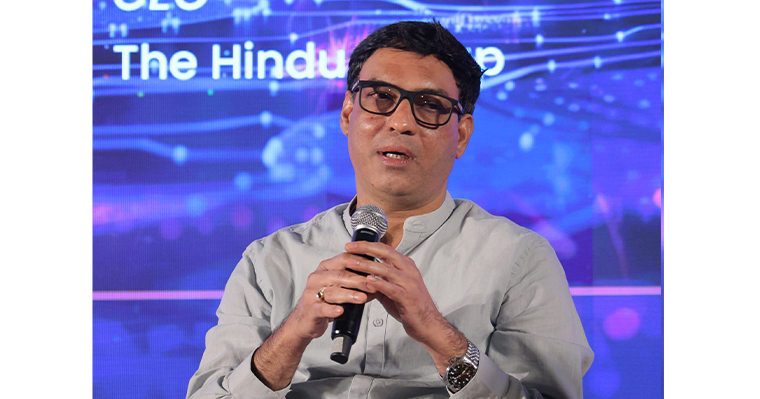
Navaneeth said he splits his company in two. The core is print: advertising and circulation revenue, and everything that comes with them. The moat is everything else: events, an English-language education business called STEP, and a curated book-publishing operation.
The distinction is financial, not sentimental.
“The core business is largely a high fixed-cost business and unpredictable variable-cost business,” Navaneeth said; newsprint duties and commodity swings hit it directly, and margins are thin by nature. The moat is a margin business where “everything has to make a margin.”
That produces the question he says defines his job: “Whether we have a good year or not depends on how the core business performs. How good a year depends on how well the moat business does.”
The strategic target is the point at which the moat can offset a bad year in the core.
Beneath it sits a harder organisational problem. Core and moat carry different risk appetites, different age profiles, different energies. “How do you have a common culture across the ecosystem?” Navaneeth asked — while conceding, after seven years running the business, that he is “less of an expert at more things than I am an expert at compared to earlier.”
Diversification that has cleared break-even
B Srinivasan, managing director of the Vikatan Group, has pushed that rebalancing — far enough that it is no longer obvious which half is the core. His 100-year-old Tamil magazine group publishes six print titles alongside a television production arm, OTT output, and a social operation that goes to Reels without waiting for print.
Print was roughly 80% of revenue seven or eight years ago and is now about half. Within print itself, around three-quarters now comes from magazine sales, book sales, and subscriptions rather than advertising.
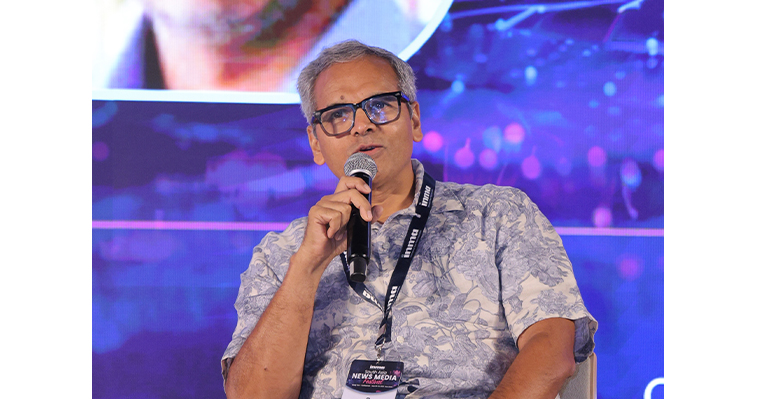
“I can’t go sell a magazine page to an advertiser,” Srinivasan said, so he sells event-built packages direct to clients rather than through agencies. The 2025-26 financial year was the first in which the print-plus business did not depend on television for its profitability.
His verdict on video was blunter. Vikatan has tripled video output on YouTube and Facebook since the pandemic while revenue from it fell. “Reels will never make you money,” he said. “But if you are not there, your brand is going to become invisible.”
Mukherjee’s version is younger. ABP launched a live-events vertical called Way — the letters stand for Who Are You — and staged concerts in Guwahati and Kolkata. “Tremendous response,” he said, “and more importantly, for me, it was a profitable response.”
What the incoming generation put first
A panel of leaders who have recently taken charge of family-built businesses named a different first priority: not revenue lines, but the organisation itself.
Mayura M S, director of digital business at Mathrubhumi, said the priority she keeps returning to is talent.
“Are we equipping everyone who is working with us with the ways of the media today — understanding formats today, understanding audiences today?” Change management, she argued, “dictates the next 10 to 15 years of that team that you’re building, and dictates the kind of leader that you are as well.”
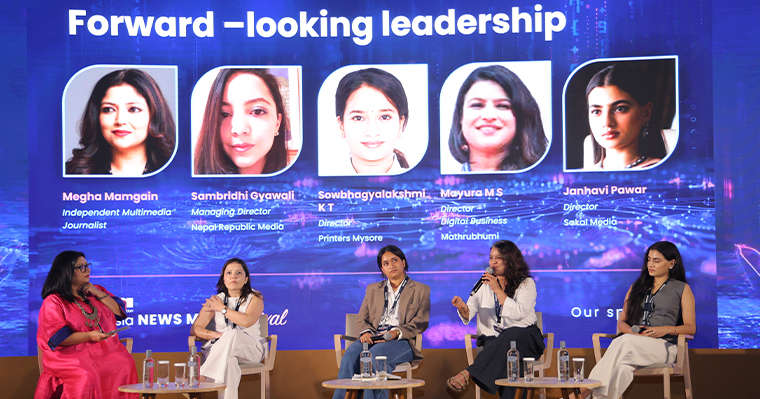
Janhavi Pawar, director of Sakal Media, made the sharpest commercial argument of that session — and, indirectly, the strongest case for diversification heard all week.
“The biggest mistake that I think people are making these days is when you look at a media house, you assume that content is the only gold mine that we have. That’s not true. It’s the relationships that you build.”
Media, she said, touches every sphere of the economy, and those relationships are the asset most publishers are failing to price.
She was equally direct about audience strategy. Pushing Gen Z towards a medium they are not drawn to is “a waste of resources,” she said. “People are not consuming news any less.”
Sowbhagyalakshmi K T, director of Printers Mysore, described editing print itself towards those readers — a redesigned page opening conversations about gender and sexuality, and Metro Life coverage built around small communities forming in Bengaluru, from skateboarders to reading groups.
Trust and whether it can be priced
Sambridhi Gyawali, managing director of Nepal Republic Media, reframed the festival’s central term: trust. Nepal’s multi-party democracy dates from 1990 and its constitution from 2015, so legacy there cannot mean longevity.
“I don’t primarily think legacy is about how many years you’ve been in media — those are just numbers. Really, it’s about credibility.”
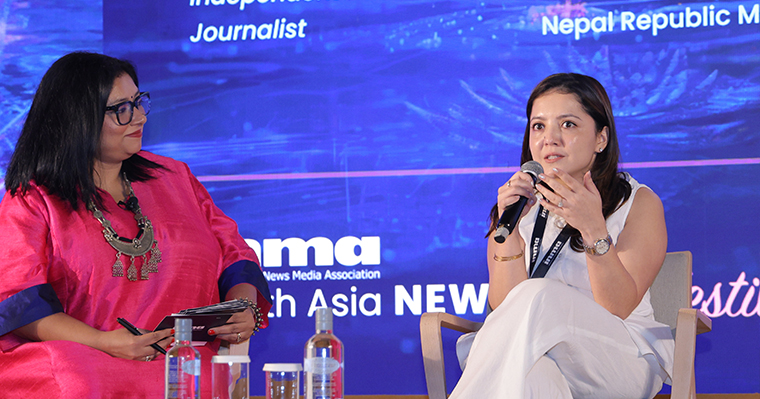
Her evidence was recent. After Nepal’s Gen Z protest movement, she said, audiences first turned to independent voices and creators — then came back. “When it came to today — why did something happen? How did it happen? — they go back to legacy media who actually practice journalism.”
That question, whether trust converts into money, produced the CEO panel’s one genuine disagreement. Navaneeth argued for a collective industry effort to publish an impact or trust score alongside raw reach, pointing to a planned cross-publisher campaign in India.
Singh objected to any narrative placing trust above the market. Where trust and engagement come together, he said, value follows and shows up in return on advertising spend — print performs well on that measure precisely because readers give it time and intent. “The market signals will eventually give value to this journey.”
The contrarian case and the permission problem
Two digital executives pushed against the mood of the previous sessions.
Puneet Gupt, COO of Times Internet, argued that collapsing search referrals will squeeze supply across the open Web — and squeezed supply raises prices. He expects display eCPMs in India to rise around 30% over the next few years and wants publishers spending now on inventory quality and audience enrichment.
He also insisted on new vocabulary: “building users, and building data, and building customers, and not rebuilding traffic.” His line on the missed opportunity travelled furthest: “We built stadiums to fill them with people, but we didn’t take phone numbers of people who came in.”
Puneet Jain, CEO of HT Digital, said the appreciation is already visible — double-digit year-on-year CPM growth, after years of the opposite. Traffic, he argued, is a launchpad rather than a destination, because “reach without relationship is a depreciating asset.”
Jain was sharpest on what actually unblocks a pivot. Data, analytics, and AI are “necessary hygiene,” not the accelerant. The real constraint is internal permission: “Give the comfort to your organization, to your team members that we will accept lower volume.”
Publishers have refused to release legacy revenue and legacy products, and so keep doing more of the same. On that reading, he said, the traffic decline “has been the best thing to happen to us.”
Underneath every strategy discussed sat the problem the opening panel named first, and Navaneeth put it most plainly. India, he said, is still adding young news readers. It is not adding young newspaper readers.
Related Articles
-

Marketers should outsource tasks, not thinking
25 October 2026 -

Bundling is a pricing decision, rebundling is an organisational...
18 October 2026 -

AI is now media’s operating environment
28 September 2026 -

5 lessons from the INMA Young Audiences Summit
28 September 2026 -

Agents, liquid content, vibe coding raise questions for news me...
9 September 2026 -

What I told 40 CEOs (and won’t gatekeep from you)
30 August 2026 -

Dow Jones turns complex B2B data into “prosumer” content with c...
13 July 2026 -

AI adoption in newsrooms should move from experiment to strateg...
12 July 2026
Upcoming Events
-

Subscriber Acquisition Master Class
10-17 November 2026
-

Media Advertising Summit
New York, United States
07-10 December 2026
-

AI-Native News Product Master Class
18-25 February 2027
-

Media Subscriptions Summit
Oslo, Norway
08-12 March 2027
-

World Congress of News Media
New York, United States
25-30 April 2027
-

Branded Content & Partnerships Master Class
20-27 May 2027
-

Subscriber Retention Master Class
17-24 June 2027
-

Conferencia Latinoamericana
15-16 July 2027
-

South Asia News Media Festival
New Delhi, India
19-22 July 2027
-

Asia/Pacific News Media Summit
19-20 August 2027
-

CEO Roundtable at Kilkenny
Kilkenny, Ireland
24-26 August 2027
-

Media Innovation Week
Amsterdam, The Netherlands
27 September - 01 October 2027








