

Substack co-founder tells news brands to start thinking like networks
Conference Blog | 22 October 2026

In 2017, as Facebook was telling publishers to pivot to video, three people in San Francisco decided the future of media might be e-mail.
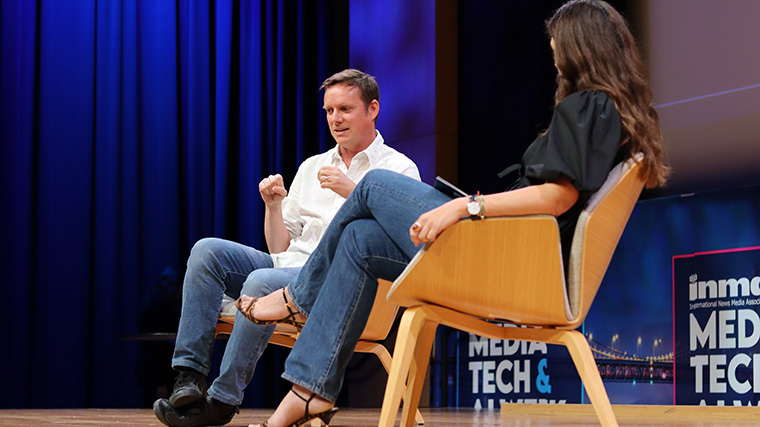
One of them, Substack co-founder Hamish McKenzie, told delegates at INMA’s Media Tech & AI Conference in San Francisco that legacy news organisations shouldn’t read Substack’s growth as a threat. They should read it as a blueprint.
Kerstin Hasse, INMA’s Young Audiences Initiative lead, opened their conversation with Substack’s numbers: more than 5 million paid subscriptions, more than 100,000 publishers making money on the platform, more than 50 earning over US$1 million a year, and a top 10 that together bring in more than US$100 million.
“The title is provocative,” McKenzie said of his forthcoming book, How to Save the Media. “But the point of it is actually that we have an opportunity to rebuild the media based on new infrastructure and new business models.”
From there, he laid out what broke and what established publishers can do about it.
The business model is the problem
The traditional media system was “mostly responsible for building the trust and understanding at scale in our world,” McKenzie said. The Internet upended the business model behind it, and what replaced it was a social media system where “the lion’s share of attention goes.”
That system “has not been great for that trust and understanding piece that media institutions specialise in,” he said.
The fix, he said, won’t come from a new billionaire owner, the perfect regulation, or tweaks to existing algorithms. It requires new infrastructure and new business models.
He applied the same logic to Twitter, which tried to buy Substack twice. What “ultimately killed the vibe on Twitter,” he said, was its 2016 commitment to advertising and engagement-based ranking.
His advice to the industry: “Keep on looking at the business model.”
It’s still the media economy
McKenzie said he dislikes the phrase “creator economy” because it undersells what is happening.
“I don’t think it’s the emergence of the creator economy that’s the big interesting thing,” he said. “I think it’s still, in fact, the media economy. But at the moment it’s been rewritten by creators, and it doesn’t have to stop there.”
The bigger opportunity, he said, is networks: “What happens if we network a bunch of these small, independent, individual-focused publications, or even subject-focused publications, niche-focused publications? I don’t think we’ve seen much in terms of the emergence of these networks yet.”
Treat departing stars as investments
When Hasse raised a common publisher fear — investing in a journalist’s personal brand only to watch them leave — McKenzie pointed to Paul Krugman, who left The New York Times after 25 years and now thrives on Substack.
“There is a world where The New York Times could have said, OK, you want to leave … maybe we could help you in that transition,” he said. That could have meant a revenue-sharing arrangement, cross-promotion to each other’s audiences, or joint events, with Krugman “still part of the New York Times family.”
That “family” idea is network thinking, McKenzie said.
“Can you think what your brand and the trust relationships with your audience mean outside the four walls of your office building or the four corners of your Web page or newsprint?”
Publishers can keep their shared ethos, editorial standards, and subject focus “but you can loosen the definition of who’s part of your media brand.”
Institutions still have plenty to offer independents, he added, from prestige and editors to legal support and insurance.
Models worth watching
McKenzie pointed to The Ringer as “a really interesting one to watch.” Bill Simmons’ sports and culture outlet found its greatest success as a podcast network, which Spotify bought in 2020. It is now launching paid newsletters on Substack from personalities such as NBA writer Zach Lowe.
“They have these strong personalities, which could also just be strong niche focus areas, and they are building communities around those personalities, and then being the support layer underneath them,” he said. Arrangements could range from full staff roles to independents who share 20% of revenue in exchange for services and the brand.
The Daily Beast is doing something similar. Such products are “much more simple to make profitable than a newsroom with hundreds of people,” McKenzie said.
He also cited The Free Press and Mehdi Hasan’s Zeteo, outlets from opposite political poles that both grew on the direct subscription model.
For publishers launching on Substack, McKenzie recommended picking a niche and becoming “the go-to source” for it, rather than treating it as another outlet for newspaper or magazine journalism.
“Sometimes it means being a little bit less polished. Sometimes it means the rawness is actually a feature.”
The e-mail list as insurance
McKenzie called the e-mail list “the best insurance for the direct relationships that you could possibly have,” especially in the age of agentic AI.
“It’s very hard to get people to visit your Web site, increasingly so with Google Zero. It’s very hard to get people to download your app,” he said. “In a world that is increasingly mediated by Big Tech, that is the ultimate insurance.”
Asked whether Gen Z will hand over an e-mail address, he said Substack sees “a large demographic of Gen Z people who are hungry for quality media experiences” and who sign up to support people they trust. E-mail, he said, is “Lindy” — an enduring technology.
AI raises the value of human connection
Asked about AI agents reading on behalf of humans, McKenzie said robot-mediated media “already exists, and it’s going to get bigger.” But he sees it as an opportunity: “It increases the value of … the things that the robots will never be able to do by definition, which is kind of like the soul connection, the human-to-human relationship.”
AI slop, he said, “works in a moment” but not over time because it undermines trust.
As for when we’ll know the media has been saved, McKenzie said it will be when new media organisational models start to thrive. By 2030, he expects it to be “a promising subset of the media economy,” not the whole of it.
Related Articles
-

Marketers should outsource tasks, not thinking
25 October 2026 -

AI’s effect on super user math
15 September 2026 -

At Mediacorp’s CNA, loyalty means giving audiences a reason to ...
20 August 2026 -

Tribun Network turns print “dots” into AI-powered insight
20 August 2026 -

Nation Media Group focuses editorial strategy on stories that m...
4 August 2026 -

Briefly News empowers journalists with AI tool suite Nova
4 August 2026 -

Economist launches subscription tier targeting younger audience...
20 July 2026 -

Grupo RBS builds social-first video operation to expand audienc...
20 July 2026
Upcoming Events
-

Subscriber Acquisition Master Class
10-17 November 2026
-

Media Advertising Summit
New York, United States
07-10 December 2026
-

AI-Native News Product Master Class
18-25 February 2027
-

Media Subscriptions Summit
Oslo, Norway
08-12 March 2027
-

World Congress of News Media
New York, United States
25-30 April 2027
-

Branded Content & Partnerships Master Class
20-27 May 2027
-

Subscriber Retention Master Class
17-24 June 2027
-

Conferencia Latinoamericana
15-16 July 2027
-

South Asia News Media Festival
New Delhi, India
19-22 July 2027
-

Asia/Pacific News Media Summit
19-20 August 2027
-

CEO Roundtable at Kilkenny
Kilkenny, Ireland
24-26 August 2027
-

Media Innovation Week
Amsterdam, The Netherlands
27 September - 01 October 2027








