

Flexible access strategies can turn interested readers into paying subscribers
Digital Subscriptions Blog | 04 October 2026

Flexible access is the strategy that sits between free content and a full subscription. It is the pricing and access options that let a reader pay for what they want right now.
The mechanism is the micro-payment — a one-time, low-value charge for a single article, a day pass, or a small bundle of stories. Flexible access works when it runs as an acquisition play, priced and tested like any other product surface, feeding the subscription funnel over time.
What flexible access means for publishers today
Most paywalls give readers two choices: commit to a recurring subscription or leave. That binary loses the largest group in your traffic mix: the reader who arrived from search or social and wants one story. A recurring plan is a decision for another day.
The appetite for paid content is already there. Eighty-five percent of consumers pay for at least one digital subscription or loyalty programme, according to Chargebee’s Global Consumer Insights Report. The gap sits in commitment level.
Flexible access closes that gap. A day pass, an unlocked article, or a low-priced weekly bundle lets an anonymous reader pay a small amount now and begin a relationship with your publication. Each transaction turns an unknown visitor into a known, billable customer you can market to later.
Why earlier micro-payment attempts struggled
Publishers have used pay-per-article monetisation strategies for more than a decade. Two problems were repeated across those attempts.
1. High transaction friction and clunky wallets.
Early programmes asked readers to create an account, load a wallet, and top it up before reading anything. Every extra step cost conversions, and card processing fees consumed much of a US$0.30 article sale. Readers abandoned at checkout, and publishers concluded the demand was missing when the checkout was the real obstacle.
2. The subscription cannibalisation fear.
The second problem was internal. Subscription teams worried that a US$2 day pass would pull revenue from a US$15 monthly plan. Flexible access then launched as a hidden, under-tested option with no acquisition budget behind it, so most programmes never ran enough tests to show what actually worked.
Payment technology has since removed most of the friction. Apple Pay and Google Pay turn a purchase into a single tap with no account creation. Billing systems now support access tiers, passes, and credits without custom development.
The remaining question is strategy: Who does the offer target, what does it unlock (a single article, a 24-hour pass, or a weekly bundle), and what does it cost to test?
Building a flexible access strategy that feeds subscriptions
Treat flexible access as an acquisition programme with three moves in sequence: segment, engage, then test. Segmentation decides who sees a pass instead of a paywall. Engagement turns a first purchase into a reading habit. Testing decides what that pass costs and what it unlocks.
• Segment readers by intent across the full traffic mix
Split your audience by relationship depth rather than by article. Anonymous, single-visit readers from search and social are the right target for a pass or unlock, because they sit outside the subscription funnel. Returning readers who visit weekly should still see a subscription offer, since a pass would compete with a conversion you were likely to win.
• Engage readers the moment they pay
A pass purchase turns an anonymous visitor into a known, billable reader. Capture the e-mail at checkout and record the content category behind the purchase. Those two data points open a direct relationship you can build on.
Use that signal to send more of what the reader already chose. A politics day pass earns a politics newsletter and a matched follow-up offer. Unlocking a recipe earns a food bundle at the moment of interest. Each message reflects the topic the reader paid to read, which lifts the odds of a second purchase and, over time, a subscription.
• Test pricing and access tiers before committing to one model
Pick the price, duration, and content scope through structured tests rather than a launch meeting. Run a US$1 day pass against a US$3 weekly pass, vary what each unlocks, and measure the outcome that counts: how many pass buyers convert to a subscription within 90 days.
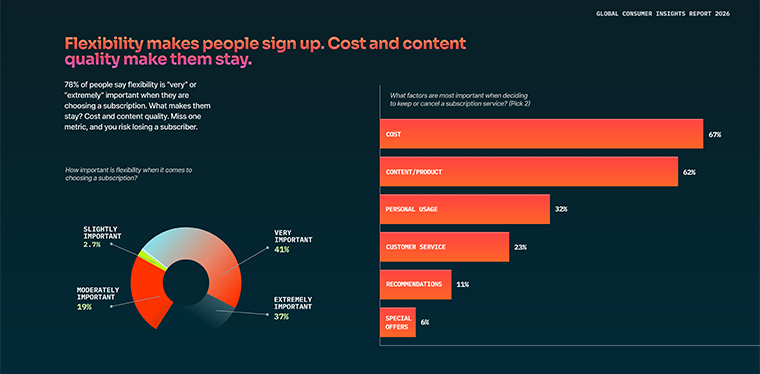
Testing is already standard practice among revenue teams. Eighty-three percent of companies test pricing before making changes, and those acting on the results within a month succeed more often, per The State of Recurring Revenue and Monetization Report. Reader demand points the same way: 78% of consumers rate flexibility as “very” or “extremely” important when choosing a subscription.
Adam Lifshitz, who spent years at Condé Nast leading payments, retention, and acquisition across some of the most recognisable media brands in the world, and is now founder and principal consultant at [re]subscribed, said to remember to isolate your variables.
“Bundle changes together, and you won’t know which one actually moved the number or whether one improvement was masking another’s decline. Isolating variables is the only way to know what’s actually driving the result,” he said. “When I tested this way — one variable, one clear read on impact — these kinds of changes have repeatedly done more than I expected going in. Not just a winning variant but a meaningfully larger lift in conversion than the size of the change would suggest.”
How to decide if flexible access fits your publication
Match the access model to the reader you’re trying to win.
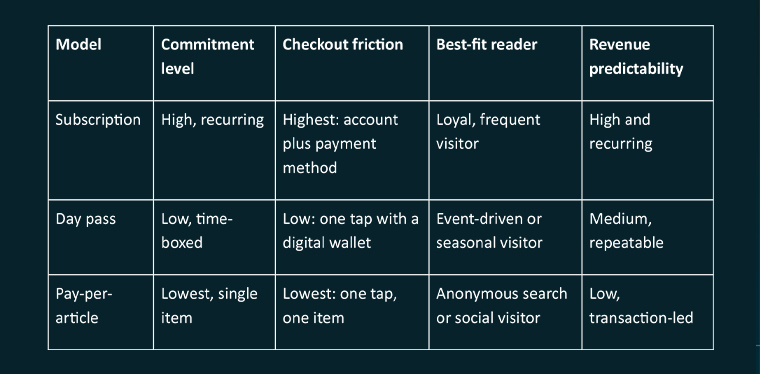
Flexible access fits when a large share of your traffic arrives anonymously, converts below 1.0%, and leaves at the paywall. It fits less well when most of your audience already returns weekly, where a pass competes with subscriptions you would win anyway.
Speed of iteration decides the outcome. Le Figaro halved sign-up time from 50 to 25 seconds, lifted conversion from 0.7% to 0.9%, and now launches new offers in hours instead of weeks. Jeune Afrique reached time-to-market 10x faster on new offers. Both results come from removing engineering dependency between the idea and the live offer.
Start with one segment and one test
Flexible access earns its place when it is designed, measured, and priced like a product. Choose one anonymous traffic segment, ship one pass at one price, and measure 90-day subscription conversion before you scale it.
Banner image: Adobe stock image by Tiwaporn Khemwatchar.
Related Articles
-

At Mediacorp’s CNA, loyalty means giving audiences a reason to ...
20 August 2026 -

Tribun Network turns print “dots” into AI-powered insight
20 August 2026 -

Nation Media Group focuses editorial strategy on stories that m...
4 August 2026 -

Grupo RBS builds social-first video operation to expand audienc...
20 July 2026 -

Inside Denník N’s successful subscription strategy
15 July 2026 -

AI adoption in newsrooms should move from experiment to strateg...
12 July 2026 -

Why are audiences going to AI answer engines for news?
30 June 2026 -

Rheinische Post programme turns print loyalty into digital conf...
11 June 2026
Upcoming Events
-

Subscriber Acquisition Master Class
10-17 November 2026
-

Media Advertising Summit
New York, United States
07-10 December 2026
-

AI-Native News Product Master Class
18-25 February 2027
-

Media Subscriptions Summit
Oslo, Norway
08-12 March 2027
-

World Congress of News Media
New York, United States
25-30 April 2027
-

Branded Content & Partnerships Master Class
20-27 May 2027
-

Subscriber Retention Master Class
17-24 June 2027
-

Conferencia Latinoamericana
15-16 July 2027
-

South Asia News Media Festival
New Delhi, India
19-22 July 2027
-

Asia/Pacific News Media Summit
19-20 August 2027
-

CEO Roundtable at Kilkenny
Kilkenny, Ireland
24-26 August 2027
-

Media Innovation Week
Amsterdam, The Netherlands
27 September - 01 October 2027








