

The destination is dead — here’s what replaces it
The Earl Blog | 08 July 2026

For a generation, the news industry built destinations — Web sites, apps, sections, brands you were meant to go to. That era is ending.
Looking across recent INMA Webinars, blogs, reports, Slack, and conversations with members, this is what I see as an emerging lead to the story … the “INMA conversation.” Let me attempt to distill this into something digestible.
Jim Egan, presenting the Reuters Institute’s Digital News Report 2026 to INMA members in a Webinar last week, put a date on the end of the destination era: For the first time across nearly 100,000 people in 48 markets, social media and video networks have overtaken both television and publisher Web sites as the most widely used source of news in the world.
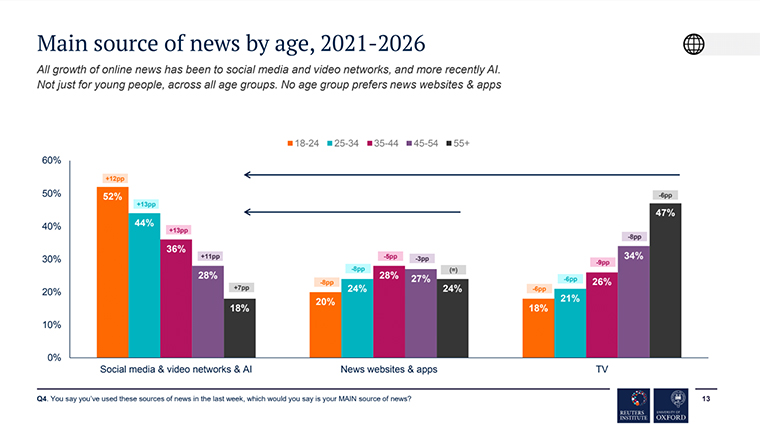
And, as Egan was careful to say, this is happening “more to do with the decline of traditional news sources” than the rise of the platforms. The audience didn’t so much leave the building as never move in. More than one-third of 18- to 24-year-olds have never regularly used a news Web site or watched TV news at all.
So the question every one of this week’s posts is really answering is the same: If the destination is dead, what is the product now? Read together, my colleagues give three answers.
Answer 1: The product is a person
The most uncomfortable number of the week comes from INMA Young Audience Initiative Lead Kerstin Hasse’s conversation with Nic Newman, senior research associate at the Reuters Institute. Some 27% of people globally now get news from an individual creator every week — and in Thailand, Peru, Morocco, and Indonesia, that figure runs to half. In France, HugoDécrypte reaches 28% of under-35s, more than Le Monde or TF1. Newman’s phrase for the new phase is the one I would underline: individuals that become brands.
Now hold that against the trust findings. The general population says creators are more relatable but less trustworthy than traditional media — a tidy trade-off. Except, Newman notes, among people who actually use creators, the trade-off vanishes: Creators score higher on every attribute, trust and impartiality included.
His explanation is structural. “When you have an individual, there’s nobody hiding behind that.” Trust, it turns out, is not conferred by the masthead. It is earned by a named human whose reasoning you can follow.
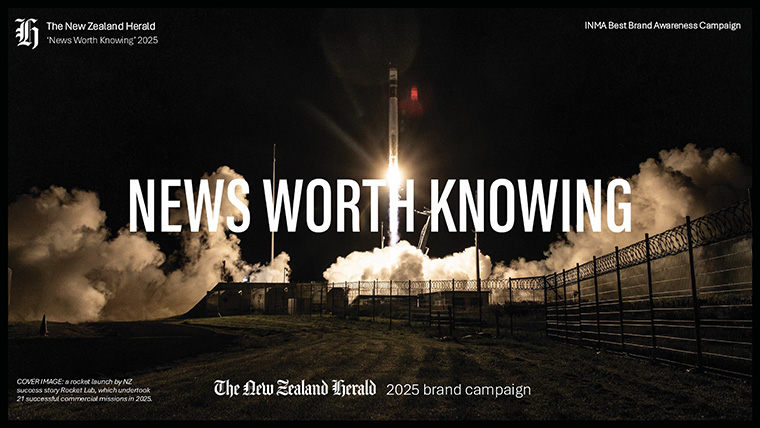
That is precisely the argument of a new report we published last week titled How News Brands Answer: Why Should I Trust You? Author Jakub Górnicki, drawing on more than 4,000 slogans from INMA’s database of news brand campaigns, tells news brands to stop claiming trust and start showing proof — building what he calls a proof system across six surfaces: people, process, place, participation, provenance, and product.
Górnicki’s line and Newman’s are the same line from two directions: As AI makes content indistinguishable and cheap, the scarce, defensible asset is visible human accountability. The correspondent you know by name. The method you can inspect.
Which raises Newman’s own needling question, the one I keep returning to: If that is what builds trust, why are most of us still hiding our journalists behind the masthead?
Answer 2: The product is shaped to a need and travels to the reader
The second answer is operational, and it is where the past week’s INMA case studies earn their keep.
INMA Newsroom Innovation Initiative Lead Sonali Verma marked 10 years of “user needs” with an uncomfortable reminder from Dmitry Shishkin: Roughly 70% of newsroom output still falls into a single need — “update me” — while delivering a fraction of the traffic. The machine runs at full speed, mostly in one direction, because we reward publishing, not need-fulfilment.

Volume is visible; usefulness is not. Her prescription is to twin user needs with formats and context — a two-minute vertical explainer and a 45-minute interview are not both simply “video.”
Watch three publishers do exactly that in these INMA articles:
Amedia looked hard at its video across 120-plus sites, decided it was below par, and rebuilt content and workflow together — vertical-first, reels, publishing from a phone, and, tellingly, training reporters on when not to use video. A 40% lift in videos produced a 286% growth in views.
Bergens Tidende heard election guides “feel like homework,” and so four senior political journalists spent weeks doing the hardest thing we do — simplifying — to build the world’s simplest election guide: a decision tree that eliminates parties until one remains. It reached 160,000 users and, as one of them said, “just made me want more.”
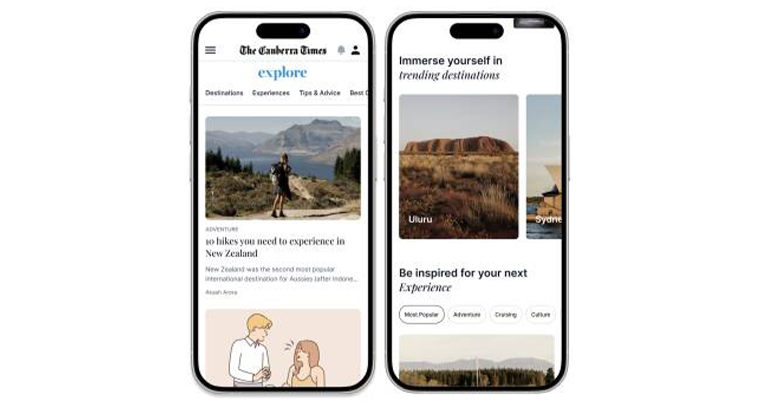
And Kate Cox’s Australian Community Media (ACM) is, for me, the cleanest statement of the shift. Explore, its travel brand, wasn’t failing on a stand-alone site — it was simply plateauing. So ACM stopped treating distribution as the last step and rebuilt Explore as a network-native product: commission once, deploy across 80-plus mastheads, package for feeds and search rather than a homepage. Baseline pageviews up 270%, organic up 237%, newsletters up 291% — and, crucially, the audience stopped falling away between spikes. Her sentence is the one to pin above the desk: The network isn’t a channel you flick on at the end; it’s the product.
Note the through-line: Amedia, Bergens Tidende, and ACM are all growth stories. This body of work is not a lament. It is a set of instructions.
Answer 3: AI is the tool, trust is the constraint
The third answer runs underneath the other two.
Jagran New Media wired Google’s Gemini into its CMS so 150-plus authors can generate drafts and metadata in one click, atomising some 1,500 articles a day — and bolted on an automated EEAT quality score, adopted at 95%, and human review before anything publishes. Search users up 18%, Discover clicks up 60%. Speed harnessed to standards, not against them.

It’s the same instinct behind our new Ask INMA app, which puts a decade of our research in members’ pockets, with sourced answers you can trace and, for the first time, an audio option — proof surfaces, applied to ourselves.
Then look at the commercial mirror. INMA Advertising Initaitive Lead Gabe Dorosz’s insights into Cannes shows the advertising world being reordered by exactly the same forces: the beachfront that belonged to publishers and agencies now belongs to the platforms and AI companies, with OpenAI declaring itself “clearly in the advertising business now.”
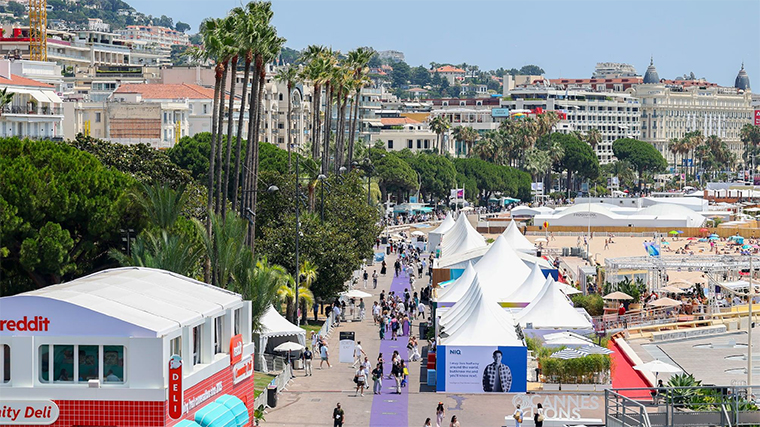
Everyone suddenly has an end-to-end agentic solution. And yet, over dinner, the quiet talk was of runaway token bills and an ROI no one can prove — what one veteran called fake-it-till-you-make-it. The tectonics are real; the certainty about how to monetise them is theatre.
The 3 outliers worth naming
Three findings cut against the grain, and INMA members should hold onto them.
First, brand trust is holding — everywhere except the United States, where, uniquely, trust in news brands has fallen below trust in news overall. That is a warning about polarisation, not a global verdict.
Second, creators are not cannibalising us. Only 13% say creators meet most or all of their needs, just 3% rely on them alone, and — the surprise — creator users consume more traditional journalism, not less. The pie is expanding.
Third, beware the comforting story we tell ourselves. Newman flatly rejects the idea that the young will “grow into” our formats as they age. They are voting for convenience, and they are not coming back for the newsprint.
Put all of these case studies together, and the argument writes itself. The destination is dead; the product is now a trusted person, a need-shaped format that travels to the reader, and AI disciplined by proof. The scarce assets in an age of infinite content are the ones no model can manufacture: a name, a method, a relationship. Everything this past week — from Lagos to Oslo to Sydney to New Delhi — is a variation on learning to build with those.
INMA members will be arguing it out in full in New Delhi, Vail, Madrid, San Francisco, and New York in the coming months. On this evidence, the argument is already half-decided.
What’s happening at INMA
Recent travels in Nigeria and Kenya: I recently visited 12 publishers in Nigeria and Kenya. To build on the theme of this week’s blog, they skipped the destination era entirely — building mobile-first, platform-native, creator-adjacent businesses because legacy revenue never cushioned them. Lean cost structures, WhatsApp-scale distribution, youth-majority audiences, and diversified revenue beyond advertising are survival disciplines, not innovations.
The lesson was that constraint breeds clarity. What Lagos and Nairobi do from necessity, Western publishers will soon do by choice — or decline. Click here for more on my Africa trip.
New report on news brands: Inspired by a keynote speech at March’s Media Subscriptions Summit in Toronto, we asked Outriders Klub Co-Founder Jakub Górnicki to expand upon his remarks in a new report titled How News Brands Answer: Why Should I Trust You?
Why is it so insightful? Because it names the news industry’s blind spot precisely: Publishers keep repeating trust claims when trust has become a product problem. The claim-to-proof reframe — six visible surfaces, measured as behaviour — converts 200 years of slogan inflation into an operational playbook executives can actually build.
Given my recent work on the brand as an operating system for the modern news media company, the authenticity and occasional earthiness of Górnicki’s report is what stuck me. This should be required reading both for newsrooms and the business side of every media company. Very readable and approachable. Download the report here.
Agenda for CEO Roundtable at Vail: INMA’s CEO Roundtable has become the conversation behind the curtain for news media CEOs. Bespoke programming. Unpredictable conversations. So it is a bit of a news nugget that we revealed our agenda last week for the August 18-20 Roundtable.
We will focus on how scarcity will decide who profits from news, redesigning for AI and how that affects strategy, how AI licensing is shifting and what that means, the AI-first CEO, transforming advertising and the revenue team, building a super-user news organisation, how newsrooms embrace liquid content, and rethinking investment in young audiences. See the agenda for yourself here.
“Ask INMA” mobile app: INMA’s 14-month-old “Ask INMA” AI answer engine is changing how members can convert our voluminous content into usable insights. Last week, we announced a mobile app that puts answers in the palm of your hand. Featuring an audio component, the app extends “Ask INMA’s” game-changing value for members. Download the app here.
INMA off-platform: INMA has a rising presence off-platform from our Web site. We recently added a Channels section that provides links to our “Nobody’s Reading This” podcast by INMA Young Audiences Initiative Kerstin Hasse, “The Debrief” podcast distilling insights from INMA conferences, the “Ask INMA” app, and our always interesting LinkedIn. Click here to see the Channels page.
Banner photo: Adobe stock by Leopoldine.
Related Articles
-

Marketers should outsource tasks, not thinking
25 October 2026 -

AI is now media’s operating environment
28 September 2026 -

The 3 editorial pillars of Chile’s first streaming news channel
23 September 2026 -

AI’s effect on super user math
15 September 2026 -

At Mediacorp’s CNA, loyalty means giving audiences a reason to ...
20 August 2026 -

Tribun Network turns print “dots” into AI-powered insight
20 August 2026 -

Nation Media Group focuses editorial strategy on stories that m...
4 August 2026 -

Briefly News empowers journalists with AI tool suite Nova
4 August 2026
Upcoming Events
-

Subscriber Acquisition Master Class
10-17 November 2026
-

Media Advertising Summit
New York, United States
07-10 December 2026
-

AI-Native News Product Master Class
18-25 February 2027
-

Media Subscriptions Summit
Oslo, Norway
08-12 March 2027
-

World Congress of News Media
New York, United States
25-30 April 2027
-

Branded Content & Partnerships Master Class
20-27 May 2027
-

Subscriber Retention Master Class
17-24 June 2027
-

Conferencia Latinoamericana
15-16 July 2027
-

South Asia News Media Festival
New Delhi, India
19-22 July 2027
-

Asia/Pacific News Media Summit
19-20 August 2027
-

CEO Roundtable at Kilkenny
Kilkenny, Ireland
24-26 August 2027
-

Media Innovation Week
Amsterdam, The Netherlands
27 September - 01 October 2027








