

Amedia scaled video to provide news for younger audiences
Ideas Blog | 05 July 2026

In Norway, as in the rest of the world, the bulk of younger audiences are not getting their news from traditional editorial sites but from apps like Snapchat and TikTok. At the same time, Norway tops the World Democracy Index due, among other things, to a high level of participation in political processes.
Amedia’s mission is to support this vibrant democracy in both the country as a whole and in all the local communities we operate in. So when the younger generations prefer to get their news through video, we have to follow suit.
At Amedia, we took a long hard look at ourselves and realised our video product was way below par, both in content and user experience. Things had to be done.
Making changes
Back in 2024, we took stock of the news video product across our 120+ sites. The analysis showed that significant development was needed; neither product nor content was up to date. Our users were, understandably, less than enthralled by the offering.
This was a strategic problem: For us, mastering video storytelling is a must to stay relevant.
We identified several challenges. To solve the problems, we used a proven method at Amedia: Focus on content development and editorial processes. Back it up with innovation in workflows and products.
The analysis identified significant differences in video maturity across newsrooms; consequently, a “one-size-fits-all” approach would not work. For the leading sites, the focus was on refining storytelling techniques and optimising consumption, including how video content is packaged and featured on the front page.
For smaller newsrooms just getting started, the priority was to initiate production and help them identify the right stories for video. Knowing when not to use video is as crucial as knowing when to use it, especially for newsrooms that have had little experience making videos.
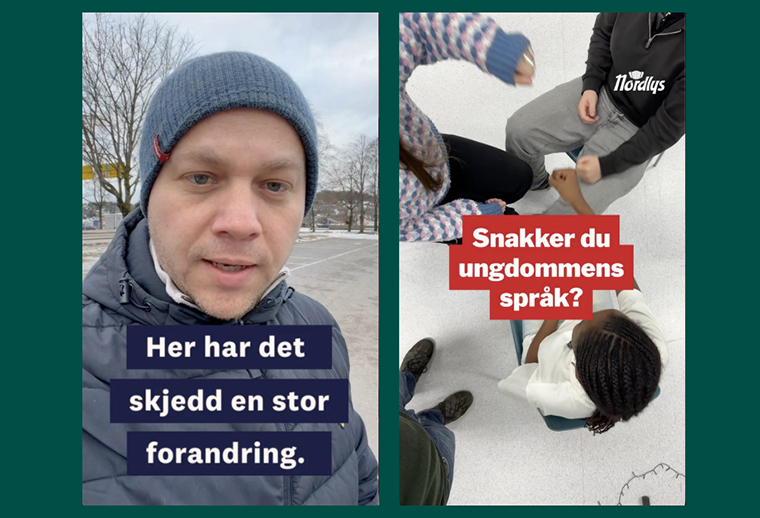
Our goal isn’t just to make videos but to ensure we use the format only when it’s the best way to deliver the story. It is vital to understand that video is not a “nice-to-have” side product, but a core feature as essential as our traditional news articles.
A select group of newsrooms and editors served as benchmarks, showcasing best practices for others to emulate.
Changing the video workflow
Just like our editorial operations, our video workflow and product needed improvement. Tools and the frontend were built for the traditional 16:9 format.
Our workflow was a bit cumbersome and not conducive to quick and easy video work, especially for breaking news. During 2025, we made improvements with two goals: to make it easier for users to consume video and to make it easier for staff to create and publish video.
Some of the changes we made included:
UX/product:
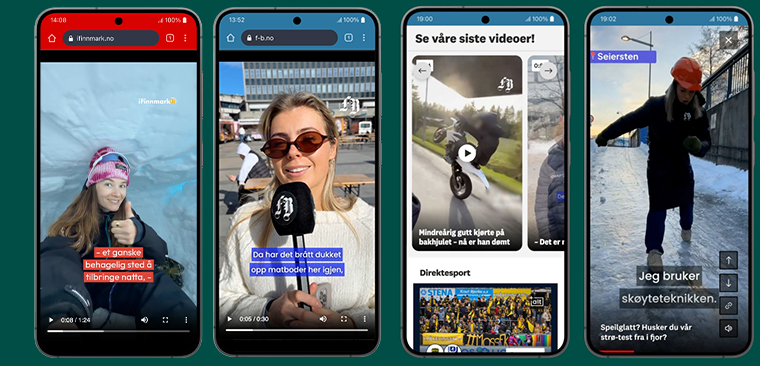
We revamped our video presentation experience, optimising it for vertical video, adding more playlists beneath the player (series, tags, most viewed, recent videos), and better “play next” features.
We added a reels experience, explicitly for vertical short-form video. The reels can be published either as a curated list on the front page, or automated based on a tag, either in an article or on the front page.
Introduced new ways of using short video clips in text articles.
Workflow:
Developed easy and quick video publishing from smartphones with our mobile-optimised Breaking News CMS.
Improved animated previews (short teaser clips) on the front page, and other new video options in our frontpage editing tool.
Created a video upload in our main CMS, removing hurdles for reporters wanting to publish video.
Developed new video graphics packages across our brands, optimised for vertical video.
Establishing a video-driven culture is a transformation that demands long-term commitment. Success depends upon getting the journalists to believe in the idea and understand why video production and consumption are so important to achieve. The primary driver is the editors’ abilities to take full ownership of the strategic process. These are the most important factors for success.
A spotlight on video
Throughout 2025, we took every opportunity to highlight the importance of video, share analytical findings, and showcase colleagues’ inspiration.
The editorial development team worked closely with newsrooms to give them the tools and insights they needed to succeed. It included sharing best practices from the spearhead newsrooms and an analysis of how to make the best video teasers on the front page.
A key principle is helping newsrooms assess where they stand today. For those publishing sporadically, the priority was establishing consistent routines for breaking news. Mastering these fundamentals is essential for “climbing the ladder,” with the highest step being a sustainable daily output of high-quality video content.
The greatest outcome has been a change in mindset among the newsroom staff. This is an essential asset as we continue working to ensure our newspapers remain relevant and profitable.
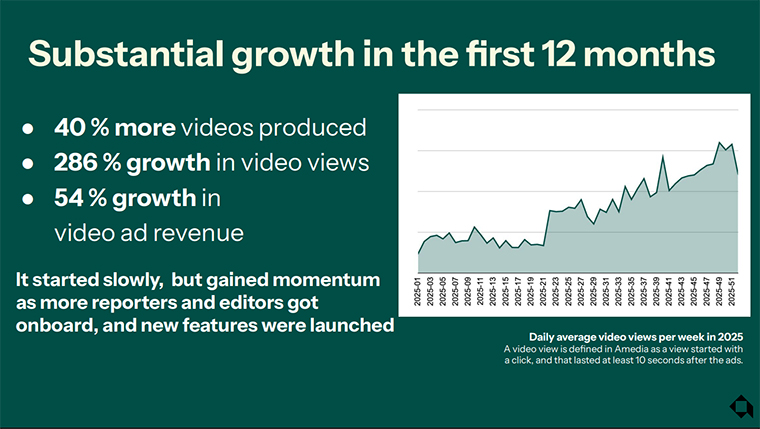
We are by no means done. So far in 2026, we have ramped up video expertise in the content development team and added several video workflow improvements. Going forward, we will continue improving our video workflow and products to make it easier for reporters to produce better videos.
At Amedia, we drive change to be able to keep doing what we always have done: reliable, independent journalism in and for the communities we cover.
Related Articles
-

5 lessons from the INMA Young Audiences Summit
28 September 2026 -

The 3 editorial pillars of Chile’s first streaming news channel
23 September 2026 -

AI’s effect on super user math
15 September 2026 -

What I told 40 CEOs (and won’t gatekeep from you)
30 August 2026 -

At Mediacorp’s CNA, loyalty means giving audiences a reason to ...
20 August 2026 -

Indian Express builds a video-first future around trusted journ...
20 July 2026 -

Economist launches subscription tier targeting younger audience...
20 July 2026 -

Grupo RBS builds social-first video operation to expand audienc...
20 July 2026
Upcoming Events
-

Subscriber Acquisition Master Class
10-17 November 2026
-

Media Advertising Summit
New York, United States
07-10 December 2026
-

AI-Native News Product Master Class
18-25 February 2027
-

Media Subscriptions Summit
Oslo, Norway
08-12 March 2027
-

World Congress of News Media
New York, United States
25-30 April 2027
-

Branded Content & Partnerships Master Class
20-27 May 2027
-

Subscriber Retention Master Class
17-24 June 2027
-

Conferencia Latinoamericana
15-16 July 2027
-

South Asia News Media Festival
New Delhi, India
19-22 July 2027
-

Asia/Pacific News Media Summit
19-20 August 2027
-

CEO Roundtable at Kilkenny
Kilkenny, Ireland
24-26 August 2027
-

Media Innovation Week
Amsterdam, The Netherlands
27 September - 01 October 2027








