

Manorama Online’s podcasts reimagine news for the ear
Ideas Blog | 21 June 2026

In a rapidly evolving media landscape, where audience attention is fragmented and consumption habits are shifting beyond text, Manorama Online took a decisive step forward with its audio journalism initiative, MO Podcast.
Rather than treating audio as a secondary format or a simple narration of articles, the project redefines how newsroom content can be experienced, placing storytelling, depth, and engagement at its core.
At its heart, MO Podcast is an ambitious attempt to build a “news-plus” audio ecosystem. Today, the initiative features 13 distinct podcast series spanning a wide range of topics, including news, crime, entertainment, spirituality, health, career guidance, gender issues and children’s content. Each series is designed not just to inform but to immerse.
What sets the initiative apart is its storytelling approach. Instead of merely reading articles, each podcast combines factual reporting with narrative structures, conversational presentation styles, expert voices, and carefully designed soundscapes.
Background scores and audio cues enhance emotional depth, while editorial rigour ensures accuracy and credibility. The result is journalism that feels alive, intimate, contextual, and engaging.

Building an audio-first strategy
The launch of MO Podcast was not an isolated experiment but part of a larger newsroom vision to build a sustainable, owned audio ecosystem. The goal was clear: to make audio a daily consumption habit driven by trust, relevance, and consistency rather than relying heavily on third-party platforms.
To achieve this, the team identified content verticals where audio storytelling could add the most value. Based on audience behaviour and editorial strengths, key focus areas included news, analysis, crime, fiction for both adults and children, career, health, entertainment, business, gender, and spirituality.
Each podcast was then developed with a distinct identity. Tone, structure and format were carefully aligned with the expectations of its target audience, moving away from a one-size-fits-all approach toward tailored listening experiences.
For instance, the popularity of crime stories led to the creation of Crime Beat, a podcast that elevates reportage through cinematic sound design and dramatic narration. The show blends investigative depth with storytelling techniques typically associated with audio documentaries, offering a compelling, almost visual experience through sound alone.
Smart distribution meets contextual relevance
A key factor behind the success of MO Podcast is its distribution strategy. Instead of treating podcasts as standalone products, they are deeply integrated into the editorial ecosystem.
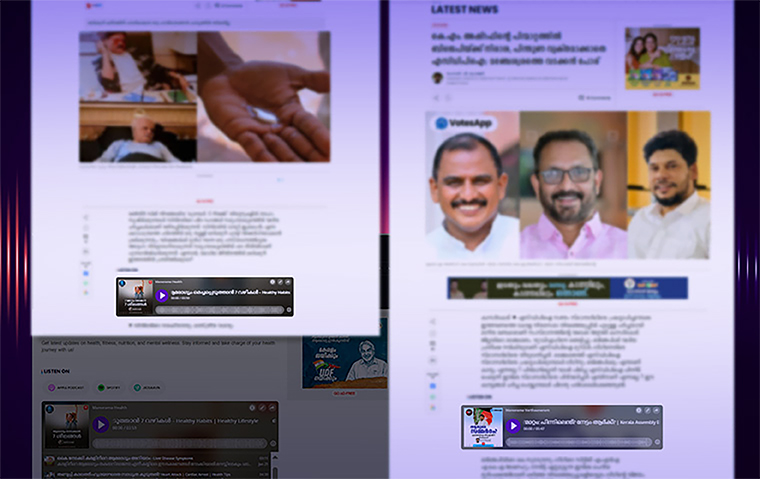
Each show is cross-promoted within relevant sections of the Web site, ensuring contextual discovery. A health podcast appears alongside health articles, while career-focused shows like Kettukondu Padikkoo are featured within education and career pages. Business podcasts such as Bulls Eye are embedded within financial coverage.
Similarly, Commentadi complements news analysis, AyinU aligns with women-centric content, and Crime Beat is positioned within crime stories. Children’s podcasts are placed in sections dedicated to young audiences.
This contextual placement enhances relevance and improves listener retention, as users are more likely to engage with audio content that aligns with what they are already reading or searching for.
From 1,000 to 46,000: A growth story
The results of this strategy have been significant. At launch, Manorama Online had around 1,000 active audio users. Within just 11 months, that number rose to 46,000 active users. Total consumption crossed 1.2 million audio downloads, reflecting both scale and engagement.
Equally notable is the nature of this growth. Despite distribution across major streaming platforms, a majority of listeners access podcasts directly through Manorama Online. This underscores strong brand trust and the effectiveness of owned distribution.
Content performance further highlights audience preferences. The health podcast has emerged as the most consumed format, with over 140,000 downloads, followed by the spiritual podcast and Crime Beat. This indicates a balanced demand for both service-oriented journalism and narrative-driven storytelling.
The road ahead
MO Podcast is more than a collection of shows. It represents a shift in how journalism adapts to changing user behaviour. By combining editorial strength with storytelling innovation and strategic distribution, Manorama Online demonstrates that audio can be a powerful extension of the newsroom.
As digital audiences increasingly seek flexible and immersive ways to consume content, initiatives like MO Podcast offer a glimpse into the future of journalism, where stories are not just read, but heard, felt and experienced.
Related Articles
-

At Mediacorp’s CNA, loyalty means giving audiences a reason to ...
20 August 2026 -

Tribun Network turns print “dots” into AI-powered insight
20 August 2026 -

Nation Media Group focuses editorial strategy on stories that m...
4 August 2026 -

Indian Express builds a video-first future around trusted journ...
20 July 2026 -

Grupo RBS builds social-first video operation to expand audienc...
20 July 2026 -

Inside Denník N’s successful subscription strategy
15 July 2026 -

AI adoption in newsrooms should move from experiment to strateg...
12 July 2026 -

Why are audiences going to AI answer engines for news?
30 June 2026
Upcoming Events
-

Subscriber Acquisition Master Class
10-17 November 2026
-

Media Advertising Summit
New York, United States
07-10 December 2026
-

AI-Native News Product Master Class
18-25 February 2027
-

Media Subscriptions Summit
Oslo, Norway
08-12 March 2027
-

World Congress of News Media
New York, United States
25-30 April 2027
-

Branded Content & Partnerships Master Class
20-27 May 2027
-

Subscriber Retention Master Class
17-24 June 2027
-

Conferencia Latinoamericana
15-16 July 2027
-

South Asia News Media Festival
New Delhi, India
19-22 July 2027
-

Asia/Pacific News Media Summit
19-20 August 2027
-

CEO Roundtable at Kilkenny
Kilkenny, Ireland
24-26 August 2027
-

Media Innovation Week
Amsterdam, The Netherlands
27 September - 01 October 2027








