

Washington Post research shows flexible access drives growth
Ideas Blog | 08 June 2026



Editor’s note: This article stems from a recent INMA report, Unlocking Subscription Growth with Flexible Access, free to INMA members.
The media industry is once again at a moment of change. AI is reshaping how audiences discover information, and trust continues to fluctuate.
While subscriptions remain a key revenue driver, growth is becoming more competitive as customer attention fragments and consumption patterns shift. Customer expectations have also evolved with an expectation in choice, control, and low-friction access to content.
Yet most publishers still rely on a single path to new monetisation. Paywalls remain the point of highest friction, typically presenting a one-size-fits-all subscription offer.
Paywall reach vs. conversion
Seventy-four percent of customers encounter paywalls and just 1% convert.
Customers are engaging but not converting. Even among those who subscribe, early churn remains a challenge, with a significant share turning off auto-renewal within the first 60 days. The signal is clear: Customers value journalism, but the standard subscription model does not fully align with how they want to pay.
Flexible access is designed to close this gap.
Rather than forcing a binary decision between subscribing and leaving, flexible access offers a range of lower-commitment options, including pay-per-article, day pass, and week pass. These options reflect a simple truth: Willingness to pay is not the same as willingness to commit.
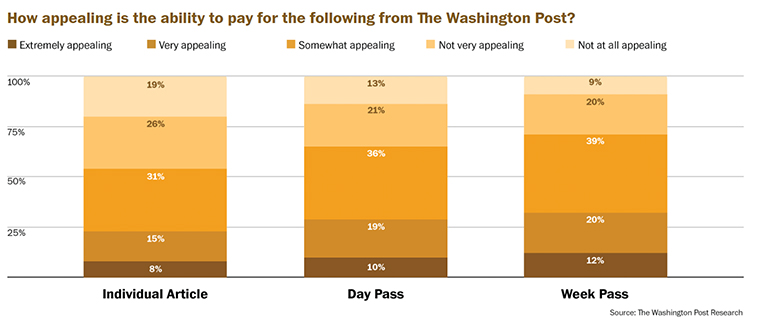
Research from The Washington Post highlights the scale of this opportunity. Demand for flexible options is strong with both customers who have and do not have a news subscription.
Even among those who said they were not interested in a subscription, a meaningful share expressed willingness to pay for flexible alternatives.
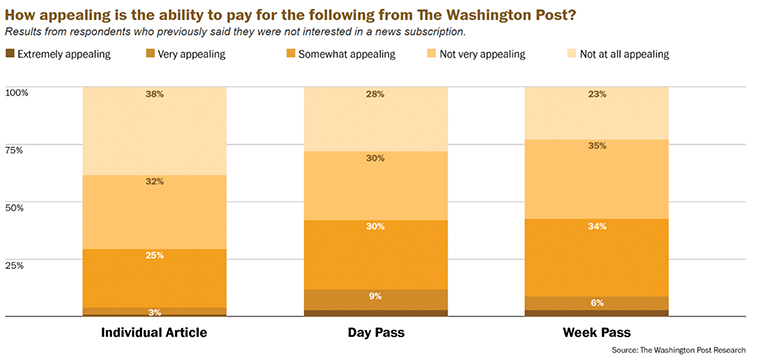
This reveals a large, underserved audience segment that is willing to pay but not on traditional terms.
To serve this segment, publishers must rethink the structure of the paywall itself.
Traditional vs. flexible model
A traditional model looks like:
Audience → paywall → subscription (high drop-off).
By comparison, a flexible model looks like:
Audience → Multiple entry points → Subscription | Article | Day Pass | Week Pass
The Washington Post began testing this model in 2024, starting with a week pass offered at multiple price points. Customer response was immediate. Bounce rates declined, conversion increased, and a significant portion of purchasers were first-time payers.
Subsequent tests introduced a day pass and a pay-per-article option, each reinforcing the same pattern. When given a choice, more customers chose to pay.
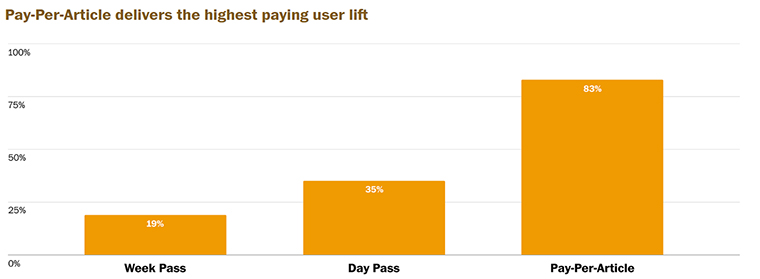
Importantly, these options did not weaken the subscription business. In many cases, they strengthened it.
Price anchoring effect
Pricing was structured to make a subscription the most compelling value. The higher-priced short-term option helped make that distinction clear. Flexible access did not compete with subscriptions. It complemented them.
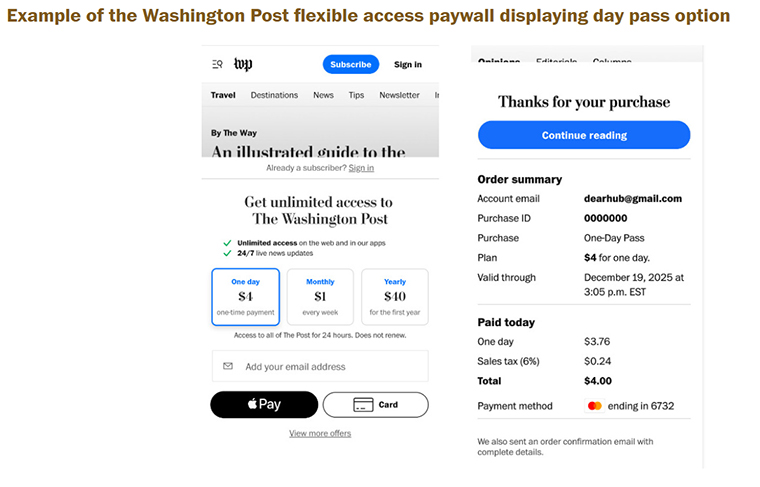
This also created a more dynamic relationship with customers. A single transaction then becomes the starting point for a broader lifecycle.
Customer journey
Early results show that one in 10 day pass customers repurchase or convert within 180 days, even without targeted lifecycle efforts. Each interaction builds familiarity, trust, and a stronger path to long-term value.
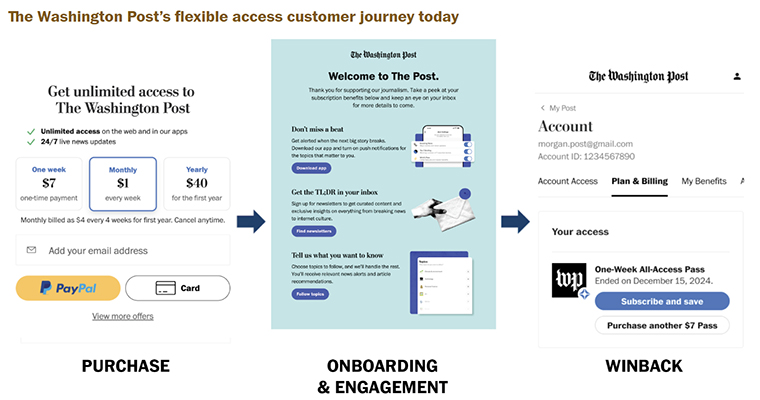
Flexible access also expands the reach of journalism. While subscribers often convert through core coverage such as politics and investigations, flexible access customers frequently enter through a broader set of content.
Content entry points
Subscribers tend to convert through politics, investigations, and opinion articles. In contrast, flexible access customers more often enter through lifestyle, culture, and service journalism. Flexible Access expands the audience and introduces new customers to the publication’s full breadth.
The implications are clear. Growth will not come from optimising a single product. It will come from building a system that reflects and serves the diversity of customer needs. Flexible access lowers barriers, captures incremental revenue, and strengthens the path to subscription.
If the industry is serious about being customer-centric, it must respond to customers’ signals for more choice. By offering flexible ways to pay and engage, publishers can build stronger relationships, expand their paying audiences, and build a more resilient future for journalism.
Acknowledgments
This work reflects a cross-functional effort across The Washington Post. We are grateful for the contributions from teams across subscriptions marketing, product, product design, engineering, insights and analytics, finance, revenue science, research, legal, news and opinions, communications, brand, partnerships, and client solutions.
Related Articles
-

WSJ executive councils show how publishers build communities th...
19 October 2026 -

Bundling is a pricing decision, rebundling is an organisational...
18 October 2026 -

7 themes from Madrid show publishers trading traffic for relati...
28 September 2026 -

5 lessons from the INMA Young Audiences Summit
28 September 2026 -

AI’s effect on super user math
15 September 2026 -

What I told 40 CEOs (and won’t gatekeep from you)
30 August 2026 -

At Mediacorp’s CNA, loyalty means giving audiences a reason to ...
20 August 2026 -

Indian Express builds a video-first future around trusted journ...
20 July 2026
Upcoming Events
-

Subscriber Acquisition Master Class
10-17 November 2026
-

Media Advertising Summit
New York, United States
07-10 December 2026
-

AI-Native News Product Master Class
18-25 February 2027
-

Media Subscriptions Summit
Oslo, Norway
08-12 March 2027
-

World Congress of News Media
New York, United States
25-30 April 2027
-

Branded Content & Partnerships Master Class
20-27 May 2027
-

Subscriber Retention Master Class
17-24 June 2027
-

Conferencia Latinoamericana
15-16 July 2027
-

South Asia News Media Festival
New Delhi, India
19-22 July 2027
-

Asia/Pacific News Media Summit
19-20 August 2027
-

CEO Roundtable at Kilkenny
Kilkenny, Ireland
24-26 August 2027
-

Media Innovation Week
Amsterdam, The Netherlands
27 September - 01 October 2027








