

New INMA report shows how 9 newsrooms put Gemini Notebook to work
INMA News Blog | 22 October 2026

INMA today released 9 Newsrooms Put Gemini Notebook to Work, a report sharing findings from the INMA x Gemini Notebook programme — a three-month virtual lab in which news publishers tested how source-grounded generative AI could extend their journalism.
Run by INMA with Google’s Gemini Notebook team (the product formerly known as NotebookLM) from June through August 2026, the programme gave participants product training and office hours with a product manager in the Gemini Notebook team.
Each publisher built and published a public Notebook using its own journalism, archives, public documents, video, and audio — and fed its findings, limitations, and product requests back to the team.
The nine participants were selected for variety across geography, language, source format, audience need, and newsroom size: Daily Maverick (South Africa), Der Spiegel (Germany), Economedia/Dnevnik (Bulgaria), Funke (Germany), Le Devoir (Canada), Mediacorp (Singapore), Mediahuis Nederland (Netherlands), Nexstar Media Group (United States), and The Republic (Nigeria).
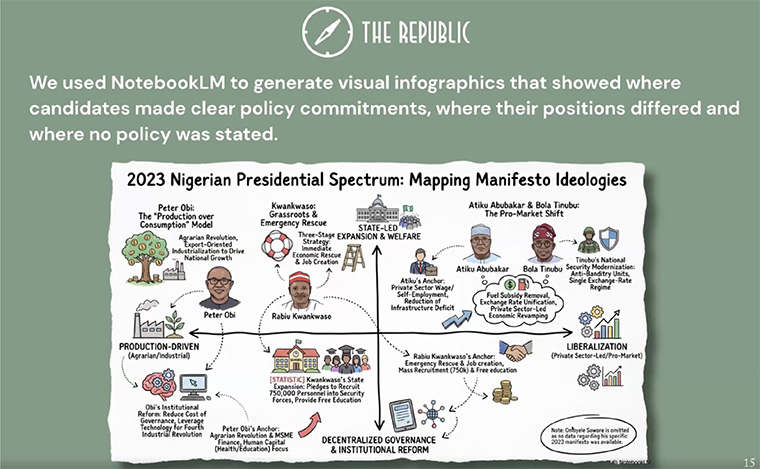
Their projects ranged from an election guide for Berlin and a civic knowledge tool in Nigeria to an archive of Quebec sovereignty coverage, a “living library” of more than a decade of Singaporean current-affairs video, a guide for residents navigating gas-extraction damage claims in the northern Netherlands, and an interactive experience marking the centenary of Route 66.
The report finds the strongest projects started with a sharply defined audience outcome rather than the technology.
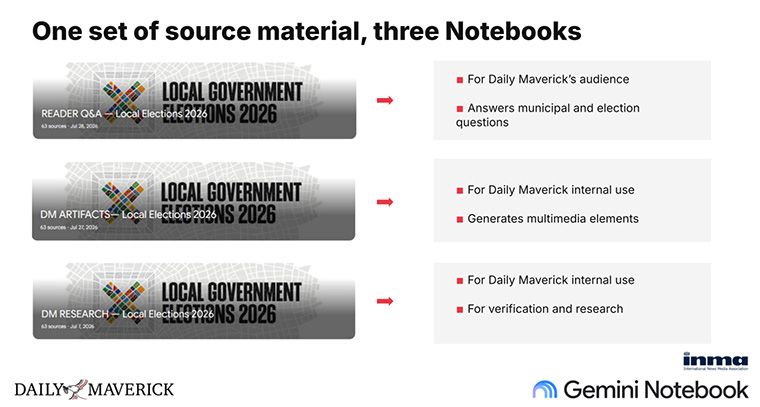
Among the cohort’s many transferable discoveries, Daily Maverick duplicated one election source base into three separate notebooks — a reader Q&A, an internal research and fact-checking tool for journalists, and a workspace for producing visual material — with shared sources but different instructions for each. Daily Maverick and Mediacorp will present their projects on stage Friday at INMA Media Tech & AI Week in San Francisco, alongside Gemini Notebook co-founder Steven Johnson.
“The central lesson is one I keep returning to in product work: Start with the user and the outcome. The technology comes afterwards,” writes Jodie Hopperton, lead of INMA’s Product & Tech Initiative, in the report’s foreword.
The report distils five lessons for publishers working with Gemini Notebook:
- Start with the person and the outcome, not the archive or the technology.
- Treat source organisation as product architecture: clean, name, tag, and catalogue before uploading.
- Treat the prompt as an editorial product specification, not a single clever question.
- Use different notebooks or instruction sets for different audiences, depths, and tasks.
- Red-team everything — difficult questions reveal weak answers, weak sources, and sometimes gaps in the journalism itself.
Drawing on detailed case studies from each participant, the report covers what teams tried, what worked, what changed, and what they would do differently next time — along with the many ways the cohort put Gemini Notebook to use, from editorial research and service journalism to archive discovery and rapid product prototyping.
9 Newsrooms Put Gemini Notebook to Work is available for free to INMA members and for purchase by non-members.
Related Articles
-

Arena Holdings learns reaching millions isn’t the same as servi...
8 October 2026 -

The Inquirer, Maeil ask: Is our content useful?
23 September 2026 -

Agents, liquid content, vibe coding raise questions for news me...
9 September 2026 -

What news CEOs are investing in — and what they are killing
8 September 2026 -

Nation Media Group focuses editorial strategy on stories that m...
4 August 2026 -

Grupo RBS builds social-first video operation to expand audienc...
20 July 2026 -

AI adoption in newsrooms should move from experiment to strateg...
12 July 2026 -

Why are audiences going to AI answer engines for news?
30 June 2026
Upcoming Events
-

Subscriber Acquisition Master Class
10-17 November 2026
-

Media Advertising Summit
New York, United States
07-10 December 2026
-

AI-Native News Product Master Class
18-25 February 2027
-

Media Subscriptions Summit
Oslo, Norway
08-12 March 2027
-

World Congress of News Media
New York, United States
25-30 April 2027
-

Branded Content & Partnerships Master Class
20-27 May 2027
-

Subscriber Retention Master Class
17-24 June 2027
-

Conferencia Latinoamericana
15-16 July 2027
-

South Asia News Media Festival
New Delhi, India
19-22 July 2027
-

Asia/Pacific News Media Summit
19-20 August 2027
-

CEO Roundtable at Kilkenny
Kilkenny, Ireland
24-26 August 2027
-

Media Innovation Week
Amsterdam, The Netherlands
27 September - 01 October 2027








