

Dagbladet Web TV team is capable of producing up to six live broadcasts daily
Media Leaders | 25 October 2021

One of the great advantages of online newspapers in terms of news coverage is their ability to report live asynchronously. This means that while linear television and radio can only report live one story at a time, online newspapers can report live several events with different starting points on the same site.
In addition, online newspapers can use far more tools: livestream, text, graphics, and audio. Additionally, online newspapers can link further, allowing the public to access other news sources that have been used.
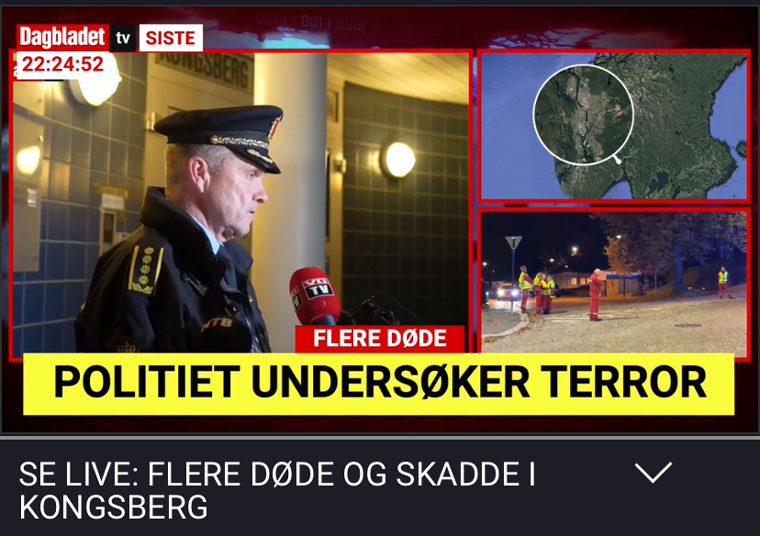
All of these features make online newspapers completely unbeatable in terms of the ability to deliver the most informative breaking news coverage.
Live TV is the best tool that shows what is happening right now. This feature is absolutely essential in breaking news.
In record time, readers have become accustomed to online newspapers using live images as pure breaking issues, which means news sites can now quickly take readers and viewers to major events — where they happen, when they happen!
Live in 60 seconds
At Dagbladet, Web TV is an important tool when it comes to communicating the latest news. Director of TV Mads A. Andersen and the two sub-editors, Bjørn Carlsen and Tanja Wibe-Lund, make sure we always cover the big events with Web TV.
Here are some figures about Dagbladet’s Web TV operations:
- With breaking news, Dagbladet TV’s reporters enter into the studio in less than 60 seconds.
- We produce two to six live broadcasts every single day.
- We have the opportunity to produce a live broadcast with one person at work.
- We are seconds away from being live 24/7.
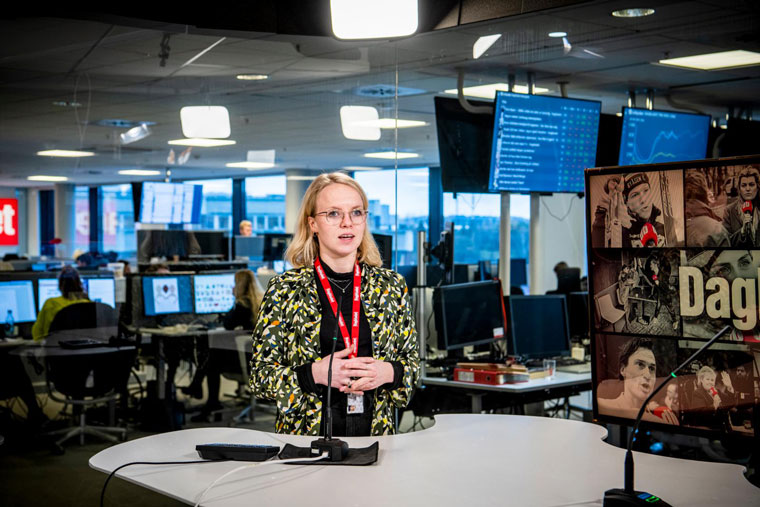
Our TV studio is only a few metres from the very core of the news media: the news desk. It is the news desk that controls news dissemination. Just as important is the immediate interaction with Dagbladet TV’s own breaking desk. It is these two desks that have developed into the very core of modern breaking work.
Close interaction
During events, revelations, and major news, the TV journalists actively work with live studio broadcasts in the dissemination of news. The TV desk conveys the latest news with maps, video, photos, sources, and agency material. We often connect people out in the field during the live broadcast to keep viewers updated.
The video content is distributed on the Dagbladet Web site, and it supplements the article text.
At Dagbladet, all writing reporters are offered TV training so they can all be confident in their role as live reporting reporters in the field. This has increased interest in, and awareness of, TV as a tool in news dissemination, in close interaction with text and news studios.
In the news operation, the TV desk and main desk work closely together on priorities and ethical decisions. There are regular, daily meeting points throughout the working day, with regular evaluations and ongoing collaboration on the interaction between TV and text.
The operational TV, photo, and news management always take a stand on how cases and incidents can be covered visually.
Related Articles
-

Journalists create agentic workflows at Bonnier
25 October 2026 -

The 3 editorial pillars of Chile’s first streaming news channel
23 September 2026 -

Onmanorama reinvents history for Gen Z with AI-created video se...
16 September 2026 -

VG turned AI video into discovery engine for premium content
14 September 2026 -

A Gazeta combines deep local roots with new technology for jour...
2 September 2026 -

FAZ’s video investment pays off on new platforms
27 August 2026 -

Reuters Digital News Report shows accelerated shifts in 2026
18 August 2026 -

South Asia’s publishers no longer expect young readers to come ...
27 July 2026
Upcoming Events
-

Subscriber Acquisition Master Class
10-17 November 2026
-

Media Advertising Summit
New York, United States
07-10 December 2026
-

AI-Native News Product Master Class
18-25 February 2027
-

Media Subscriptions Summit
Oslo, Norway
08-12 March 2027
-

World Congress of News Media
New York, United States
25-30 April 2027
-

Branded Content & Partnerships Master Class
20-27 May 2027
-

Subscriber Retention Master Class
17-24 June 2027
-

Conferencia Latinoamericana
15-16 July 2027
-

South Asia News Media Festival
New Delhi, India
19-22 July 2027
-

Asia/Pacific News Media Summit
19-20 August 2027
-

CEO Roundtable at Kilkenny
Kilkenny, Ireland
24-26 August 2027
-

Media Innovation Week
Amsterdam, The Netherlands
27 September - 01 October 2027








