

A Gazeta combines deep local roots with new technology for journalism that makes a difference
Ideas Blog | 02 September 2026

A Gazeta has spent years undergoing transformation, leveraging its nearly centennial history to further consolidate its local presence through digital narratives. At its core is public interest journalism in everything it produces. In 2025, this strategy became evident with the “Morro do Macaco Tragedy” and “River of Mud and Struggle” projects, which emphasised the innovative use of video and digital storytelling.
Memory as a mission
“Morro do Macaco Tragedy” emerged, in a way, from a simple yet powerful question: how can we prevent a tragedy that marked Espírito Santo from falling into oblivion?
In 1985, following a period of intense rainfall, a major landslide struck the Morro do Macaco community in Vitória, leaving behind fatalities, displaced residents, and scars that crossed generations. Forty years later, the documentary Web series returns to this area not just to retell the history, but to document, with rigour and sensitivity, what has changed since then, and what remains the same for families still living on the brink of risk.
The project combined rare archival footage from the 1980s with current interviews of survivors, rescuers, technicians, and government representatives. This weaving together of past and present created a multimodal narrative in which documents, data, testimonies, and scenes from daily life mutually reinforce one another, providing an experience that video is uniquely capable of delivering in a highly impactful way. More than numbers and timelines, the public encountered faces, voices, and memories that had long been invisible.
Image, politics, and reparation
By showing that, four decades after the landslide, families were still living in areas of extremely high risk, “Morro do Macaco” challenged official narratives that denied or minimised these vulnerabilities. During an ecumenical ceremony marking the 40th anniversary of the tragedy, the documentary prompted a rare political gesture: in the face of the images and testimonies, the mayor announced new investments in slope-containment works and community infrastructure, and authorities publicly acknowledged the historical neglect of the region’s residents. There was even an apology.
This is a central point of the project: the series is not limited to a tribute to the past but functions as a tool for accountability and transformation. The combination of audiovisual evidence, geotechnical data, and an accessible narrative led public authorities to reconsider their stance on risk areas and accelerate the relocation of families in critical situations. In parallel, the content became input for debates on the climate crisis, urban planning, and alert systems, reinforcing the role of local journalism as a guardian of memory and an ally in preventing future disasters.
A river of mud, struggle, and innovation
While “Morro do Macaco” revisits a 40-year-old trauma, “Rio de Lama e Luta” (River of Mud and Struggle) looks at the decade following the collapse of the Fundão dam in Mariana, Brazil’s largest environmental disaster, whose wave of toxic tailings travelled the Doce River basin until it reached the Espírito Santo coast. Over the past 10 years, traditional communities in Espírito Santo have continued fighting for compensation, recognition, and a minimally safe future on the banks of a river that was severely damaged.
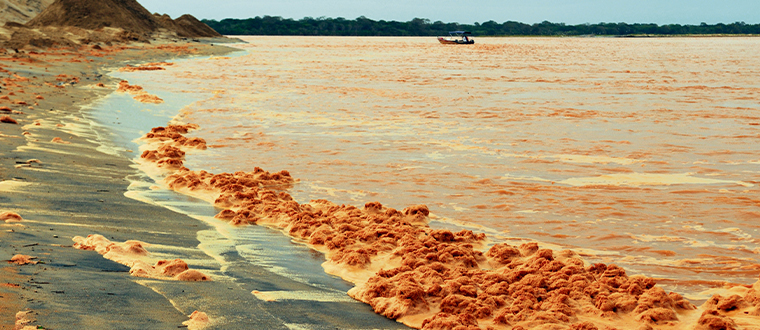
To tell this story, A Gazeta’s team travelled almost 200 kilometres through Espírito Santo, listening to fishermen, indigenous people, quilombolas (descendants of runaway slaves), and riverside dwellers who still face material, emotional, and cultural losses.
The result was a “scrollytelling” experience that replicates, on the mobile or computer screen, the path of the mud: as the user scrolls the page, videos, photos, data, and digital art combine to reconstruct the chronology of the disaster and the communities’ resistance.
The innovation here is not just in the format, but in how technology is placed at the service of the story. With the support of artificial intelligence tools, the team created personalised visual elements, organised a dynamic chronological infographic that simulates the mud’s advance in the river’s course as the user progresses through the narrative, and highlighted excerpts from interviews and data in a more didactic and engaging way for younger audiences, who primarily get their information from social media.
Furthermore, faced with a technical inability to present the material in a more interesting way using the templates available in our CMS, they created a template generator to customise the final presentation, overcoming the technological barrier. Far from being a shortcut, AI serves as a creative ally that amplifies impact and understanding.
Local, digital, and global
The strength of “Rio de Lama e Luta” is also measured by the special page: the distribution strategy on social media, especially Instagram, brought the story to hundreds of thousands of people, many of them young people who did not follow the tragedy in 2015. Simultaneously, the special puts the future of the Doce River back at the centre of the debate, at a moment when a billion-dollar agreement for the basin’s recovery is being discussed, and broadens the conversation about socio-environmental responsibility.
Together, “Morro do Macaco” and “River of Mud and Struggle” show what happens when a regional newsroom combines deep local roots, mastery of digital languages, and openness to experimenting with new technologies. These are projects born from local pain that directly engage with global debates on climate risk, urban vulnerability, environmental justice, and the ethical use of AI in storytelling. It shows that local journalism can transcend geographical borders when it preserves memory, promotes debate, and demands transformation.
Related Articles
-

7 themes from Madrid show publishers trading traffic for relati...
28 September 2026 -

The 3 editorial pillars of Chile’s first streaming news channel
23 September 2026 -

At Mediacorp’s CNA, loyalty means giving audiences a reason to ...
20 August 2026 -

Briefly News empowers journalists with AI tool suite Nova
4 August 2026 -

Indian Express builds a video-first future around trusted journ...
20 July 2026 -

Grupo RBS builds social-first video operation to expand audienc...
20 July 2026 -

Inside Denník N’s successful subscription strategy
15 July 2026 -

Why are audiences going to AI answer engines for news?
30 June 2026
Upcoming Events
-

Subscriber Acquisition Master Class
10-17 November 2026
-

Media Advertising Summit
New York, United States
07-10 December 2026
-

AI-Native News Product Master Class
18-25 February 2027
-

Media Subscriptions Summit
Oslo, Norway
08-12 March 2027
-

World Congress of News Media
New York, United States
25-30 April 2027
-

Branded Content & Partnerships Master Class
20-27 May 2027
-

Subscriber Retention Master Class
17-24 June 2027
-

Conferencia Latinoamericana
15-16 July 2027
-

South Asia News Media Festival
New Delhi, India
19-22 July 2027
-

Asia/Pacific News Media Summit
19-20 August 2027
-

CEO Roundtable at Kilkenny
Kilkenny, Ireland
24-26 August 2027
-

Media Innovation Week
Amsterdam, The Netherlands
27 September - 01 October 2027








