

7 steps for newsroom AI adoption
Newsroom Innovation Initiative Blog | 13 May 2026

What does it take to get a newsroom to adopt AI tools happily?
I had the good fortune to attend a meeting of the Canadian AI Journalism Network recently, where co-founder Nikita Roy, who produces the Newsroom Robots podcast, outlined seven excellent steps.
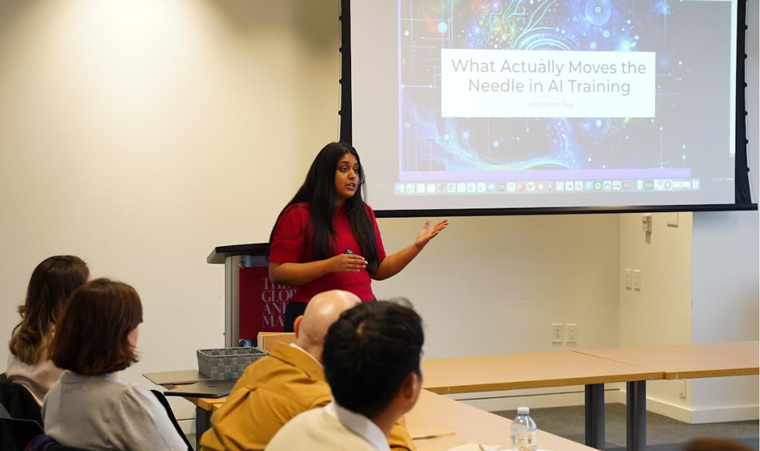
1. Start with workflow audits, not AI training. If you want your newsroom to use AI, don’t start with an AI training programme. Instead, the process should begin with understanding workflows, from start to finish.
“It’s about understanding: What does today’s baseline look like? How does work actually happen?” said Roy, who also hosts the Newsroom Robots podcast.
This process includes mapping the full workflow path, from ideation to publication and distribution. “If it’s a story, how does it go from story idea to actually appearing on the Web site, to your social media platforms?”
2. Surface pain points and “unlimited capacity” opportunities. The audit’s purpose is to reveal where AI could meaningfully help. It ties AI adoption to real frustrations and ambitions rather than abstract use cases.
“You’re surfacing the gaps,” Roy said. “The big question over there is, if you had unlimited capacity, what would you do differently? It starts to unlock a lot of the opportunities that people themselves come up with.”
And that last part is vital for success: Ensuring the problem is a genuine problem that needs to be solved, and the solution is something a journalist themself would use and could be invested in. This works far better than someone in another department seeing the potential of AI and coming up with a solution that feels unnatural or unwanted in the newsroom.
3. Provide role-specific, evidence-based use cases. To win over skeptics, she emphasises providing concrete examples that are tailored to particular roles. Ask your editorial staff to speak to their colleagues about how AI is genuinely helping them be better at their work.
Journalists prefer to listen to their peers rather than to someone parachuted in from a different department who may not understand what they do, why they do it, and what their concerns are.
4. Integrate AI into existing tools and workflows. Roy warns against adding “yet another tool” that comes with friction. Instead, try using extensions that are embedded in Google Docs, CMSs, and Slack.
“The biggest issue I’ve seen with AI adoption has been: I don’t want to go to another tool,” she said. “It’s not just about, how do we create a new tool, but how do we integrate that into people's product workflows?”
5. Define clear guardrails and transparency around AI use. Journalists are professional skeptics. They need to see where and how AI is allowed to be used, where it is absolutely forbidden — and how it works. Build confidence by showing them the guardrails you have put in place.
6. Build change agents across desks. Rather than trying to upskill everyone at once, Roy recommends cultivating internal champions who become the go-to people when their colleagues have questions and who can independently show their colleagues how AI is solving real problems for them.
“You can’t upskill an entire newsroom overnight, but you can build a lot of change agents and AI ambassadors,” she said.
7. Reimagine workflows and roles instead of just chasing efficiency. AI is a people and workflow problem not a pure tech project, she points out.
“The question really is, how do we reimagine workflows now that AI exists?” she said. “Otherwise, you’re just going to go and start to automate the old workflows, the old processes, the old bottlenecks.”
If you’d like to subscribe to my bi-weekly newsletter, INMA members can do so here.
Banner photo: Adobe Stock By Martn.
Related Articles
-

Marketers should outsource tasks, not thinking
25 October 2026 -

AI is now media’s operating environment
28 September 2026 -

The 3 editorial pillars of Chile’s first streaming news channel
23 September 2026 -

AI’s effect on super user math
15 September 2026 -

At Mediacorp’s CNA, loyalty means giving audiences a reason to ...
20 August 2026 -

Tribun Network turns print “dots” into AI-powered insight
20 August 2026 -

Nation Media Group focuses editorial strategy on stories that m...
4 August 2026 -

Briefly News empowers journalists with AI tool suite Nova
4 August 2026
Upcoming Events
-

Subscriber Acquisition Master Class
10-17 November 2026
-

Media Advertising Summit
New York, United States
07-10 December 2026
-

AI-Native News Product Master Class
18-25 February 2027
-

Media Subscriptions Summit
Oslo, Norway
08-12 March 2027
-

World Congress of News Media
New York, United States
25-30 April 2027
-

Branded Content & Partnerships Master Class
20-27 May 2027
-

Subscriber Retention Master Class
17-24 June 2027
-

Conferencia Latinoamericana
15-16 July 2027
-

South Asia News Media Festival
New Delhi, India
19-22 July 2027
-

Asia/Pacific News Media Summit
19-20 August 2027
-

CEO Roundtable at Kilkenny
Kilkenny, Ireland
24-26 August 2027
-

Media Innovation Week
Amsterdam, The Netherlands
27 September - 01 October 2027








