

As AI changes newsroom workflows, organisations are reimagining their roles
Newsroom Innovation Initiative Blog | 20 October 2026




This month’s Newsroom and AI Master Class took a deep dive into how news organisations are integrating AI to drive transformation and build sustainability.
Sonali Verma, lead of the INMA Newsroom Innovation Initiative, opened the recent three-day event with an overview of the shifts she’s seen across the industry. Her findings showed a clear pattern: Newsrooms no longer see AI as merely a helpful tool but as a way to reimagine how journalism is produced, delivered, and valued.
Three threads now run through nearly every innovation in the industry, she noted: “At the end of the day, it is about focusing on what is relevant to our audience, focusing on what our value proposition is in the news business, and focusing on what is scarce in a world where information is abundant.”
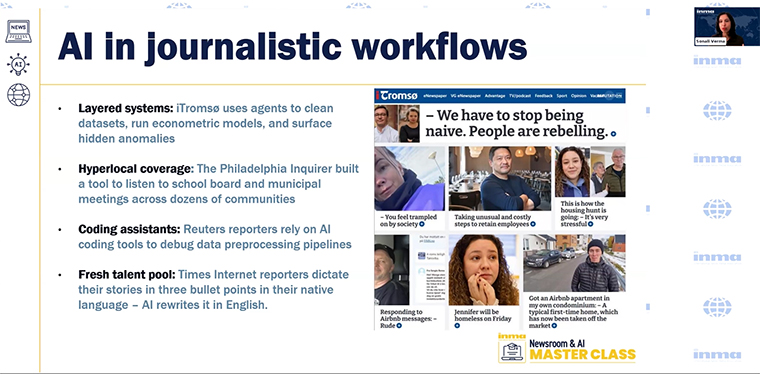
She shared examples of how AI is dramatically expanding newsroom capacity:
- Small teams like Norway’s ITromso use layered agent systems to clean fragmented datasets, run econometric models, and surface anomalies, freeing reporters for fieldwork and human interviewing.
- Others, like The Philadelphia Inquirer and Hearst Newspapers, use AI to listen to long public meetings and flag story leads.
- Reuters uses AI coding tools to debug data pipelines, lowering the barrier to investigative data journalism.
- In India, Times Internet has restructured workflows so reporters can dictate stories in their native language and have AI rewrite them into polished English copy, unlocking new talent pools.
As part of the shift, news organisations are moving away from commodity news and toward distinctive, high‑value journalism. In East Africa, Nation Media Group prioritises enterprise reporting and high‑value stories over daily churn, using AI to spot oversaturated topics and fresh angles.
Across the industry, article volume is dropping as publishers focus on journalism that audiences will pay for: “I’m finding over and over again that the answer to that lies in quality content,” she said.
“The way we think about what we’re actually selling in the news business” is also changing, she said.
Bloomberg has long monetised workflow, tools, and intelligence rather than articles, and many publishers are now exploring proprietary data, expert systems, and information products as new revenue streams.
Hearst’s property‑tax protest script generator is a prime example: a utility tool trained on expert reporting that drove subscriptions and helped homeowners reduce appraisal values.
Newsrooms have now become active participants in growth and retention, Verma said. Some embed marketing and subscription teams directly in editorial operations, enabling “rapid decisions on story promotion and campaign execution.” Many brands are now putting their journalists in the spotlight “so readers can realise they’re connecting with a real human.”
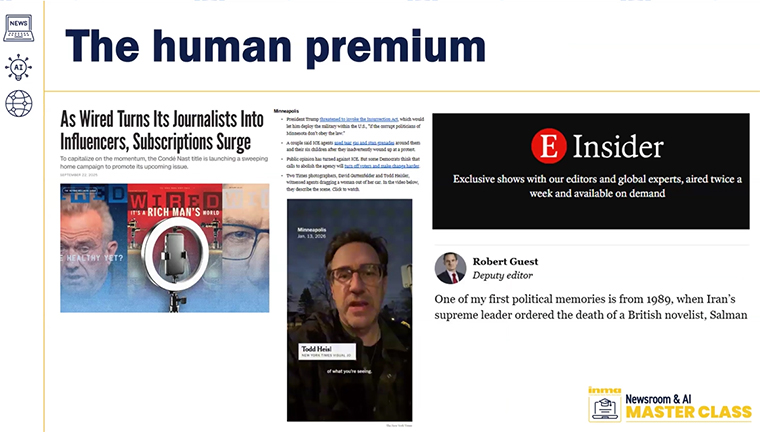
She pointed to Wired’s strategy to build its best-known writers into platform personalities on TikTok or Instagram.
“Even The Economist, which forever has shunned bylines, has changed its approach in some areas, showcasing key talent through podcast newsletters,” Verma noted. “They’re putting people’s faces and names there because they’re betting that the future of journalism isn’t algorithmic; it’s deeply human.”
AI as a supporting tool
The Wall Street Journal has spent the past three and a half years reinventing its newsroom and tailoring it to a world where information is increasingly abundant and cheap.
As head of digital, Taneth Evans has led that transformation, which began with the goal of becoming “an audience-first publication for people who mean business.”

AI has enhanced that mission.
The Wall Street Journal uses AI for low-lift tasks like alt text and SEO headlines, but Evans is most excited about applications that support journalism previously impossible due to time or resource constraints. Her favourite example is Orca, an AI listening tool developed inside the newsroom.
“It turns messy audio into structured data, so it can listen to tens of thousands of hours of podcasts and flag interesting things to us,” she said, adding it can identify topics, track changes over time, and surface insights reporters can investigate.
For example, the team used Orca to analyse Trump‑supporting podcasts, examining how often hosts mentioned the Epstein scandal and how that narrative fractured parts of his base.
“Could we have done that story? Yes,” Evans said. “But we either would’ve had to have had thousands of people listening to podcasts or … spent a whole year listening.”
With AI’s assistance, a difficult task became a timely, data‑driven story.
Empowering — not replacing — humans
Sweden’s Helsingborgs Dagblad has a straightforward view of AI, explained Marcus Ekdahl, editor-in-chief: “Journalism begins and ends with people. AI changes what is possible in between.”
The Bonnier News-owned company’s agentic workflow means software can complete several related tasks — such as monitoring new material, classifying and assessing it, producing a summary — and then hand it off to a journalist.
“This is a significant step beyond just asking a chatbot a single question,” Ekdahl said.
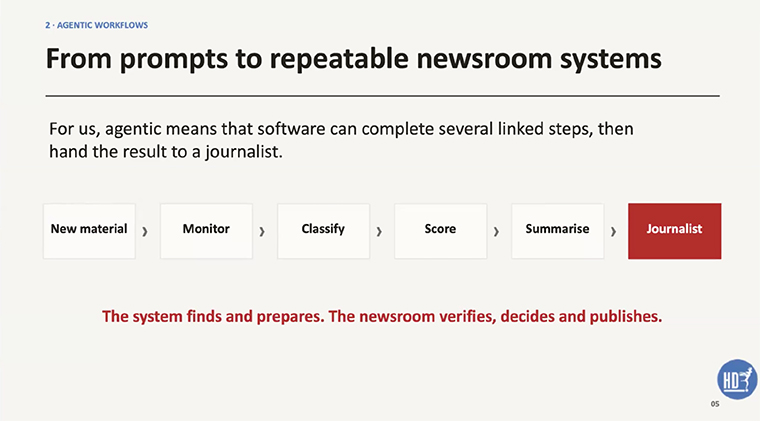
These repeatable processes can operate overnight or when journalists are too busy to monitor a particular source. But Ekdahl stressed this does not amount to an autonomous newsroom: “The system finds and prepares. The newsroom verifies, decides, and publishes.”
The strongest argument for AI is not efficiency, Ekdahl said, but journalism that could not otherwise be produced at the same depth. Helsingborgs Dagblad’s investigation into the shadow fleet of sanctioned vessels and oil tankers moving along the Skåne coastline covered more than 330 sanctioned vessels and over 250,000 AIS positions, combined with sanctions lists and registry data.
AI-assisted methods helped collect, connect, and analyse the material, allowing reporters to identify patterns and focus on the most relevant vessels and movements.
But journalists checked registries, traced ownership, verified findings, interviewed sources, and placed the information in local and geopolitical context.
“AI made the scale manageable,” Ekdahl said, “but journalism made it meaningful.”
Leaning into trust
As editor-in-chief and CEO of VG, a Norwegian publication in Schibsted’s portfolio, Gard Steiro is thinking about what’s next in and for the news business. But that’s harder in a rapidly changing world where the industry’s future is uncertain.
“The difference from before is that our time horizons are shorter than they used to be, and we really need to plan for multiple scenarios,” he said.
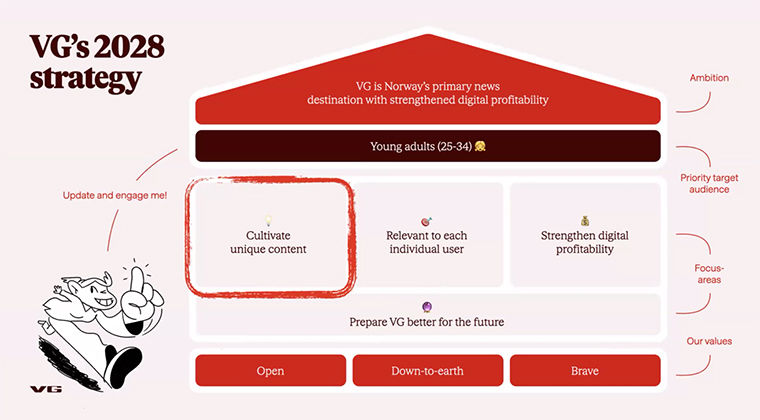
With AI “already embedded in every strategic priority,” Steiro said the future of news depends on determining who will be trustworthy and whether convenience matters more than trust.
“In a world where people trust OpenAI more than they trust us, we have no future. If people stop coming to us directly, it becomes very difficult to fund journalism,” he said. “The consumers of news need both a trusted resource and user-friendly experience that meets their needs.”
To remain competitive, legacy brands, in particular, must find efficient ways to produce and tailor content and reimagine the user experience for their audiences. And Steiro reminded the audience that people depend on journalism, not chatbots and AI: “In all the swirl of technology, we must never forget who we are here for,” he said.
“There are people out there who need to be met at eye level, people who need to be seen, people whose stories must be told, people who depend on us as reporters.”
Stuff takes journalism deeper
At Stuff Digital, the goal is not simply to make the newsroom faster; it is to free journalists to produce more distinctive reporting while strengthening direct relationships with audiences.
Over the past year, the newsroom has sharpened its focus on two areas where audience demand is strongest: live and breaking news, and deep, original journalism, Keith Lynch, editor-in-chief, said.
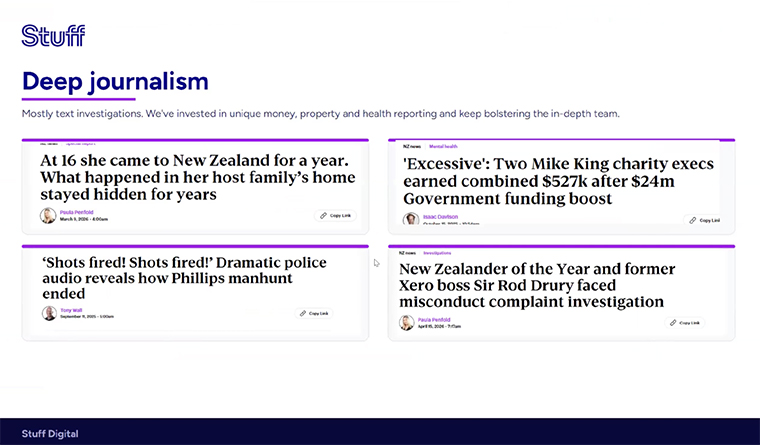
“People come to Stuff for big live and breaking stories,” Lynch said. They also come for “really good, strong, deep, and unique journalism.”
Now, Stuff concentrates on covering what is happening in New Zealand right now while investing in investigative reporting and specialist coverage, including money, property and health.
The strategy requires a different newsroom structure, and Stuff has encouraged its best-known journalists to rethink how they connect with audiences. Its deeper journalism has traditionally been text-oriented, but the newsroom is exploring live events, public conversations, and experiences that bring readers closer to the people behind the reporting.
These projects draw partly on the creator economy, where audiences often develop strong relationships with individual personalities. Lynch said it is encouraging journalists “to foster fans” and inviting the direct audience “to feel closer to Stuff than ever before.”
More efficient routine news production creates the capacity to invest in journalism competitors cannot easily replicate. And getting this right will allow Stuff’s journalism to become “much more valuable, unique, and to serve that direct audience.”
Banner image: Adobe stock image by Long.
Related Articles
-

Marketers should outsource tasks, not thinking
25 October 2026 -

AI is now media’s operating environment
28 September 2026 -

The 3 editorial pillars of Chile’s first streaming news channel
23 September 2026 -

AI’s effect on super user math
15 September 2026 -

At Mediacorp’s CNA, loyalty means giving audiences a reason to ...
20 August 2026 -

Tribun Network turns print “dots” into AI-powered insight
20 August 2026 -

Nation Media Group focuses editorial strategy on stories that m...
4 August 2026 -

Briefly News empowers journalists with AI tool suite Nova
4 August 2026
Upcoming Events
-

Subscriber Acquisition Master Class
10-17 November 2026
-

Media Advertising Summit
New York, United States
07-10 December 2026
-

AI-Native News Product Master Class
18-25 February 2027
-

Media Subscriptions Summit
Oslo, Norway
08-12 March 2027
-

World Congress of News Media
New York, United States
25-30 April 2027
-

Branded Content & Partnerships Master Class
20-27 May 2027
-

Subscriber Retention Master Class
17-24 June 2027
-

Conferencia Latinoamericana
15-16 July 2027
-

South Asia News Media Festival
New Delhi, India
19-22 July 2027
-

Asia/Pacific News Media Summit
19-20 August 2027
-

CEO Roundtable at Kilkenny
Kilkenny, Ireland
24-26 August 2027
-

Media Innovation Week
Amsterdam, The Netherlands
27 September - 01 October 2027








