

Bauer Media reimagines liquid content
Newsroom Innovation Initiative Blog | 20 May 2026

You’re a reporter who goes out there, talks to sources, gets a story, digs into research, and ends up with 20,000 words of content. Alas, only 4,000 words make it to the magazine.
Sound familiar? What if the future of content lay in using the rest of your work more effectively?
“In the age of AI, the only superpower that we’re having as media houses is our journalistic superpower,” Marcel Semmler, chief product officer of Bauer Media, told World Congress study tour participants. “What is it? It’s generating knowledge. We have domain expertise in all of our journalists. They are specialists in their field of expertise.”
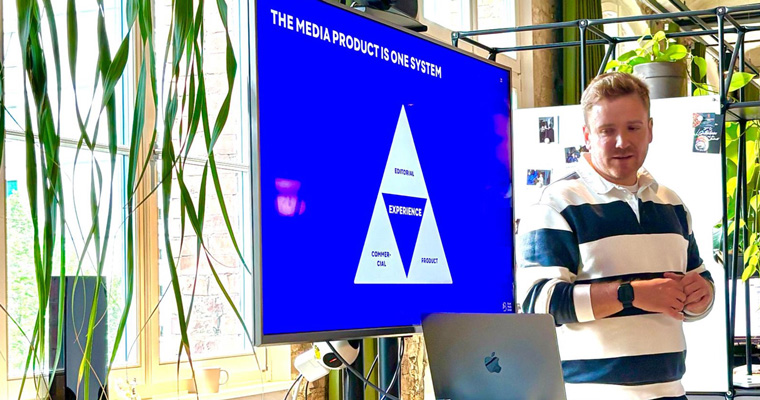
Instead of thinking of a video, an article, or a social media post as an asset, we need to consider our knowledge to be the asset that we are investing in, he said.
“If knowledge is our new asset, we need to get into a point where we can capture that knowledge in a system and then create value out of that, where the article, the video, whatever output format is just one small part of the equation and not the defining factor anymore.”
Instead, media brands should be thinking of how to reshape the “molecules” of information in different contexts and moments for different audiences, Semmler said.
Bauer was dealing with four different CMSs in two countries. They ended up reworking workflows from the ground up rather than simply trying to make existing products and processes work.
“We started with workflow optimisation. If you bring that already, no new platform, no AI tools in place will help you. They make you look a little bit better, but they won’t help you at all. So we looked at the workflow and awkward design.”
They also considered the structure of content: “How can we structure and semantically capture the knowledge behind it? Then we looked at how AI and agentic AI can help: How can we present that knowledge in different formats on different surfaces?”
The team spoke to hundreds of editorial staff over the past two years and found “we can really break the process and do new stuff. And how can we translate that into technology? This is what we just tested.”
When it came to reimagining future workflows, Bauer started from the ground up and noted the many steps of creating content — research, brainstorming, writing a briefing, planning, and finally writing the article itself.
“We saw there’s a lot of handovers and a lot of friction,” said Pascal Gemmer, principal at Forte Digital, which is working with Bauer on agentic AI. He noted that when ChatGPT was introduced in the newsrooms, the process didn’t change — it simply added another tool everyone had to use.
“And this is where we looked at and saw that we really need to think about how to completely reorganise the workflow,” he said. “Some of the stuff we’re doing is not necessary anymore because it can be done in the background. But some stuff has to be done in a completely different order, and new processes have to be in place.”
The result: five tools that help the newsroom. For example, one is a system that identifies trends, analyses them, and pushes that out to journalists every morning.
“By doing that, for each department, we were able to bring down the journalistic work every morning, six to eight hours down every day,” he said. “We also managed to create a briefing process with 150 identical workflow steps that is creating content briefings at scale.”
Bauer also uses AI to rewrite content in the style and voice of each of its brands. Journalists then go over the work and edit it.
“When we talked with our editorial teams, they came up with the concept that it’s like I have a junior editor journalist on my side doing some of the heavy lifting so that I can focus on my journalistic work as a journalist.”
Does this mean Bauer will produce far more articles? “It’s not about volume. It;s about specificity and precision,” Semmler said.
“This idea of single format articles being a thing … maybe I’m on a kind of topic page where every element that I see about, say, golf courses in the U.K. is tailored to my needs. Pulling all the information that is out there and not as we would have done it in the past. We would create an overview page for golf courses. Then we have for each golf course another article. Then we have for that sub-article sub-articles.
“I think this will collapse over time because the content can liquidly form into different areas, and AI is making it possible because it’s a large language model in the end, and it’s making it cheap.”
If you’d like to subscribe to my bi-weekly newsletter, INMA members can do so here.
Related Articles
-

Marketers should outsource tasks, not thinking
25 October 2026 -

AI’s effect on super user math
15 September 2026 -

At Mediacorp’s CNA, loyalty means giving audiences a reason to ...
20 August 2026 -

Tribun Network turns print “dots” into AI-powered insight
20 August 2026 -

Nation Media Group focuses editorial strategy on stories that m...
4 August 2026 -

Briefly News empowers journalists with AI tool suite Nova
4 August 2026 -

Indian Express builds a video-first future around trusted journ...
20 July 2026 -

Grupo RBS builds social-first video operation to expand audienc...
20 July 2026
Upcoming Events
-

Subscriber Acquisition Master Class
10-17 November 2026
-

Media Advertising Summit
New York, United States
07-10 December 2026
-

AI-Native News Product Master Class
18-25 February 2027
-

Media Subscriptions Summit
Oslo, Norway
08-12 March 2027
-

World Congress of News Media
New York, United States
25-30 April 2027
-

Branded Content & Partnerships Master Class
20-27 May 2027
-

Subscriber Retention Master Class
17-24 June 2027
-

Conferencia Latinoamericana
15-16 July 2027
-

South Asia News Media Festival
New Delhi, India
19-22 July 2027
-

Asia/Pacific News Media Summit
19-20 August 2027
-

CEO Roundtable at Kilkenny
Kilkenny, Ireland
24-26 August 2027
-

Media Innovation Week
Amsterdam, The Netherlands
27 September - 01 October 2027








