

The Guardian’s experimentation with video leads to new formats, audiences
Newsroom Innovation Initiative Blog | 26 August 2026

As news consumption around the world shifts toward digital, visual, and creator‑driven formats, news media organisations are learning how to adjust. During this week’s Webinar, Christian Bennett, executive editor at The Guardian, explained how this shift has inspired one of company’s most ambitious transformations in recent history.
Bennett detailed a newsroom-wide initiative called Project Berger that was created to help the 200‑year‑old institution adapt to a new reality of younger audiences, fragmented platforms, and an environment where video increasingly plays a key role in journalism consumption.
“We have a history of innovation,” Bennett noted, adding that in a time when “almost anyone’s our competitor,” traditional publishers can’t rest on what they’ve already done; they have to look at what’s next.
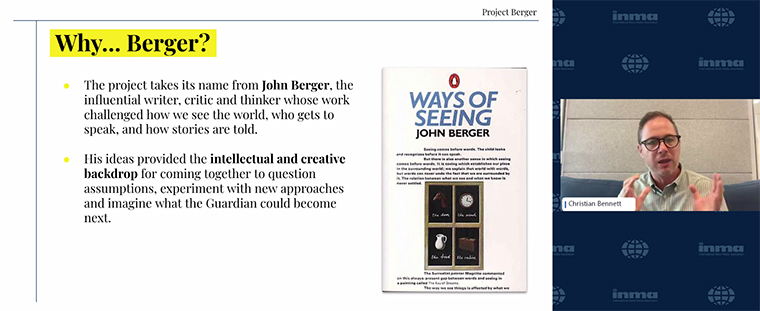
What’s in a name?
Bennett explained that Project Berger’s name is a nod to John Berger, the influential writer, critic and creator of Ways of Seeing, a television programme that later became a book.
“I think that’s quite a cool text-centric message to send out to a text-centric organisation: that intellectual thoughts can start off visually and be transferred to text. Text should not just be the default format for everything,” he explained, noting THE Guardian produces “two novels worth of text a day” but had been creating just a single Instagram video.
Despite its history of innovation, which included being early to the Internet and pioneering podcast formats, Bennett said The Guardian had become cautious. And when traditional publishers compare themselves only to traditional competitors, they risk losing their audience.
Project Berger responded to this reality by addressing recent shifts in audience behaviour, the rise of AI, and the explosion of misinformation and disinformation. It also recognises the change in how younger audiences consume news and what they expect from media organisations
The project’s goals are broad but clear: become more visual, more digital, more experimental, more global, more collaborative, more audience‑centric, and more sustainable. One key element is experimentation — something he said The Guardian had moved away from.
“I think we’ve got ourselves to the point where we just did stuff that we’d know had work, and if something failed, it felt catastrophic,” he said. “I think sometimes if you experiment, you have the right guardrails in how you experiment … you can get to some really interesting places.”
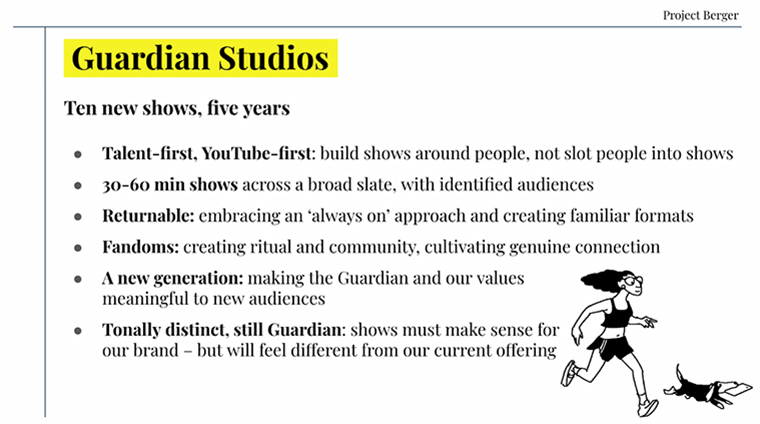
A studio for creators
One of the most significant components of Project Berger is Guardian Studios, which Bennett oversees. Guardian Studios is focused on developing ambitious video projects and shows that can compete with broadcasters and creator‑driven media.
The media landscape has changed so dramatically that young journalists no longer need legacy institutions to build an audience, Bennett said. They can create that on their own.
The Guardian realised it had to offer something meaningful to talent: the ability to create work they could not produce alone, supported by teams that understand social strategy, marketing, community building and commercial considerations.
The challenge is to pursue these opportunities without abandoning the Guardian’s identity. “You’re doing it in what looks and feels and is a Guardian way,” Bennett said.
The organisation has already begun experimenting across desks. It recognised the need to put its journalists front and centre, beginning with the international desk “because we have really brilliant reporters there already, and they’re used to doing stuff.”
Reporters were trained to script and film themselves on location while production and graphics were handled centrally. The reporters embraced the new approach, and The Guardian discovered new on‑camera talent.
The experiment brought fresh angles to reporting the organisation already pays for, and it helped audiences see how journalism is done in the field, Bennett said.
One of his favourite experiments involved longtime columnist Polly Toynbee, who has been writing for The Guardian for roughly 40 years. Her first Instagram video, which addressed intergenerational wealth, received more attention than almost any column she has ever written; only a column published immediately after Brexit got more views.
That demonstrated that even veteran journalists can reach new audiences when supported with the right tools and production expertise.
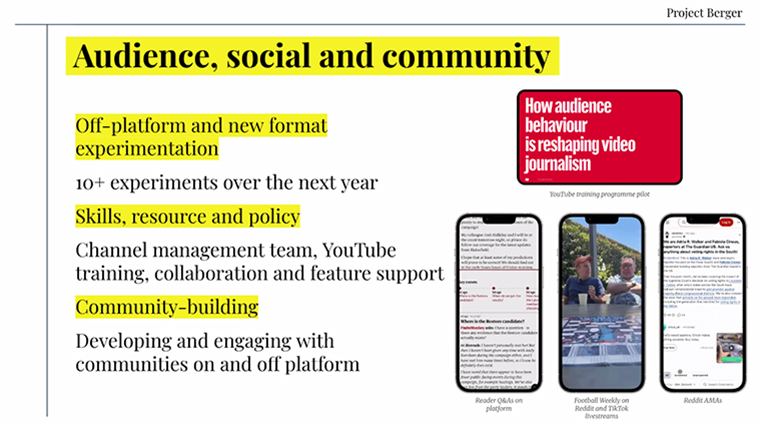
Taking experimentation farther
The Guardian also experimented during the Men’s World Cup, particularly with Football Weekly, its long‑running and highly popular sports podcast.
The company sent the hosts to Los Angeles and built a studio for them, but the most surprising success came from informal social media posts that showed the hosts living together and arguing over household chores. The posts drew hundreds of thousands of views and sparked playful debates among fans.
“It was this really kind of beautiful, authentic parasocial relationship, which I thought was really exciting,” Bennett said.
The Guardian also launched a Football Weekly Reddit community ahead of the tournament, “and it’s pretty much run by fans now.” It has more than 20,000 regular users, and the podcast frequently references discussions happening there.
In the United States, The Guardian built a social‑video‑first team focused on soccer. One of its first clips, showing a reporter attempting to walk to a stadium in New Jersey, earned 3 to 4 million views overnight.
“So it’s been a really interesting example of thinking about, OK, what is the best way to tell this story?” Bennett said. “We’re not going to default to text; we’re going to choose the best way, and we’re going to try and find an audience with it.”
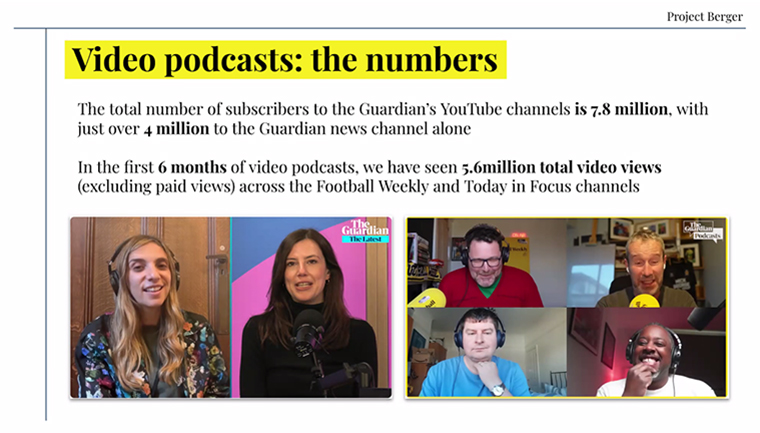
The rise of video podcasts has driven change over the past couple of years, forcing The Guardian to rethink how it produces audio. Football Weekly, which has been around for 20 years, had to be retrofitted for video.
The hosts, many in their 40s and 50s, had to learn to be authentic on camera without mimicking influencer culture. The transition was difficult for the production team, but the results have paid off: The show now has a growing audience watching on TV screens, and it has sold out live shows in New York, Dublin, and London.
Today in Focus, The Guardian’s daily news podcast, required a different approach. Its morning edition is narrative‑driven and did not translate easily to video, so the team created a second afternoon edition built specifically for studio video.
Bennett said the new edition “has absolutely flown,” and the organisation is now considering how to evolve the main show.
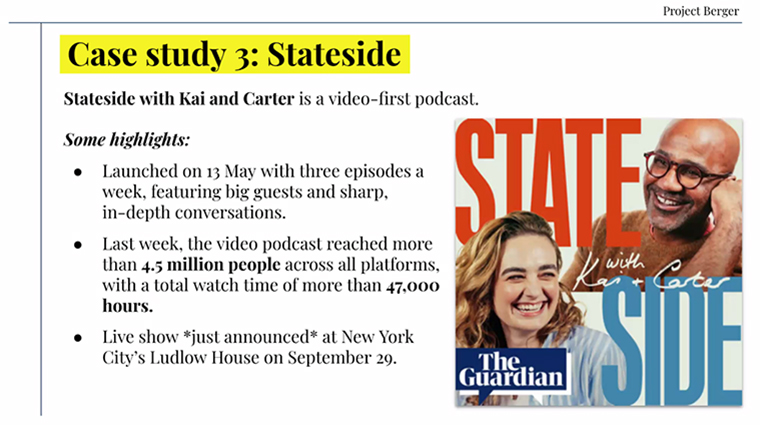
The Guardian also launched Stateside, its first U.S. video‑first podcast. Bennett said the project required rethinking everything from contracting to team structure to YouTube strategy. It has performed well so far, and he sees significant room for growth in the American market.
Project Berger represents a bold attempt to reshape The Guardian for a new era, one that caters to the digital habits of global audiences. Publishers who choose to do the same will need to experiment and find what works for their brand and their audience, Bennett said.
“What you don’t do is say, ‘Because that organisation over there does it like that, then I have to do it like that.’ You have to figure out what’s right for you and not be scared to tinker with it.”
Banner photo: Adobe stock by metamorworks.
Related Articles
-

AI’s effect on super user math
15 September 2026 -

What I told 40 CEOs (and won’t gatekeep from you)
30 August 2026 -

At Mediacorp’s CNA, loyalty means giving audiences a reason to ...
20 August 2026 -

Nation Media Group focuses editorial strategy on stories that m...
4 August 2026 -

Indian Express builds a video-first future around trusted journ...
20 July 2026 -

Economist launches subscription tier targeting younger audience...
20 July 2026 -

Grupo RBS builds social-first video operation to expand audienc...
20 July 2026 -

AI adoption in newsrooms should move from experiment to strateg...
12 July 2026
Upcoming Events
-

Subscriber Acquisition Master Class
10-17 November 2026
-

Media Advertising Summit
New York, United States
07-10 December 2026
-

AI-Native News Product Master Class
18-25 February 2027
-

Media Subscriptions Summit
Oslo, Norway
08-12 March 2027
-

World Congress of News Media
New York, United States
25-30 April 2027
-

Branded Content & Partnerships Master Class
20-27 May 2027
-

Subscriber Retention Master Class
17-24 June 2027
-

Conferencia Latinoamericana
15-16 July 2027
-

South Asia News Media Festival
New Delhi, India
19-22 July 2027
-

Asia/Pacific News Media Summit
19-20 August 2027
-

CEO Roundtable at Kilkenny
Kilkenny, Ireland
24-26 August 2027
-

Media Innovation Week
Amsterdam, The Netherlands
27 September - 01 October 2027








