

Two years in, YLE’s liquid content strategy evolves
Newsroom Innovation Initiative Blog | 19 May 2026
Many of us first heard the term “liquid content” on an INMA study tour of Helsinki in September 2024, when Mika Rahkonen, head of strategy at national broadcaster YLE,told us: “We are in an era of liquid content where we watch audio, listen to text, and read video.”
In other words, content that can take different forms and be served in different sizes at specific times or locations, representing a real convergence of different media. The goal is to stay relevant in a fragmented information ecosystem by fitting into customers’ lives more conveniently, allowing the content to find its audience rather than the audience having to find the content.
This concept shifts the focus away from the finished article, video, or social post as the product.
“When content becomes more like a modeling paste,” it unlocks a world of possibilities, said Rahkonen, who spoke at the INMA World Congress earlier this month, elaborating on a topic that he put on our collective radar 20 months ago.
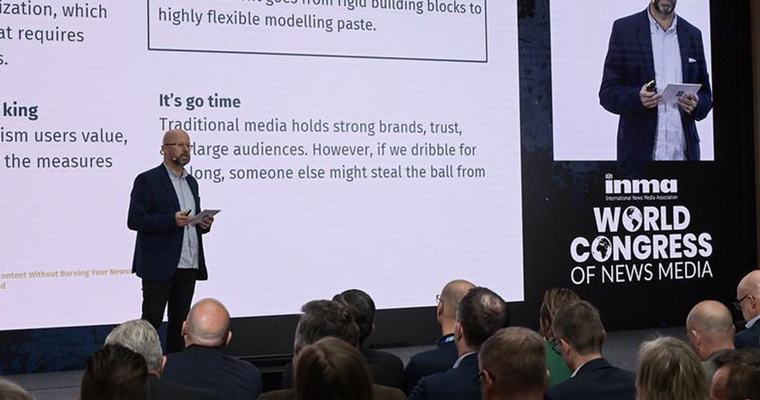
He sees it as the next step in personalisation, a journey YLE began 13 years ago when building its first personalised news algorithm. It seeks to personalise down to the specific content and context, not just topics.
Yet, this approach challenges the 150-year-old journalistic principle of defining the biggest stories according to the interest from — and meaning for — the largest audience.
Since the cost for AI-assisted production is near zero, “a story that reaches and engages a relatively small amount of people can have tremendous value to those people. That story would never have been made before. Now it costs next to nothing, maybe, so it can be done.”
Despite all this change, some concepts remain non-negotiable: Great original content, accuracy, and trust must remain in place, he said.
The newsroom’s strategy is shifting from asking people to come to them to going where the people are, Head of Newsroom Riina Malhotra said.
Implementing liquid content requires reversing the production process, she said. Instead of starting with a format (e.g., a video or text article), the journalist must start with the question: “What does this person actually need to know?”
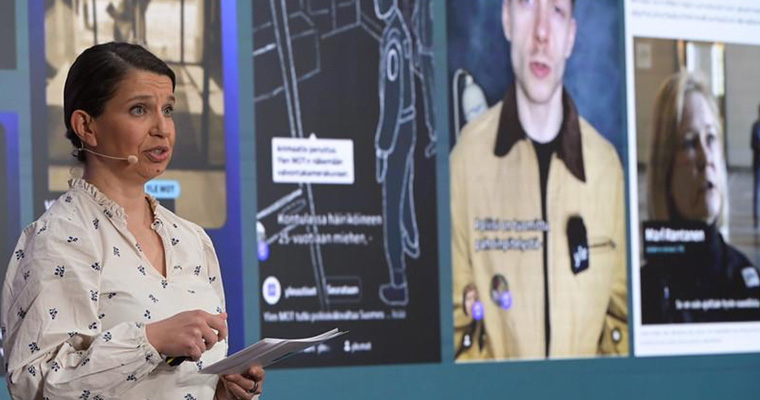
“Format follows need. We have been doing it the wrong way around,” Malhotra said. “It’s also a big chance — a big opportunity to stay relevant for the professional media when journalism can travel to where people already are and the forms that they take.”
Content needs to be optimised and broken into smaller pieces to be gathered in the right format, at the right time, for the right person. For example, a major investigative story was split into several articles, multiple videos, social media content, and programmes on broadcast TV and radio.
“Versioning must not be a journalist’s task,” Malhotra said. “It should be automated. Our best reporters should spend their time reporting, not copy-pasting the same stories into different systems.”
Journalists focus on the “human touch,” asking difficult questions, and providing context. AI can perform versioning, summarising, and optimising, but the human journalist is crucial because “AI can’t decide what matters.”
The shift to liquid content also necessitated an organisational shift, she said, pointing out that the newsroom needs to adopt an “our stories” mindset, moving away from “my stories and your stories.” Audience understanding is now an “editorial skill” understood by every journalist and editor.
If you’d like to subscribe to my bi-weekly newsletter, INMA members can do so here.
Related Articles
-

Marketers should outsource tasks, not thinking
25 October 2026 -

AI’s effect on super user math
15 September 2026 -

At Mediacorp’s CNA, loyalty means giving audiences a reason to ...
20 August 2026 -

Tribun Network turns print “dots” into AI-powered insight
20 August 2026 -

Nation Media Group focuses editorial strategy on stories that m...
4 August 2026 -

Briefly News empowers journalists with AI tool suite Nova
4 August 2026 -

Indian Express builds a video-first future around trusted journ...
20 July 2026 -

Grupo RBS builds social-first video operation to expand audienc...
20 July 2026
Upcoming Events
-

Subscriber Acquisition Master Class
10-17 November 2026
-

Media Advertising Summit
New York, United States
07-10 December 2026
-

AI-Native News Product Master Class
18-25 February 2027
-

Media Subscriptions Summit
Oslo, Norway
08-12 March 2027
-

World Congress of News Media
New York, United States
25-30 April 2027
-

Branded Content & Partnerships Master Class
20-27 May 2027
-

Subscriber Retention Master Class
17-24 June 2027
-

Conferencia Latinoamericana
15-16 July 2027
-

South Asia News Media Festival
New Delhi, India
19-22 July 2027
-

Asia/Pacific News Media Summit
19-20 August 2027
-

CEO Roundtable at Kilkenny
Kilkenny, Ireland
24-26 August 2027
-

Media Innovation Week
Amsterdam, The Netherlands
27 September - 01 October 2027








