

Why should readers choose us again?
Newsroom Innovation Initiative Blog | 27 September 2026

How are your newsrooms responding to the changing AI-driven information ecosystem? What kind of content are you prioritising now that search traffic is increasingly unreliable?
I am increasingly hearing that pageviews and impressions are no longer metrics that matter in many newsrooms. Instead, they are paying attention to markers of loyalty and retention.
How does this feed into content strategy?
I previously wrote about how some brands are focusing on needs served and utility. Here are two more case studies, one on loyalty and one on reader sentiment:
Focus on loyalty
At Mediacorp in Singapore, the newsroom is acutely aware of — and connected to — the broader information ecosystem because they understand traffic patterns have already changed.
The question the team asks is: “When audiences encounter us without visiting our homepage, how do we make them choose us again?”
“We used to think that good journalism would just bring readers to our Web site, but we know that really doesn’t work all the time anymore,” said Alvin Chong, supervising editor for growth and innovation. “If people don’t find our content where they already spend their day, then are we creating content in vain? Is this something that will just be lost in the wind every time we click publish?”
So, Mediacorp decided to engage its audiences in two ways: by going to them on platforms such as TikTok and by bringing them closer through its own products, such as interactive features on its Web site and app.
You’ve probably already read about their phenomenally successful Snackbot tool, which uses AI to coach journalists to produce more relevant vertical videos, and their FAST tool, which has deepened reader engagement and loyalty through summaries.
“We focus on video as an engine of liquid content,” Chong said, pointing out that video is full of reusable content that can be repurposed in different forms.
For example, the team cleaned up YouTube transcripts and embedded precise chapter markers and then used an AI agent to curate 240 episodes of a popular consumer-focused programme called Talking Point. Their audience could chat with it and get answers to questions, such as whether their towels were clean enough or which yogurt was healthiest. It also features quizzes and other interactive elements to engage users.
Mediacorp also built a tool that helps write an engaging blurb for an article to be shared on chat apps such as WhatsApp or Telegram. Now the bot has seen enough data to advise the newsroom on which post is likely to perform better than others.
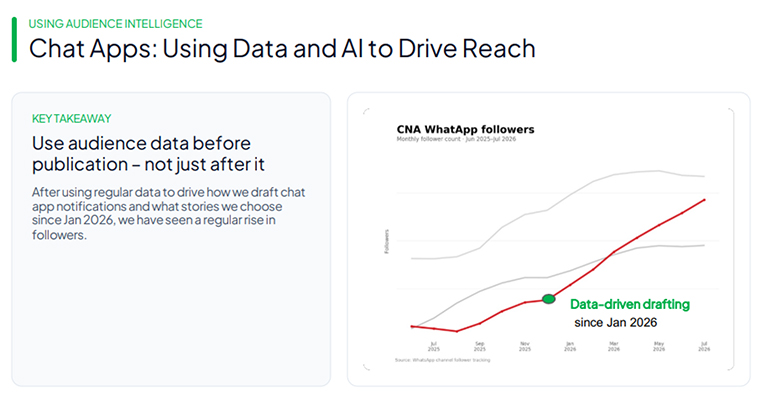
“Loyalty is repeated choice. It doesn’t mean a subscription — it can just be choosing to follow us on TikTok and keeping notifications switched on for WhatsApp or Telegram, coming back to CNA Fast again the next day, or playing another game,” Chong said.
“After every click, did we give the user a reason to choose us again?”
Focus on reader sentiment
Indonesia’s Tribun analyses reader sentiment to understand whether its journalism is resonating or whether coverage needs to be reshaped to be relevant.
“The future of media lies not in counting reach but in decoding audience signals and turning them into meaningful insight,” said CEO Dahlan Dahi. “As technology advances and disruption reshapes the industry, the challenge is no longer collecting data but how to connect digital, print, and user interaction data into meaningful insights.”
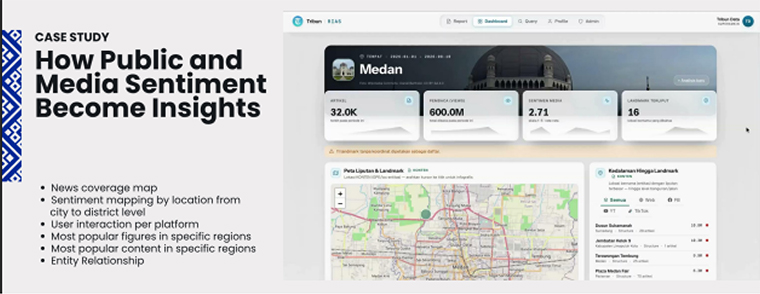
Tribun’s tool examines the sentiment in every piece of content published and also gauges public sentiment about that content through social media. It identifies cities, people, places, and things, and analyses which content and topics are relevant to them, then creates a knowledge graph, which AI then generates insights from.
“We don’t just cover Indonesia. We have built a network of sensors across the country,” Dahi said. “The signal tells the newsroom what their audience thinks, hopes, and feels.”
If you’d like to subscribe to my bi-weekly newsletter, INMA members can do so here.
Banner photo: Adobe stock image by AntonioDiaz.
Related Articles
-

What 11 Bay Area companies agree on about news in the AI era
26 October 2026 -

Marketers should outsource tasks, not thinking
25 October 2026 -

WSJ executive councils show how publishers build communities th...
19 October 2026 -

The front door is gone — and Asia-Pacific publishers are rebuil...
26 August 2026 -

BusinessDay moves from business content to business intelligenc...
6 August 2026 -

Estrategia & Negocios reinvents itself into a profitable 360-de...
23 July 2026 -

The reality check of user needs: “Update me” drives most demand...
13 July 2026 -

10 years later, user needs must be twinned with content formats...
1 July 2026
Upcoming Events
-

Subscriber Acquisition Master Class
10-17 November 2026
-

Media Advertising Summit
New York, United States
07-10 December 2026
-

AI-Native News Product Master Class
18-25 February 2027
-

Media Subscriptions Summit
Oslo, Norway
08-12 March 2027
-

World Congress of News Media
New York, United States
25-30 April 2027
-

Branded Content & Partnerships Master Class
20-27 May 2027
-

Subscriber Retention Master Class
17-24 June 2027
-

Conferencia Latinoamericana
15-16 July 2027
-

South Asia News Media Festival
New Delhi, India
19-22 July 2027
-

Asia/Pacific News Media Summit
19-20 August 2027
-

CEO Roundtable at Kilkenny
Kilkenny, Ireland
24-26 August 2027
-

Media Innovation Week
Amsterdam, The Netherlands
27 September - 01 October 2027








