

How long is the shadow of The New York Times’ paywall?
Readers First Initiative Blog | 24 August 2026

News publishers have spent years optimising what happens when a reader hits a paywall. The New York Times is now testing what happens before the reader clicks.
In August, I noticed an experiment on The Times’ home page, shown to a non-logged-in user in the United Kingdom. A prominent module announced: “These top stories are free to read.”
Individual links carried the same promise. After clicking, the reader reached a registration wall: “This story is free to read. Log in to continue.”
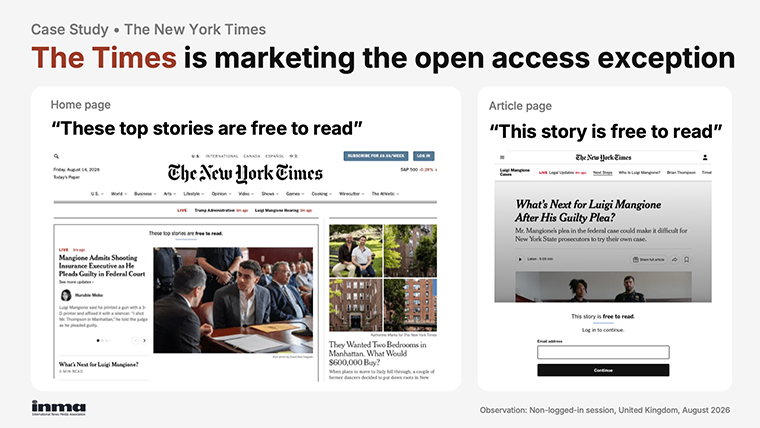
Free access in exchange for registration is not new at The Times. The explicit promotion of free access on the homepage, the newspaper’s most valuable estate, is. And it points at a problem created, paradoxically, by paywall success.
The shadow of the paywall
Every publisher with a paywall operates two of them.
The first is the one configured in their tech stack — what content or features are locked, for whom, and what would it cost to unlock it. Publishers obsessively measure stop rates, checkout starts, conversion rates, and so on.
The second paywall is the one consumers build in their heads. Every hit on a locked article teaches the reader which publishers and which kinds of links will be blocked. Readers act on that expectation before the publisher can show a barrier and its offer.
I call it the shadow of the paywall. The stronger and more familiar the actual paywall, the longer its shadow.
How long is the shadow?
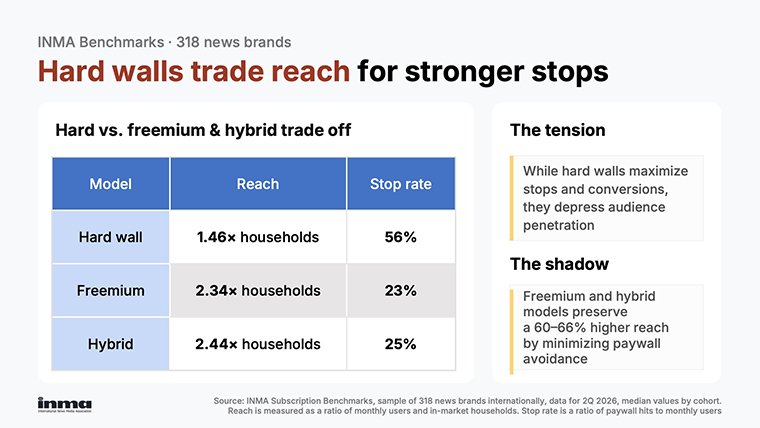
Using the paywall performance data from 318 news brands benchmarking with INMA, we can estimate the scale of paywall avoidance.
In Q2 2026, most news Web sites with hard walls were stopping at least 56% of users monthly, while most sites with freemium or hybrid walls — 25% or fewer users.
The freemium or hybrid-walled sites enjoyed 67% higher online reach, measured in household penetration, than the hard-walled sites.
The psychological barrier extends into promotional channels. Claudio Cabrera, vice president of newsroom strategy and audience at The Athletic, described the effect on the newsletter links at the INMA Media Subscriptions in Toronto earlier this year: “People don’t even click if they expect to hit a paywall.”
(The Athletic’s answer was to label free links explicitly in its flagship newsletter, The Pulse.)
A 2021 study in the Journal of Informetrics tested clicks on social media links to the same scientific articles with free versus paid access labelling. The links labeled “Open access” drew, on average, twice the clicks. The performance dropped substantially when a post did not say the article was freely accessible.
If effects of this order hold in news, the shadow paywall may be suppressing more demand than the real one stops.
Getting out of the shadow
The shadow of the paywall is formed by signals, which means it can be managed with signals.
The Times’ “Free to read” label is a marketing message designed to lower the anticipated cost of the click. Conversely, “Subscriber exclusive,” “Premium,” “Plus,” and the lock icons send two signals at once:
To subscribers: This is the distinctive journalism you pay for.
To non-subscribers: You probably cannot read this.
The same badge raises the shadow for one group and reinforces value for the other.
Hence the experiments across the industry: lock icons swapped for “keys” or “diamonds,” premium markers shown to subscribers but hidden from logged-out users.
The Times test suggests a third approach: Instead of marking every closed article, market the open exceptions. It preserves the assumption that most of the product is paid while cutting visible doorways through the shadow.
Greg’s Readers First newsletter is a public face of a revenue and media subscriptions initiative by INMA, outlined here. INMA members can subscribe here.
Related Articles
-

Bundling is a pricing decision, rebundling is an organisational...
18 October 2026 -

Sports brand AS cannot sell subscriptions, so it sells scale
21 September 2026 -

Legacy, history are key to Corriere della Sera's digital subscr...
17 September 2026 -

AI’s effect on super user math
15 September 2026 -

How the Daily Maverick built a reader revenue engine on trust
5 August 2026 -

Subscription benchmarks reveal dynamic strategies set top news ...
15 June 2026 -

Washington Post research shows flexible access drives growth
8 June 2026 -

Sydney Morning Herald expands into underserved communities, sub...
7 June 2026
Upcoming Events
-

Subscriber Acquisition Master Class
10-17 November 2026
-

Media Advertising Summit
New York, United States
07-10 December 2026
-

AI-Native News Product Master Class
18-25 February 2027
-

Media Subscriptions Summit
Oslo, Norway
08-12 March 2027
-

World Congress of News Media
New York, United States
25-30 April 2027
-

Branded Content & Partnerships Master Class
20-27 May 2027
-

Subscriber Retention Master Class
17-24 June 2027
-

Conferencia Latinoamericana
15-16 July 2027
-

South Asia News Media Festival
New Delhi, India
19-22 July 2027
-

Asia/Pacific News Media Summit
19-20 August 2027
-

CEO Roundtable at Kilkenny
Kilkenny, Ireland
24-26 August 2027
-

Media Innovation Week
Amsterdam, The Netherlands
27 September - 01 October 2027








