

News check-outs have overtaken online retail
Readers First Initiative Blog | 08 September 2026

New INMA research shows the last step of the subscription sale has nearly quadrupled in efficiency in 10 years and more than doubled in the last two years. But the gap between performances of individual publishers remains massive.
The Baymard Institute has tracked e-commerce cart abandonment across 50 studies and found it sitting stubbornly around 70% for two decades. This means roughly three shoppers in 10 finish what they start.
Online retail used to outperform news publishers: When Harvard’s Shorenstein Center analysed U.S. metropolitan newspaper data from the 2010s, only 9.9% of those who entered the flow on desktop finished it. On mobile it was five times worse again.
News check-out flows have improved dramatically since then, and today they are more efficient than in retail!
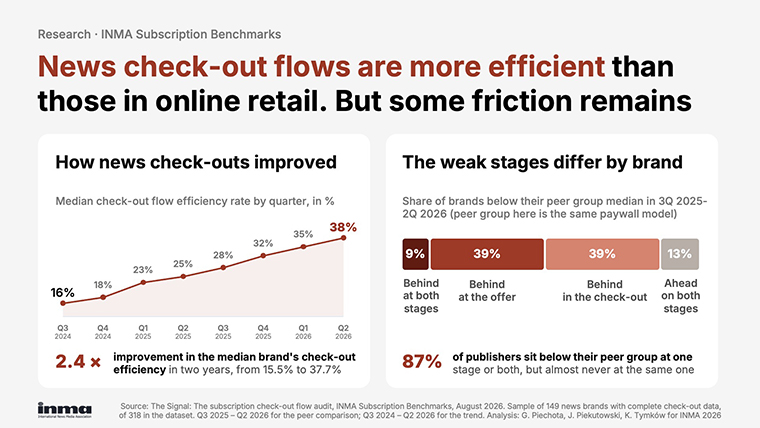
Among the 149 news brands that reported complete check-out data, out of 318 in the INMA Subscription Benchmarks dataset, the median brand’s check-out flow efficiency has more than doubled in the past two years alone and reached 38% in Q2 2026.
We calculate check-out flow efficiency as the share of users who complete the purchase started, for example, by clicking “Subscribe” on the paywall.
The performance gaps
The new Signal report, published in August and available for the companies benchmarking with INMA, showed the check-out flow improvement has not been evenly distributed.
When we measured the whole journey, from the paywall stop to the purchase success page, the strongest publishers (top 10%) converted five times the share of stopped readers as the weakest (bottom 10%).
That gap is not explained by market characteristics, and it persists inside every segment. This means the gap is likely executional.
The sale has two key moments of truth:
First the offer: A reader meets the wall, looks at what is on sale, and decides whether to start the check-out.
Then the actual check-out flow: They have begun, and now have to get through the customer data form and the payment.
We scored every brand against others running the same paywall model, and called a stage “behind” when a brand sat below its peers’ median on it:
39% are behind at the offer.
39% are behind in the check-out.
9% are behind at both.
13% are ahead on both.
This insight is useful for optimising the offer and the flow. If readers are not opening your check-out in the first place, no amount of form-trimming will move your numbers. The work is the offer page, the plans you show, the price architecture, and which readers see the wall and when.
The most encouraging finding is how rarely a publisher is bad at everything. When we tightened the test — whether you are below the bottom quartile of your peer group rather than below its median — not one brand in the study sat in the bottom quartile at both stages.
Weakness, it turns out, is specific. So the fix usually is, too.
What to do
Three practical recommendations from the new INMA report:
Find out which stage you are losing people at before you commission any work. The two stages may sit side by side on a dashboard and behave nothing alike.
Focus on the biggest obstacles. Across the case studies in INMA’s archive, the changes that removed a whole step — for example, removing a mandatory registration from the purchase flow — were worth several times more than the ones that tidied an existing flow.
Measure your payment declines. A meaningful share of the people your funnel counts as abandoners never chose to abandon at all. Their bank refused the card. Interestingly, payment methods see different decline rates at sign-up and renewal.
Greg’s Readers First newsletter is a public face of a revenue and media subscriptions initiative by INMA, outlined here. INMA members can subscribe here.
Banner photo: Adobe Stock by Sergey.
Related Articles
-

Bundling is a pricing decision, rebundling is an organisational...
18 October 2026 -

7 themes from Madrid show publishers trading traffic for relati...
28 September 2026 -

AI’s effect on super user math
15 September 2026 -

What I told 40 CEOs (and won’t gatekeep from you)
30 August 2026 -

Economist launches subscription tier targeting younger audience...
20 July 2026 -

10 years later, user needs must be twinned with content formats...
1 July 2026 -

News publishers leverage audience insights to build deeper rela...
23 June 2026 -

Bonnier News Local, Gota Media strike gold with their Core Mode...
21 June 2026
Upcoming Events
-

Subscriber Acquisition Master Class
10-17 November 2026
-

Media Advertising Summit
New York, United States
07-10 December 2026
-

AI-Native News Product Master Class
18-25 February 2027
-

Media Subscriptions Summit
Oslo, Norway
08-12 March 2027
-

World Congress of News Media
New York, United States
25-30 April 2027
-

Branded Content & Partnerships Master Class
20-27 May 2027
-

Subscriber Retention Master Class
17-24 June 2027
-

Conferencia Latinoamericana
15-16 July 2027
-

South Asia News Media Festival
New Delhi, India
19-22 July 2027
-

Asia/Pacific News Media Summit
19-20 August 2027
-

CEO Roundtable at Kilkenny
Kilkenny, Ireland
24-26 August 2027
-

Media Innovation Week
Amsterdam, The Netherlands
27 September - 01 October 2027








