

News publishers leverage audience insights to build deeper relationships
Readers First Initiative Blog | 23 June 2026




News companies are fighting for audience attention in an increasingly fragmented media landscape.
During the INMA Subscriber Retention Master Class, media leaders shared how news organisations can build deeper audience relationships by understanding the role of super users, assessing and improving the onboarding experience, developing audience personas, and driving newsletter engagement.
The power of the super user
As overall media engagement declines, a new superhero appears to be emerging for news media organisations: the super user. Based on INMA’s benchmarking studies, the super user has been “one of the biggest discoveries of the past year,” said Greg Piechota, INMA’s researcher‑in‑residence and lead of the Readers First Initiative.
He told members the rise of this not-so-mythical creature could be the key to generating pageviews and revenue. Super users, he noted, are “users who are very engaged with media … these people are the most valuable consumers across goods and services.”
Although their percentage is small, their impact is not; these highly engaged readers who drive a disproportionate share of revenue. Across 317 brands INMA studied, Piechota said the research found:
- Subscribers generate 10 times as many sessions as the average user.
- They view 15 times more pages.
- They spend three times the amount of time on Web sites.
And because of this, their collective impact is enormous. For the median news site, 1% of users — the subscribers — generate 26% of all pageviews. For top‑quartile sites, that number jumps to 42%.
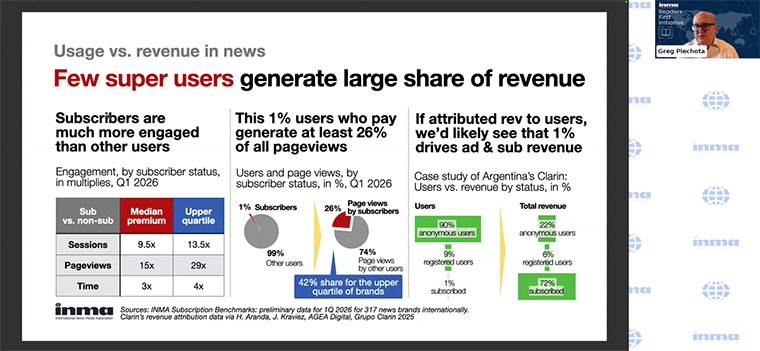
“Clearly, these are the people who generate most of the money that pays for your business,” Piechota said. “It might be very few of them, but of course the question would be: If we want to grow the business, how do we get more super users?”
The answer to that question surprised even Piechota: reach.
In INMA analysis of what correlates most strongly with the number of heavy users (defined as users with at least 10 sessions per month), the clearest predictor was simply the size of the overall audience. Publishers with more users had more heavy users — consistently, across markets and brands.
For news publishers, this is a profound shift in thinking. Loyalty is not something manufactured through product features alone; it is something harvested from a large pool of casual users.
The Guardian redesigns its onboarding programme
The Guardian is redesigning onboarding to become a long-term retention strategy rather than a short-term activation programme.
Data showed the most significant retention decline occurs during the first four months after someone becomes a supporter.
Aislinn Mallon, head of CRM at The Guardian, and Yvienne Ribao, senior CRM manager, said rather than viewing onboarding as a 14-day programme, The Guardian began looking at it as a critical early-life period during which long-term habits are formed.
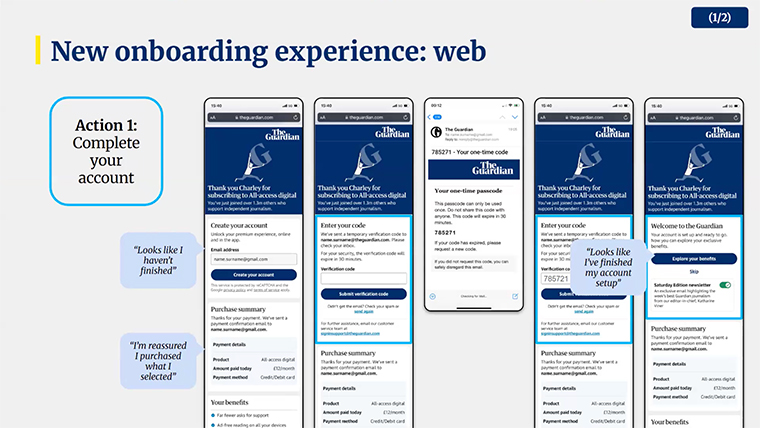
“The goal here is to ensure supporters continue finding value well beyond their first month,” Ribao said.
Like many onboarding experiences, the post-purchase landing page suffered from an abundance of competing calls to action.
New supporters were presented with numerous options before they had even completed basic setup. In some cases, they were asked to sign in again after finishing the purchase process, creating unnecessary friction at a moment when enthusiasm should be highest.
Instead of treating onboarding as a product catalogue, The Guardian now reveals benefits progressively and uses behavioural signals to determine what supporters see next.
The goal became encouraging behaviours that are associated with stronger retention outcomes. The Guardian refers to these as “high-value actions” — engagement signals that indicate a supporter is becoming more deeply connected to the brand.
Throughout months two, three, and four, supporters continue receiving prompts to activate benefits and discover new ways to engage with The Guardian’s journalism. Weekly communications highlight different sections of the site, newsletters, podcasts, and other editorial offerings.
The goal is not to drive one-off interactions but to establish routines.
Early indicators suggest progress. The new onboarding experience has produced an 87% sign-in rate within the first 24 hours, an increase of 7.3 percentage points compared with previous performance. The Guardian has also seen improvements in app adoption, with 35% of supporters downloading apps within their first 10 days.
Wall Street Journal develops audience personas
Vivyan Tran, director of content strategy at the The Wall Street Journal, described how the U.S. publication built five audience personas from the ground up and embedded them into the daily editorial workflow of a newsroom with over four million subscribers.
“Our audience is not a monolith,” Tran said. “They have very different needs, and there are many different things and feelings about what they need from us.”
The five segments are explorers, pre-suites, current core, next gen, and C-suite.
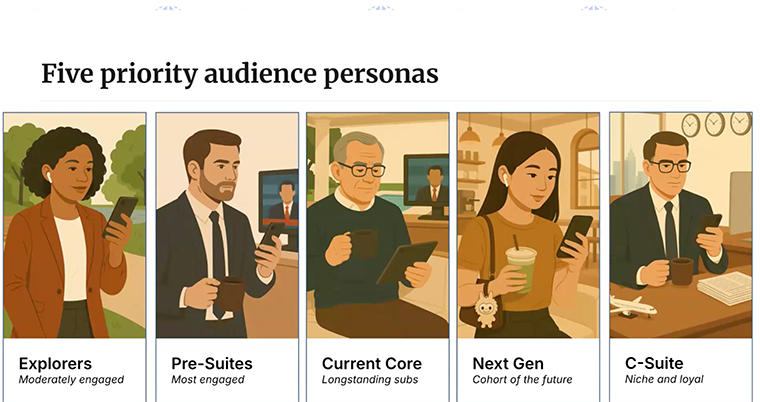
After building the segments, the team’s priority was getting them into the hands of editors in a usable form.
The Wall Street Journal moved away from raw pageviews and built a contextual metrics dashboard that gives stories a score from one to five across four measures: subscriber interest, engaged time, purposeful reach, and conversion rate.
A four or five means the story overperformed relative to expectations; a one or two means it underperformed; a three means it performed as expected.
“When I’m looking at page views, I don’t have context for this,” Tran said, describing the problem the dashboard was designed to solve. “Is this a good number? Is this a bad number? Because at the end of the day, a number without context doesn’t mean much.”
The personas are now informing new editorial initiatives. The team is investing in more visual storytelling to bring in next gen and explorer readers, doubling down on personal finance and careers coverage for lighter readers, and thinking through how to repackage ambitious journalism across formats to extend its reach.
“A busy pre-suite might want to read the data-led chart version,” Tran said, “or an explorer might want to watch a reporter-led vertical video on it.”
The next phase is extending persona thinking into products. Tran said the team is looking across the portfolio of newsletters and other products to think through which persona each one primarily serves and how to optimise for that audience without being exclusionary: “That’s going to be our prime target and everyone else who comes in, we're really happy to have them.”
Newsletters drive retention at Die Welt
Die Welt, the premier publication for Axel Springer, has a portfolio of 22 newsletters, most of which are free, covering news, politics, finance as well as lifestyle content such as health, culture, and entertainment. Newsletters serve as a retention engine thanks to the variety of content offered and curated.
“We see that a digital subscriber who also signed on for one or more of our newsletters has a three times higher retention rate than subscribers that don't have that,” Nikias Thißen, director of paid content at Axel Springer, said.
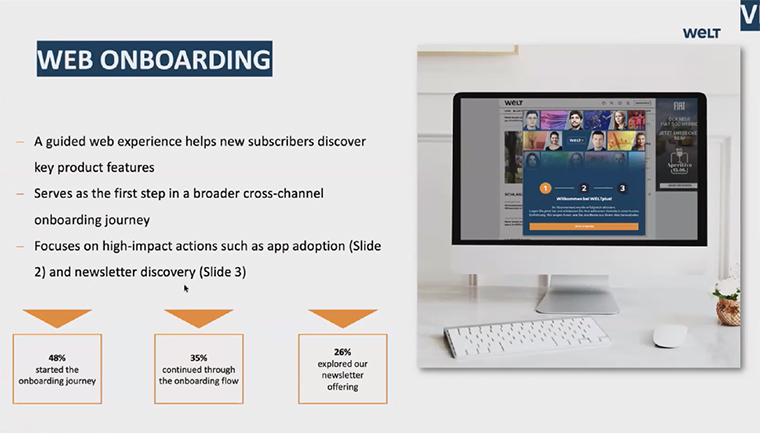
Most subscribers are acquired from Die Welt’s Web site and there is a “focus on features that are actually linked to a long-term engagement.” Such features include push notifications and a discovery tool for subscribers to find relevant newsletters.
“We just know through data that if people are subscribing to newsletters, they are staying longer, so the retention is actually so much better for us,” Violetta Michel, senior CRM marketing manager at Axel Springer, said.
Related Articles
-

Bundling is a pricing decision, rebundling is an organisational...
18 October 2026 -

7 themes from Madrid show publishers trading traffic for relati...
28 September 2026 -

AI’s effect on super user math
15 September 2026 -

What I told 40 CEOs (and won’t gatekeep from you)
30 August 2026 -

Economist launches subscription tier targeting younger audience...
20 July 2026 -

Inside Denník N’s successful subscription strategy
15 July 2026 -

10 years later, user needs must be twinned with content formats...
1 July 2026 -

Hamburger Abendblatt unlocked a 20% subscription uplift with we...
14 June 2026
Upcoming Events
-

Subscriber Acquisition Master Class
10-17 November 2026
-

Media Advertising Summit
New York, United States
07-10 December 2026
-

AI-Native News Product Master Class
18-25 February 2027
-

Media Subscriptions Summit
Oslo, Norway
08-12 March 2027
-

World Congress of News Media
New York, United States
25-30 April 2027
-

Branded Content & Partnerships Master Class
20-27 May 2027
-

Subscriber Retention Master Class
17-24 June 2027
-

Conferencia Latinoamericana
15-16 July 2027
-

South Asia News Media Festival
New Delhi, India
19-22 July 2027
-

Asia/Pacific News Media Summit
19-20 August 2027
-

CEO Roundtable at Kilkenny
Kilkenny, Ireland
24-26 August 2027
-

Media Innovation Week
Amsterdam, The Netherlands
27 September - 01 October 2027








