

AI-assisted coding helps VG create content readers can interact with
Audio & Video Innovations | 01 June 2026

What happens when readers get a useful version of the news before they ever reach us?
AI assistants already summarise, translate, and repackage information. Personal agents may soon deliver news in the format, tone, and length each user prefers.

The threat is not only that our journalism may be summarised elsewhere. It is that the habit of navigating to us weakens.
So, the strategic question becomes urgent: If AI can deliver the facts, what can our own environments deliver that a summary cannot?
One answer is experience: journalism readers can use, explore, test, remember, or apply.
Beyond passive formats
The Reuters Institute’s 2026 Trends and Predictions report found that 75% of media leaders expect agentic AI tools to have a large or very large impact on the news industry. Many publishers are responding by investing more in video and audio. That makes sense. Video provides presence; audio offers intimacy.
But if these formats remain passive, they do not fully answer the bigger strategic challenge: What kind of relationship are we creating with the user?
In an AI-shaped news environment, the competitive edge will not be information alone. It will be what trusted journalism helps people do with information.
A summary can give someone the main points. It is much harder to replace the value of a tool a reader used, a choice they made, a question they answered, or a game that helped them remember something.
From consumption to participation
Digital publishing has long been built around consumption. We publish, and readers read, watch, or listen. We measure attention.
Participation changes that exchange. When readers take part, they create signals of value: what they are trying to understand, where they hesitate, what they need help with, and what feels relevant to their lives.
Done responsibly, the reader gets something useful back. The publisher gains a clearer understanding of user needs, builds stronger direct relationships, and creates products that are harder to replace with a generic AI summary.
Editorial should be asking what the reader is trying to understand, decide, remember, or do — and could this story help them do it?
AI lowers the threshold for testing
In my experiments at VG, one question has proved especially useful: What if this story becomes something readers can experience and not only read?
AI-assisted prototyping — some call it “vibe coding” — makes that question easier to test by turning an idea into something clickable before it becomes too abstract, too expensive, or too late.
This does not replace developers, review, or quality control. However, it lowers the threshold for testing tools, games, calculators, timelines, and scenarios around our journalism.
5 ways experiences can add value
These VG experiments are not grand solutions. They are small attempts to uncover the experience inside a story.
1. Atmosphere
One early experiment I did was add a button that made snow fall inside a Christmas-related article.
It was technically modest, but it changed the article from something readers only consumed into a place where something happened. Interaction can create mood, presence, and occasion.
2. Utility
The Screen Check was a tool based on Norwegian health authorities’ advice on children’s screen time. Instead of only explaining the recommendations about screen time, we built a tool allowing parents to enter a child’s age, answer a few questions, and receive relevant guidance.
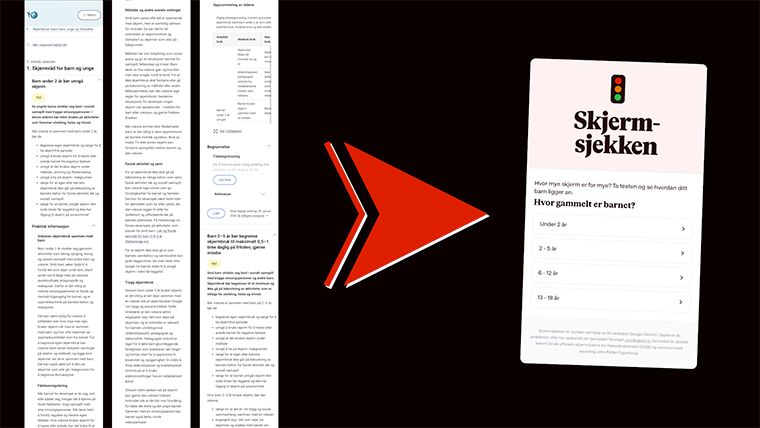
The point was not entertainment. It was public advice turned into a service. It offered verified information, expert knowledge, and editorial judgment parents could apply to their own lives.
3. Social use
We created a dating story that became a digital card game with 100 questions readers could use together. This turned lifestyle journalism into something social and not just something to read alone.
4. Memory
For International Women’s Day, we offered a timeline game that encouraged readers to place female pioneers in the correct year. Instead of asking readers to scroll through history, we asked them to test what they knew.
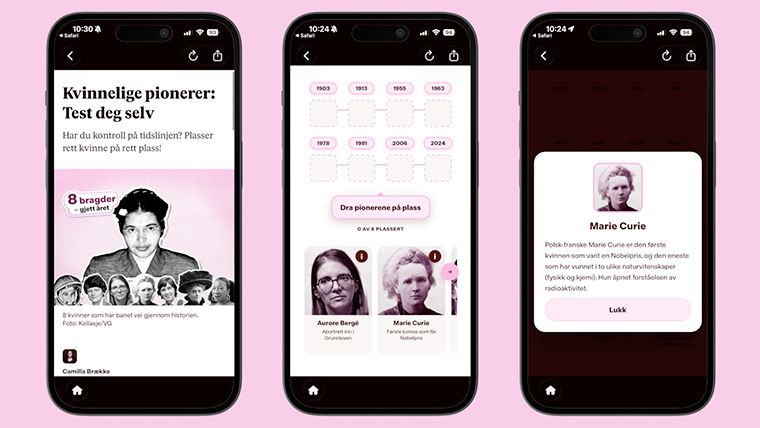
The game mechanic was not decoration. It helped readers think, guess, fail, adjust, and remember.
5. Easy-to-apply advice
In a story about getting children to clean their rooms, we used AI-assisted coding to turn psychologist advice into clickable examples: what parents often say, what they could say instead, and why the difference matters.
A small clean-up game let readers feel the chaos the article described, while visual expert bios compressed background information.
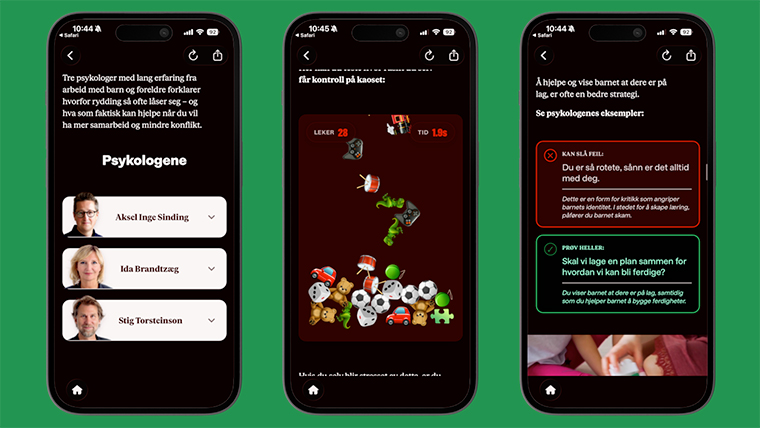
The result was not a bigger article but a more usable one by incorporating expert journalism readers could test, touch, and apply.
The strategic value
Across these experiments, the real value was not the technology. It was the shift in the reader’s role.
A passive article may tell us that someone clicked. An interactive experience can tell us more about what users are trying to understand, decide, or solve.
Not every article should become interactive, but some stories can do more. A calculator can make an economic story personal, a timeline can make a long-running story understandable, a game can make knowledge memorable, and a decision tool can make public advice useful.
The value is not interactivity itself. It is what participation makes possible: relevance, memory, usefulness, and a stronger direct relationship with the reader.
The strategic boundary
AI can help us build and test faster. But it does not understand the journalism, the brand, or the audience relationship for us. It cannot decide what is editorially justified, trustworthy, or ready to publish.
This is why AI-assisted prototyping needs editorial control. A prototype may be quick, but publishing is slow for a reason.
Every experiment teaches us what AI is good at, where it fails, what must be solved manually, and when a developer needs to take over.
Often, the work has to be split into smaller tasks. Sometimes the best result comes from combining AI, editorial judgment, design instincts, and ordinary manual craft.
AI democratises the first draft of code, but it does not democratise accountability.
A destination worth returning to
The article is not dead. Reporting is not less important. Trust, verification, and editorial judgment matter more, not less, in an AI-driven information environment.
However, the article may no longer be enough on its own.
If AI assistants can deliver a useful summary before readers reach us, our own environments need to offer something more distinctive: not just what happened but ways to understand why it matters. Sometimes that will be a beautifully written story, video, audio, or analysis. Sometimes it will be a tool, a game, a test, a timeline, or an experience readers can step into.
AI can summarise an article. It is much harder to replace what a reader has understood, chosen, tested, remembered, or used.
Related Articles
-

Marketers should outsource tasks, not thinking
25 October 2026 -

AI’s effect on super user math
15 September 2026 -

At Mediacorp’s CNA, loyalty means giving audiences a reason to ...
20 August 2026 -

Tribun Network turns print “dots” into AI-powered insight
20 August 2026 -

Nation Media Group focuses editorial strategy on stories that m...
4 August 2026 -

Briefly News empowers journalists with AI tool suite Nova
4 August 2026 -

Grupo RBS builds social-first video operation to expand audienc...
20 July 2026 -

AI adoption in newsrooms should move from experiment to strateg...
12 July 2026
Upcoming Events
-

Subscriber Acquisition Master Class
10-17 November 2026
-

Media Advertising Summit
New York, United States
07-10 December 2026
-

AI-Native News Product Master Class
18-25 February 2027
-

Media Subscriptions Summit
Oslo, Norway
08-12 March 2027
-

World Congress of News Media
New York, United States
25-30 April 2027
-

Branded Content & Partnerships Master Class
20-27 May 2027
-

Subscriber Retention Master Class
17-24 June 2027
-

Conferencia Latinoamericana
15-16 July 2027
-

South Asia News Media Festival
New Delhi, India
19-22 July 2027
-

Asia/Pacific News Media Summit
19-20 August 2027
-

CEO Roundtable at Kilkenny
Kilkenny, Ireland
24-26 August 2027
-

Media Innovation Week
Amsterdam, The Netherlands
27 September - 01 October 2027








