

New case for subscription growth built on reach, relationships, and super users
World Congress Blog | 10 May 2026

The next phase of subscription growth will depend less on tightening paywalls and more on expanding reach, building emotional relationships with audiences, and better serving “super users” — the highly engaged consumers who drive disproportionate value for publishers, according to INMA Readers First Initiative Lead Greg Piechota.
In a wide-ranging presentation during the INMA World Congress of News Media in Berlin last week, Piechota outlined how audience behaviour, fragmented discovery, and changing platform dynamics are forcing publishers to rethink subscription strategies.
Drawing on new INMA benchmarking data, retailer loyalty research, and case studies from publishers around the world, he urged media executives to move beyond thinking about subscriptions as simple transactions.
“This is the reason we need to be sustainable in the future,” Piechota said. “This is the reason we need to grow audience, grow brand, grow revenue.”

Journalism’s mission and the economics behind it
Reflecting on the release of Gazeta Wyborcza journalist Andrzej Poczobut after five years in prison in Belarus, Piechota used the moment to remind delegates why sustainable journalism businesses matter.
He quoted Poczobut as saying: “I’m just an ordinary person who, in indecent times, tries to remain decent. That is both so little and so much.”
He then turned to the economics of the modern news business, sharing INMA benchmark data showing readers now fund roughly 60% of publisher revenues globally, while advertisers account for about 30%. Piechota also said 22% of business units in INMA’s benchmarks generated digital revenues higher than editorial costs.
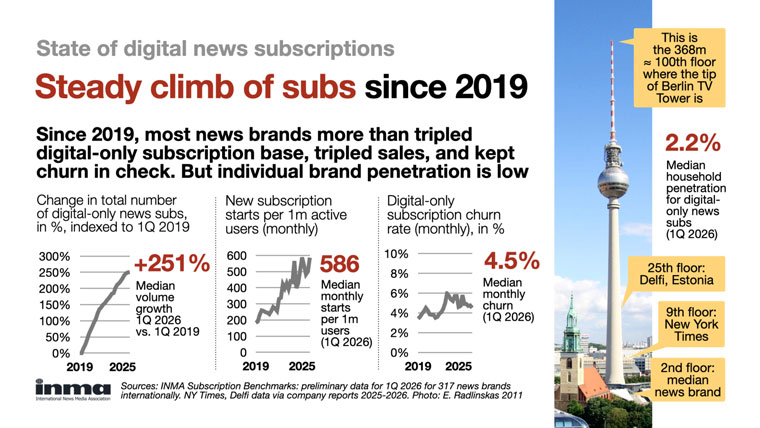
Digital subscriptions have steadily grown since 2019, he said, with many publishers tripling their subscription bases while maintaining relatively low churn. Yet he argued the industry still remains early in its digital subscription journey.
“The median publisher … it’s just 2%,” Piechota said, comparing subscription penetration against households. “Those publishers are basically on the second floor.”
Why audience scale still matters
One of the central themes of the presentation was the importance of audience scale. According to Piechota, publishers with the fastest subscription growth in 2025 were not necessarily those with the strictest paywalls or highest prices, but those that maintained or expanded their audience reach.
“What really differentiated fast growers was that they had more users,” he said.
Piechota challenged a common industry narrative that loyalty matters more than reach, presenting research suggesting the two are deeply connected. Referencing retail marketing studies by Byron Sharp and benchmarking data from hundreds of publishers, he argued that larger brands naturally generate more loyal users.
“If you tell me these things are connected — empirically connected — we can see it in the data,” Piechota said. “Being on top of mind of someone, being widely available, being easy to buy is super important for the growth of the business.”
He also pointed to operational friction in subscription sales, saying publishers still lose too many potential subscribers during checkout and registration processes.
The growing importance of “super users”
The presentation repeatedly returned to the concept of “super users” — highly engaged audience members who subscribe, spend more time with content, and often drive both advertising and subscription revenues.
Across 300 brands studied by INMA, Piechota said roughly 1% of users generated 26% of all pageviews. One publisher revealed during an INMA benchmarking session that 1% of its users generated 81% of total revenue from subscriptions and advertising combined.
“These are consumers,” Piechota said. “These are the people that buy TV sets and go to concerts.”
Publishers, he said, should think less about one-way audience funnels and more about long-term relationships, habits, and emotional loyalty. He described subscriptions increasingly as a system built around engagement loops, advocacy, community participation, and shared experiences.
He also highlighted how many publishers are experimenting with article gifting, affiliate subscriptions, social features, and community interactions to deepen engagement among their most loyal audiences.
Discovery is fragmenting across platforms
News publishers need to rethink how they approach audience discovery in an era dominated by platforms, creators, and AI-driven fragmentation, Piechota said. Consumers may first encounter journalism through TikTok, YouTube, podcasts, or social media before eventually searching for a trusted news brand directly.
“Just because we have eyes closed doesn’t mean it stopped to exist,” he said, referring to the industry’s inability to measure off-platform audience journeys.
He pointed to organisations such as Le Monde and The New York Times as examples of publishers investing heavily in audience development teams, social distribution, community building, and product experiences beyond traditional newsroom structures.
Piechota also cited the Czech publisher Seznam, which rebuilt its commenting systems and later launched its own social network around public affairs conversations.
Rethinking subscription value
The presentation concluded with lessons from Germany’s media market and the study tour stop at The Pioneer, whose high-end membership and travel offerings prompted Piechota to challenge delegates to think differently about subscription value.

“Why don’t we ask them for €5,000?” he said of super users. “Why don’t we ask them for €10,000?”
For publishers navigating slowing platform traffic, rising AI disruption, and intensifying competition for attention, Piechota’s message was ultimately that sustainable growth will depend on stronger brands, broader reach, and deeper audience relationships — not simply harder paywalls.
All photos by Robert Downs Photography.
Related Articles
-

Bundling is a pricing decision, rebundling is an organisational...
18 October 2026 -

The 3 editorial pillars of Chile’s first streaming news channel
23 September 2026 -

AI’s effect on super user math
15 September 2026 -

What I told 40 CEOs (and won’t gatekeep from you)
30 August 2026 -

Indian Express builds a video-first future around trusted journ...
20 July 2026 -

Economist launches subscription tier targeting younger audience...
20 July 2026 -

Inside Denník N’s successful subscription strategy
15 July 2026 -

Why are audiences going to AI answer engines for news?
30 June 2026
Upcoming Events
-

Subscriber Acquisition Master Class
10-17 November 2026
-

Media Advertising Summit
New York, United States
07-10 December 2026
-

AI-Native News Product Master Class
18-25 February 2027
-

Media Subscriptions Summit
Oslo, Norway
08-12 March 2027
-

World Congress of News Media
New York, United States
25-30 April 2027
-

Branded Content & Partnerships Master Class
20-27 May 2027
-

Subscriber Retention Master Class
17-24 June 2027
-

Conferencia Latinoamericana
15-16 July 2027
-

South Asia News Media Festival
New Delhi, India
19-22 July 2027
-

Asia/Pacific News Media Summit
19-20 August 2027
-

CEO Roundtable at Kilkenny
Kilkenny, Ireland
24-26 August 2027
-

Media Innovation Week
Amsterdam, The Netherlands
27 September - 01 October 2027








