

For young audiences, the consumer funnel often starts with a social platform
Young Audiences Initiative Blog | 28 May 2026

Something I talked a lot about during the World Congress in Berlin earlier this week: the media funnel.
Earlier this year, my INMA colleague Greg Piechota made a point in Toronto about audience funnels. He said: “The funnel didn’t break; it just fragmented.” Regarding younger audiences, that mostly means they encounter journalism through social media over individual journalists.
That framing helped me sharpen something I’d been developing alongside my work on this initiative, a way of mapping how young audiences move toward journalism — and where they fall off. I brought it to Berlin. Here’s how it works:
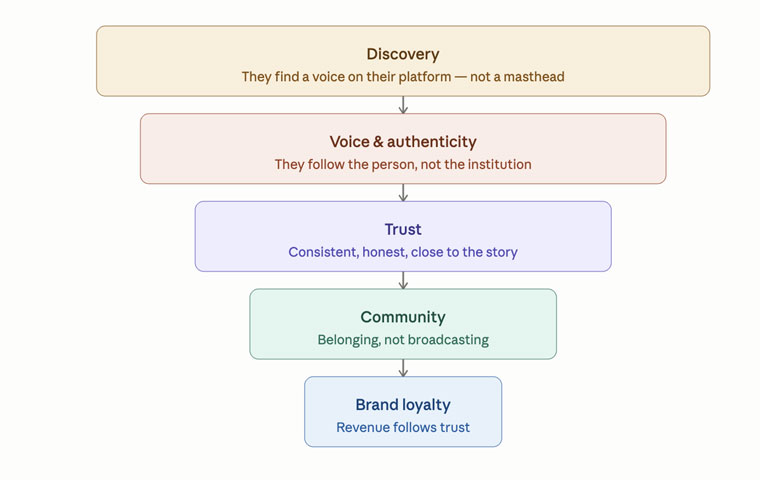
Let’s start at the top: Discovery doesn’t happen on your Web site. It happens on platforms you don’t own. The first job of any serious young audience strategy is to exist in their orbit. You cannot expect them to come find yours.
If you want to win over young people, don’t hide journalists behind institutional tone, collective bylines, and masthead logos. Let them have an authentic voice and show your audience how you produce your journalism. VG shows reporter Kyrre Lien in Lebanon reporting out of bombed house, and the audience appreciates the transparency and authenticity.

This is where the magic happens. This is where people start to trust you. That trust builds through transparency about how you work, honesty about what you don’t know, and willingness to be accountable when you get something wrong.
Trust doesn’t scale on a quarterly reporting timeline. You just simply have to earn it. But honestly, that is a good thing. Because trust is such an important basis of (good!) journalism.
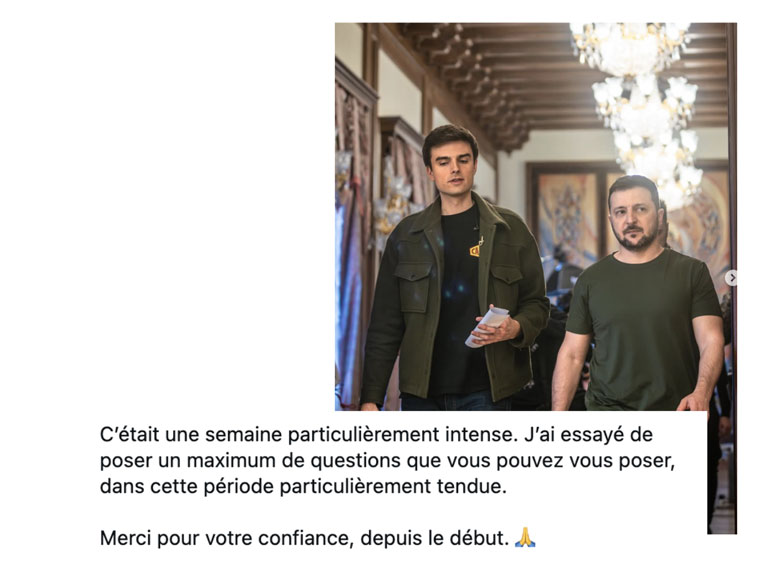
With this trust you will be able to build a relationship with your audience. I give you another example. The French creator/journalist Hugo Décrypte met Volodymyr Zelensky in 2024. In the caption of the photo below, he explains that he tried to ask him as many questions as possible from his audience. And he thanks them for their trust. This is a true community. Young audiences don’t just want to consume content. They want to participate, respond, and belong to something.
And only after all of that — after discovery, after a human voice, after earned trust, after a real sense of belonging — brand loyalty becomes possible. And yes, I do think your brand can profit from a voice and build brand trust through it. But I also think, more and more, you will have to live with the fact that part of this loyalty will stay with your talents.
Banner photo: Adobe Stock By alexdndz.
If you’d like to subscribe to my bi-weekly newsletter, INMA members can do so here.
Related Articles
-

5 lessons from the INMA Young Audiences Summit
28 September 2026 -

The 3 editorial pillars of Chile’s first streaming news channel
23 September 2026 -

At Mediacorp’s CNA, loyalty means giving audiences a reason to ...
20 August 2026 -

Tribun Network turns print “dots” into AI-powered insight
20 August 2026 -

Economist launches subscription tier targeting younger audience...
20 July 2026 -

Grupo RBS builds social-first video operation to expand audienc...
20 July 2026 -

Inside Denník N’s successful subscription strategy
15 July 2026 -

10 years later, user needs must be twinned with content formats...
1 July 2026
Upcoming Events
-

Subscriber Acquisition Master Class
10-17 November 2026
-

Media Advertising Summit
New York, United States
07-10 December 2026
-

AI-Native News Product Master Class
18-25 February 2027
-

Media Subscriptions Summit
Oslo, Norway
08-12 March 2027
-

World Congress of News Media
New York, United States
25-30 April 2027
-

Branded Content & Partnerships Master Class
20-27 May 2027
-

Subscriber Retention Master Class
17-24 June 2027
-

Conferencia Latinoamericana
15-16 July 2027
-

South Asia News Media Festival
New Delhi, India
19-22 July 2027
-

Asia/Pacific News Media Summit
19-20 August 2027
-

CEO Roundtable at Kilkenny
Kilkenny, Ireland
24-26 August 2027
-

Media Innovation Week
Amsterdam, The Netherlands
27 September - 01 October 2027








