

News Movement treats creators as collaborators, not competitors
Young Audiences Initiative Blog | 06 October 2026

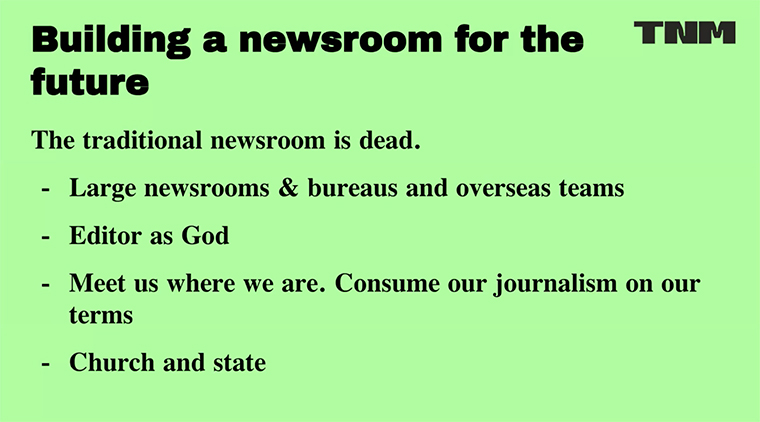
According to Rebecca Hutson, editor-in-chief of The News Movement: “The traditional newsroom is dead.”
The three-year-old, social-first news business has built its newsroom around challenging traditional assumptions about how journalism is commissioned, produced, distributed, and funded. Rather than expect audiences to seek out its journalism, it publishes on Instagram, TikTok, YouTube, LinkedIn, and Substack to reach them where they already spend time.
Speaking at the INMA Young Audiences Summit, Hutson said The News Movement’s model combines a lean newsroom, multi-skilled reporters, audience listening, platform-native storytelling, and collaboration with creators. Its goal is to reach “news-adjacent” Gen Z consumers who are actively avoiding conventional news products.
“We get out of bed every morning to fulfil our original founding mission of telling news in ways that reach those audiences and give them access to the information and good quality journalism and storytelling that they need to navigate the world around them,” she said.
A leaner newsroom
Hutson said the structure that served the news industry for more than 200 years may no longer be fit for purpose. Large newsrooms with numerous desks, layers of hierarchy, editors, and sub-editors are particularly difficult for smaller businesses to sustain.
The role of the journalist has also changed. Rather than specialising in one task, The News Movement’s reporters pitch, produce, and publish their stories. They write copy, create and edit content, and understand social platforms.
The organisation also challenges the idea that one editor’s instincts and interests should determine the newsroom’s agenda. Editors remain essential, Hutson said, but must consider audience needs, platform behaviour, and performance data while remaining flexible about the formats used to tell stories.
“Our journalism comes from the bottom up every time,” she said.
Audience listening governs the newsroom’s work. After publishing, the team examines comments and other below-the-line activity to understand what was unclear, how a story could improve, and what should be covered next.
The newsroom also works with freelancers, stringers, creators, and people with direct proximity to a story. Its journalists provide editorial guidelines, scrutiny, and fact-checking without assuming they are always the best people to tell every story.
Creators add proximity
Creators are central to The News Movement’s editorial and commercial operations. They may front its journalism, lead repeatable formats, or help distribute its reporting.
For identity-led stories, Hutson said lived experience and community connections can produce more credible coverage than sending a journalist with little connection to the subject. When covering Black trans pride in London, for example, the organisation worked with a Black trans creator who understood the community and its conversations.
The newsroom retained editorial oversight and fact-checked the work, but the creator brought proximity, trust, and knowledge.
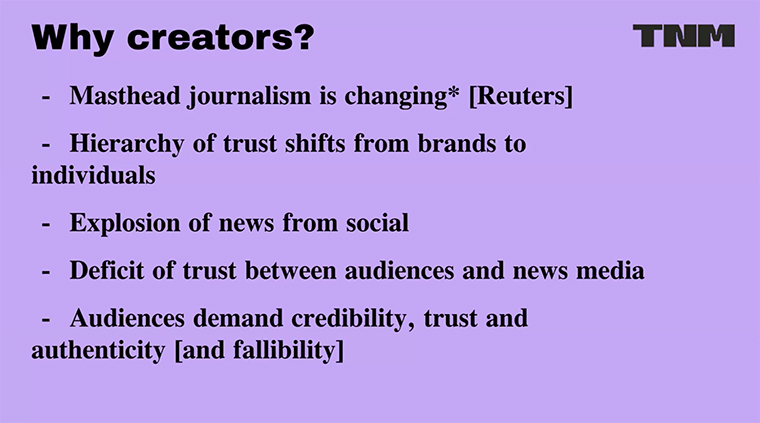
The News Movement has also worked with drag king Teddy Bang on Snatch from the Source, a fortnightly queer-history series that Hutson described as its most successful format. For a story about Chelsea footballer Cole Palmer, it used a football creator who understood the club’s fans, language, and culture.
Creators have also influenced the outlet’s production style. Its journalism avoids looking overly polished or studio-heavy, instead using accessible language and a lo-fi approach that feels like “a FaceTime to a friend.”
“The slicker things look, oftentimes, people get more suspicious of it and why you’re doing it,” Hutson said.
Collaboration requires flexibility
Working with creators should be a co-creation process rather than a conventional relationship between a commissioning editor and reporter, Hutson said. Creators understand what works for their audiences and need a say in how the final content appears.
That collaboration does not require publishers to compromise editorial standards. It does, however, require due diligence, realistic lead times, and clear conversations about language, editorial positions, and non-negotiable boundaries.
Publishers should verify that creators fit their brands and have not said or done anything they would struggle to justify. They should also recognise that creator partnerships can take longer because ideas and formats are developed collaboratively.
Hutson recommended building long-term relationships instead of approaching creators for isolated assignments. Retainers, revenue-sharing arrangements, and shared intellectual property are among the models publishers could explore.
Creators must also be paid appropriately.
“Just offering people exposure or the opportunity to work with your brand doesn’t really cut it anymore,” she said.
Look beyond reach
The News Movement has moved away from treating follower counts and video views as its primary measures of success. It instead focuses on engagement and below-the-line activity, including whether people save its journalism, share it to their stories, or send it to WhatsApp groups.
Hutson described the organisation as a “companion brand” that prioritises fewer, more impactful stories instead of pursuing high-volume inventory.
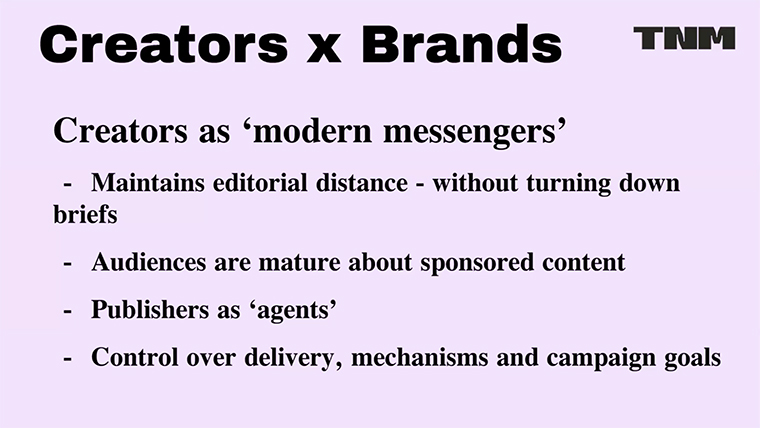
Creators can help publishers understand more than views and reach. Their audience relationships can provide insight into engagement, demographics, and the journeys people take when consuming content.
They can also support commercial work. The News Movement has used creators for partnerships with Hinge, the Department of Transport, and McCain Oven Chips. Hutson said audiences do not necessarily hate advertising, but “they just don’t like being lied to about it.”
Embrace the discomfort
Hutson acknowledged she once saw creators as a threat to journalism. She now believes publishers should be excited about finding new ways to share high-quality reporting.
That does not mean surrendering editorial control. News organisations bring experience in storytelling, integrity, scrutiny, and standards, while creators bring new formats, communities, and methods of distribution.
The News Movement also accepts the risk that young journalists may build profiles and leave for other organisations. Its response is to continue investing in a pipeline of early-career talent and celebrate when former employees move on.
“We’re kind of a feel-the-fear-and-do-it-anyway organisation,” Hutson said. “If we aren’t involved in how they evolve, they’re going to happen to us.”
Banner photo: Adobe stock image by Sebra.
Related Articles
-

5 lessons from the INMA Young Audiences Summit
28 September 2026 -

The 3 editorial pillars of Chile’s first streaming news channel
23 September 2026 -

AI’s effect on super user math
15 September 2026 -

What I told 40 CEOs (and won’t gatekeep from you)
30 August 2026 -

Economist launches subscription tier targeting younger audience...
20 July 2026 -

Grupo RBS builds social-first video operation to expand audienc...
20 July 2026 -

With Düsseldorf geht aus, Rheinische Post brings local gastrono...
14 July 2026 -

Bonnier News Local, Gota Media strike gold with their Core Mode...
21 June 2026
Upcoming Events
-

Subscriber Acquisition Master Class
10-17 November 2026
-

Media Advertising Summit
New York, United States
07-10 December 2026
-

AI-Native News Product Master Class
18-25 February 2027
-

Media Subscriptions Summit
Oslo, Norway
08-12 March 2027
-

World Congress of News Media
New York, United States
25-30 April 2027
-

Branded Content & Partnerships Master Class
20-27 May 2027
-

Subscriber Retention Master Class
17-24 June 2027
-

Conferencia Latinoamericana
15-16 July 2027
-

South Asia News Media Festival
New Delhi, India
19-22 July 2027
-

Asia/Pacific News Media Summit
19-20 August 2027
-

CEO Roundtable at Kilkenny
Kilkenny, Ireland
24-26 August 2027
-

Media Innovation Week
Amsterdam, The Netherlands
27 September - 01 October 2027








