
A progress report on agentic trading
Advertising Initiative Blog | 08 November 2026

Over the first few weeks in October, I sat in on more than two dozen sessions at Advertising Week New York and events around it, including an AgenticAdvertising.org meetup at iHeartMedia, the Advertising Economic Forum (AdEF) at Horizon Media, Optable Connect, and theDanAds Summit.
Agentic trading came up frequently, and the sessions gave me a bit more clarity on where we’re likely heading.
Here’s what I learned.
1. Agentic trading is real, but it’s still very small
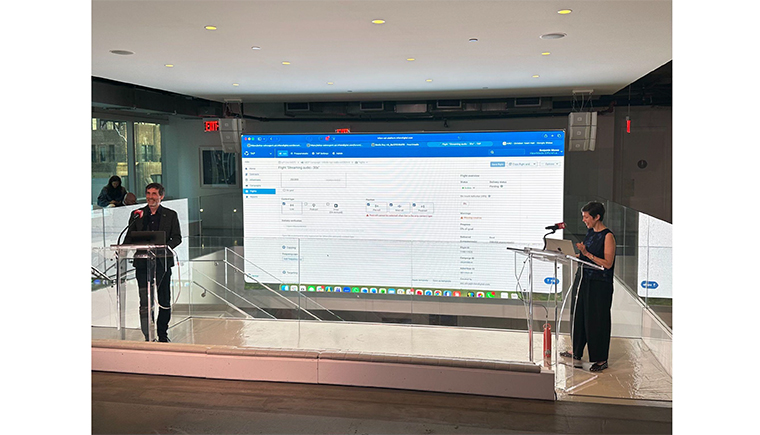
In September, I said I’d be watching for anyone to report a six-figure agentic month. At AdEF on October 6, pubX CEO Andrew Mole said his company is now doing “six figures in spend a month,” up from zero four months earlier. There were live transactions on stage all week, too: a Claude-based buyer agent booked iHeartMedia radio at the AgenticAdvertising.org meetup, and Optable, a publisher data company, pushed an approved order into Google Ad Manager at Optable Connect.
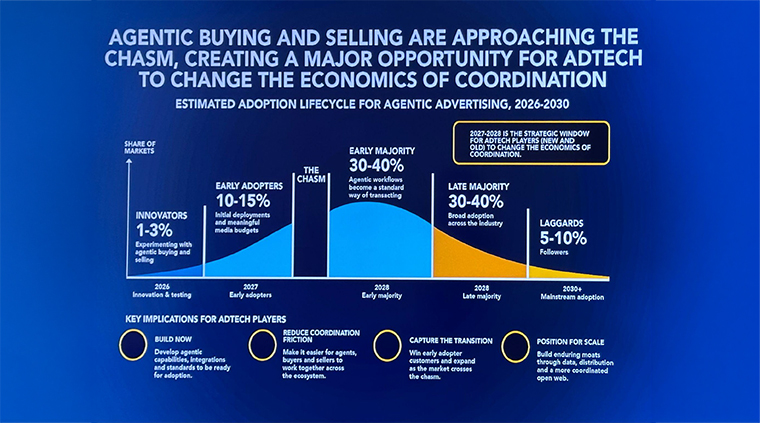
Total spend is still very small, however. Emarketer’s Yory Wurmser estimated agentic spend at a run rate of US$30-US$50 million a year, “still only 0.01%” of the market. His first projections, presented at Optable Connect, put agentic media buying at US$100 million in 2026, US$3.9 billion in 2027, and US$29.5 billion in 2028. By 2028, he expects “10% or so of media dollars” to flow through agents.
This generally mirrored Tom Triscari’s forecast at the AdTech Economic Forum a few days before, which highlighted 2027 as the big question in terms of demand.
At the DanAds Summit a week later, moderator Rob Beeler asked the many publishers in the room how many had done US$10 of business through a seller agent. Few hands went up. “I’ve done 50 cents,” he said. “We are that early.”
Olha Paramonova of Sigma Software, whose industry group surveyed agentic adoption in May and again in October, said most of the 30 companies that answered in October are still running pilots.
On October 22, Digiday reported CNN International hopes to have its first agent-sold dollars flowing in Q1 2027. Faisal Karmali, vice president/digital operations for CNN International Commercial, said agent-led deals could start at 5% of its ad business or one day reach 50%.
2. Agentic deals are really direct deals
Almost everything I saw live was either a direct deal or a version of private marketplace or programmatic guaranteed, with agents working on briefs, proposals, packaging, and IO setup. The open auction isn’t being discussed much at all, so it’s either further down the line or becoming irrelevant.
IAB Tech Lab emphasised this at both Optable Connect and DanAds. CEO Anthony Katsur said a seller often gets “20 minutes to pitch 40 ad products,” and “humans just are not great at processing all that information.”
Matthew Jacobs, IAB Tech Lab’s head of agentic technologies, said smaller publishers often don’t get the meeting at all, while a brand’s buying agent has “unlimited time” to look at thousands of publishers and products: “Previously, I wasn’t going to read a domain list of 10,000 domains ... but an agent could.
Ravi Patel, CEO of the ad tech company SWYM, told Digiday seller agents “take cost out of the RFP-to-trafficking grind. But they automate the deal, not the delivery.”
3. Publishers decide what agents can buy
On the DanAds panel “Who’s Really in Control,” Jacobs described what agencies would like from publishers: “I just want to open up your ad server. Let me go in there, pick whatever I want, combine it however I want.” And what publishers tell him: “No one’s going to do that.”
He expects buyers to keep pushing for more choice (“I want to buy down to the show title and I want to pay one dollar a click for that”) and sellers to keep bundling because “the only way I can sustain my CPMs is to bundle.”
For now, publishers are making only small, selected packages available to agents. Paramonova said many are creating new products just for agentic buyers, so the tests stay separate from their main direct business.
Several speakers suggested publishers should start by studying the briefs buyers’ agents send. Jacobs said publishers should ask, “How should I merchandise for this new marketplace?” Beeler said knowing what a buyer actually wants “is so much better than being told I’m worth a dollar thirty-seven.”
As Digiday put it, a buyer’s agent never sees CNN’s ad sales team, only how its inventory is described.
4. Agents might cut ad tech fees or add new ones, we don’t know yet
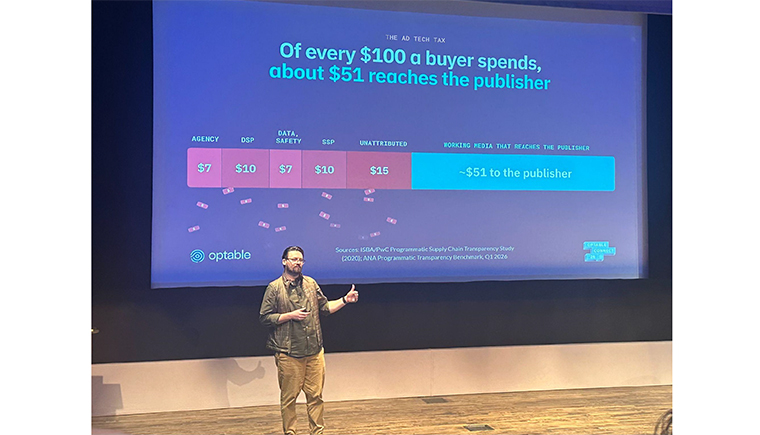
At DanAds, Optable CEO Vlad Stesin said publishers are “being paid less than 50 cents of a dollar,” and Emarketer estimates 41% of U.S. real-time bidding display spend goes to programmatic fees this year.
Optable launched its Agentic Marketplace at Connect with no fee for publishers to sell through it. Its co-founder, Bosko Milekic, described the risk: “If every intermediary is bolting an agent onto its stack, and each one takes a cut of working media, Agentic just recreates the adtech tax ... only faster.”
Many of the rules for these deals aren’t really written yet.
Digiday listed the open questions, including who defines quality inventory, “how a buyer’s agent checks if the seller’s agent is authorised to sell in the first place” and who pays “when an agent misreads a brief and spends money anyway.”
On October 19, AgenticAdvertising.org president Ben Masse published an open letter to the incoming ANA CEO asking marketers to agree four terms with any company building agents for them: the brand owns what its agent learns, can take that information with it, can see why an agent made a decision, and can use agents in every channel.
I think publishers will need similar terms of their own.
The two leading standards for how buying and selling agents work together both have new versions. IAB Tech Lab’s AAMP 3.0 adds a common way to send a brief, answer an RFP, negotiate, and close a deal, and it’s now open for public comment. AgenticAdvertising.org’s AdCP added social media buying in version 3.2.
5. Agencies think people will make the final decisions, at least at first
At Advertising Week on October 7, agency executives from WPP, Dentsu, Publicis, and The Shipyard agreed on which decisions agents shouldn’t make. Jennifer Dass, president of transformation at WPP: “I will never allow anyone to say, hey, let’s make a decision based off of what an agent says.”
I suspect this will change as agentic buying becomes ubiquitous and error rates fall. An agent developer at Optable Connect said as much about approvals: “If it’s 99% approved, you stop caring.”
Agencies were also launching agentic products all week. Digiday listed three:
Dentsu’s Carat with NBCUniversal, FreeWheel, and Newton on an agent for upfront buying.
Stagwell’s relaunched media agency built around an agentic system called Machine OS.
And Tinuiti opening its measurement tools to AI agents.
At DanAds, Angelina Eng of Enso Horizon, who was at the IAB until recently, said the holding companies want to move planning and buying to AI by 2027. A speaker from the floor said agencies will use AI “as a profit center to build a more profitable business and take more margin.”
6. Buyers are starting to measure outcomes and results by publisher
At AdEF, Shukmei Wong, senior vice president/omnichannel media at Involved Media, said a media mix model is “great for overall channel mix. It’s not going to help me understand if a publisher is working better than the next publisher.”
At DanAds, FreeWheel’s Gil Sommer said some publishers are now selling direct deals optimised toward outcomes. I think this matters for agentic buying too, because a buyer’s agent can only rank publishers on the data it has.
7. Open Web display keeps losing ground, and speakers disagreed on whether agents will help
AdEF closed with “Last Media Dollar Live,” a game in which players split a hypothetical budget between channels, two at a time.
Across roughly 50,000 rounds played, open Web banners drop from No. 9 in actual market spend to about No. 19 in players’ preferences. Mediaocean CEO Bill Wise predicted programmatic display, mobile, and everything else “in the middle is just going to get less and less material over time.”
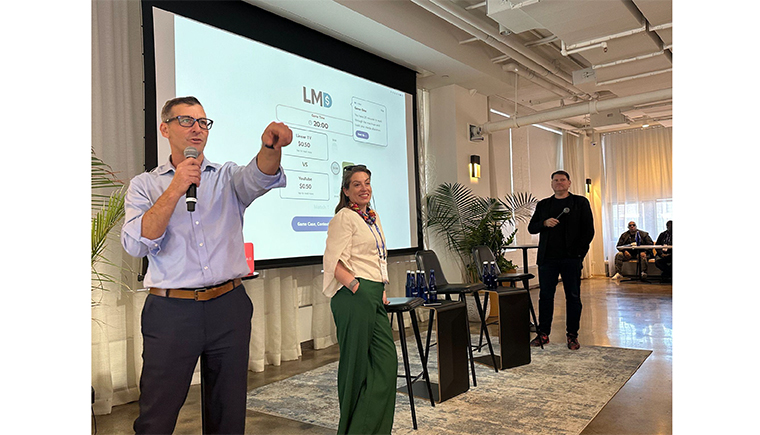
At DanAds, Beeler asked whether agentic buying will win money back from the walled gardens. Pieter van den Bergh of RTL AdAlliance said too much revenue is “streaming to YouTube and the big socials” and that agents could help publishers show the quality of their inventory: “Let’s not mess it up this time.”
Stesin said the threat to the biggest platforms is “everybody else teaming up and doing a much better job.” Jacobs disagreed and said he sees “nothing in the technology of agentic” that would shift share away from Google, Amazon, and Meta, given the growth of creator media.
Beeler put the sell side’s part in it plainly: “We are harder to buy from. Period. And that’s our problem.”
Revised guidance for publishers
I think the three recommendations I made in June and September are still relevant, with some updated detail from New York:
Be legible to new buyers. Package signals and products an agent can read (inventory, data, a price, and the evidence your audience is valuable.)
Help write the rules. What agents look for, who pays for agent errors, how cancellations work, and who owns insights and data are all still being decided.
Experiment with seller agents, with guardrails. Paramonova’s advice: Ask your biggest buyers what they plan for 2027, and “if you’re not in pilots yet, go check with your partners.”
IAB Tech Lab’s Anthony Katsur and AgenticAdvertising.org’s Benjamin Masse will discuss all of this onstage together at the INMA Media Advertising Summit on December 9.
If you’d like to subscribe to my bi-weekly newsletter, INMA members can do so here.
Banner photo: Adobe stock image by InfiniteFlow.
Related Articles
-

Q3 publisher earnings reflect audience strategies
22 November 2026 -

The next business is brand partnerships, not ad inventory
25 October 2026 -

As the traffic ad model ends, publishers need a new advertising...
14 October 2026 -

In moving from an attention to an intention economy, who gets p...
16 September 2026 -

An update on OpenAI and the LLM ad platforms
14 September 2026 -

News companies are starting to build for agentic trading
13 September 2026 -

BCN, Time share lessons in selling ads to machines
9 September 2026 -

What’s really defensible in the age of AI?
30 August 2026
Upcoming Events
-

Media Advertising Summit
New York, United States
07-10 December 2026
-

AI-Native News Product Master Class
02-09 February 2027
-

Media Subscriptions Summit
Oslo, Norway
08-12 March 2027
-

Africa Media Revenue Summit
18 March 2027
-

World Congress of News Media
New York, United States
25-30 April 2027
-

Branded Content & Partnerships Master Class
20-27 May 2027
-

Subscriber Retention Master Class
17-24 June 2027
-

Africa Audience & Technology Summit
15 July 2027
-

Conferencia Latinoamericana
15-16 July 2027
-

South Asia News Media Festival
New Delhi, India
19-22 July 2027
-

Asia/Pacific News Media Summit
19-20 August 2027
-

CEO Roundtable at Kilkenny
Kilkenny, Ireland
24-26 August 2027