

Q3 publisher earnings reflect audience strategies
Advertising Initiative Blog | 22 November 2026

In February, I wrote that Q4 earnings showed the post-traffic playbook was working. In August, I said the thing to watch for the rest of the year was which publishers report falling traffic alongside rising ad revenue.
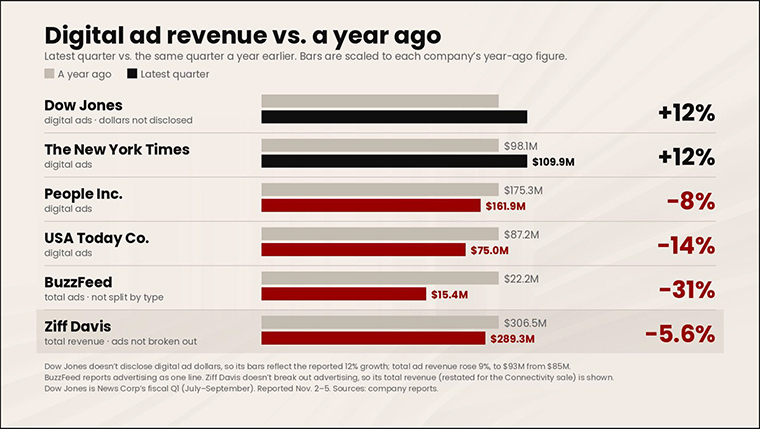
Q3 results came in during the first two weeks of November, and they are a harder test. Here is digital advertising revenue versus a year ago at four U.S. companies that report it publicly:
Dow Jones: up 12%, its fourth straight quarter of double-digit growth.
The New York Times: up 12% to US$109.9 million, short of its own guidance and its slowest growth since late 2024.
People Inc.: down 8% to US$161.9 million.
USA Today Co.: down 13.9%.
Note the difference in where each company gets its audience.
Dow Jones said direct traffic is The Wall Street Journal’s main source. The Times’ CEO Meredith Kopit Levien described a model “driven a lot by subscriber engagement.” People Inc. has lost nearly 70% of its Google search traffic in about two years, and its core sessions fell 26% in Q3, the steepest decline it has reported. USA Today Co. blamed Google-driven traffic changes for a 32% fall in its indirect advertising.
So, at least across these four, the publishers that lost the most traffic also lost ad revenue this quarter.
What’s working
Direct-sold advertising is holding up much better than indirect. USA Today Co.’s direct-sold digital advertising (about US$200 million a year) grew slightly, while its indirect advertising (about US$100 million a year) fell 32%. In September, I noted that USA Today’s ad revenue hadn’t followed its subscription revenue. It still hasn’t: Digital-only ARPU hit another record at US$10.82 while digital advertising fell.
Revenue that doesn’t depend on a site visit is growing. People Inc.’s non-session revenue grew 15% to US$125 million and is now 43% of digital revenue, up from 38% a year ago. That kept total digital revenue growing 2%, its 12th straight quarter of growth. People now runs more than 50 social video series sold as season-long sponsorships, which CEO Neil Vogel called “very lucrative and very high margin.” More than half of the recent business for D/Cipher, its contextual targeting product, came from connected TV (CTV) rather than the open Web.
Events keep growing. Semafor’s new Silicon Valley & The World summit signed 24 commercial partners before its first edition, with revenue “well into the eight figures,” Chief Commercial Officer Rachel Oppenheim told Adweek’s Mark Stenberg.
And we saw more evidence that super-users and subscribers continue to be worth more to advertisers. The BBC has passed 100,000 paid subscribers, and those subscribers generate 5x to 10x more advertising revenue than non-subscribers. Stop turning ads off for the most valuable people!
In the U.K., Association of Online Publishers and Deloitte’s latest index showed display advertising up 4.5% in Q2 even as total digital revenue across 13 publishers fell 1.5%.
What isn’t working
Advertising that depends on search is shrinking faster than demand. In Q2, People Inc.’s rate increases roughly covered a 22% drop in visits, and session revenue was about flat. In Q3, with sessions down 26%, session revenue fell 6%, even with higher rates on both programmatic and direct-sold inventory.
The costs are real. People Inc. cut 195 jobs, about 6% of staff, and lowered its 2026 digital revenue outlook for the first time this year. USA Today Co. cut its outlook and started its second US$100 million cost-cutting programme in just over a year. At News Corp, the news media segment’s ad revenue fell 2%, and The Sun’s global monthly audience fell 26%.
What’s still an open question
Can the new businesses grow fast enough to offset?
Vogel said not every new bet has to work for People to get back to double-digit growth. Chairman Barry Diller said he wants “substantial growth, not single-digit growth” next year. CFO Tim Quinn said he expects non-session revenue to reach about half of digital revenue a year from now. The fastest-growing piece of that revenue this quarter was licensing (up 49%, led by Apple News), not advertising.
Is The Times’ slowdown about supply or demand?
Its digital ad growth went from 31.6% in Q1 to 20.7% in Q2 to 12% in Q3, and it guided to high-single-digit to low-double-digit growth for Q4, against 25% a year ago. Kopit Levien said last year’s growth was helped by new ad supply, and that future increases in supply will be smaller. She declined to tie the miss to AI search, saying where ads land in a quarter “can be hard to predict.” This is still the 11th straight quarter of digital ad growth, and Q4 will tell us more.
Does direct selling hold up everywhere?
Adweek’s Mark Stenberg reported that Condé Nast is forecasting about US$130 million in Q4 U.S. advertising bookings, more than US$35 million below its internal goal, with reports pointing to the departure of senior sales leaders. Condé Nast disputed the figures and said U.S. advertising will finish the year very close to target. One person familiar with the business told Adweek: “You use the big-ticket events to drive the overall deals.”
And at Apartment Therapy Media, CEO Maxwell Ryan told A Media Operator that direct sales were hard this year and that the company has cut some sales staff to raise its margins. Direct selling is expensive to run, and it depends on having the sales people and the products.
Has traffic stopped falling? USA Today Co. said search traffic did not decline from Q2 to Q3, and People Inc. believes its biggest drops are behind it. We’ll continue to watch this in Q4.
If you’d like to subscribe to my bi-weekly newsletter, INMA members can do so here.
Banner photo: Adobe stock image by Sino.
Related Articles
-

The next business is brand partnerships, not ad inventory
25 October 2026 -

As the traffic ad model ends, publishers need a new advertising...
14 October 2026 -

In moving from an attention to an intention economy, who gets p...
16 September 2026 -

An update on OpenAI and the LLM ad platforms
14 September 2026 -

News companies are starting to build for agentic trading
13 September 2026 -

BCN, Time share lessons in selling ads to machines
9 September 2026 -

What’s really defensible in the age of AI?
30 August 2026 -

The media industry optimised buying, but it forgot to optimise ...
23 August 2026
Upcoming Events
-

Media Advertising Summit
New York, United States
07-10 December 2026
-

AI-Native News Product Master Class
02-09 February 2027
-

Media Subscriptions Summit
Oslo, Norway
08-12 March 2027
-

Africa Media Revenue Summit
18 March 2027
-

World Congress of News Media
New York, United States
25-30 April 2027
-

Branded Content & Partnerships Master Class
20-27 May 2027
-

Subscriber Retention Master Class
17-24 June 2027
-

Africa Audience & Technology Summit
15 July 2027
-

Conferencia Latinoamericana
15-16 July 2027
-

South Asia News Media Festival
New Delhi, India
19-22 July 2027
-

Asia/Pacific News Media Summit
19-20 August 2027
-

CEO Roundtable at Kilkenny
Kilkenny, Ireland
24-26 August 2027