

elDiario.es built its revenue on members before it built a paywall
Conference Blog | 22 September 2026

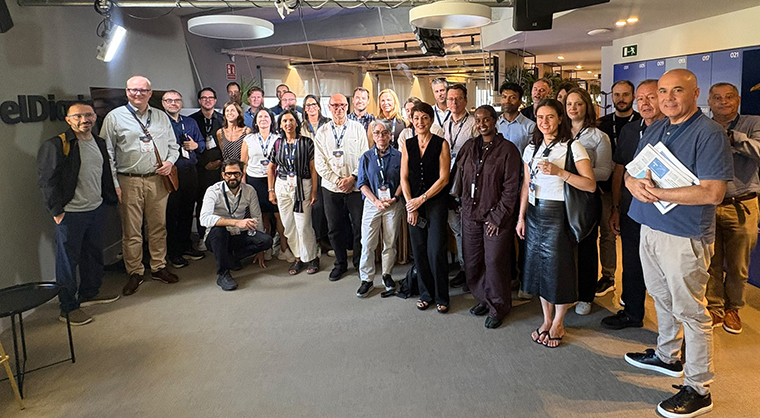
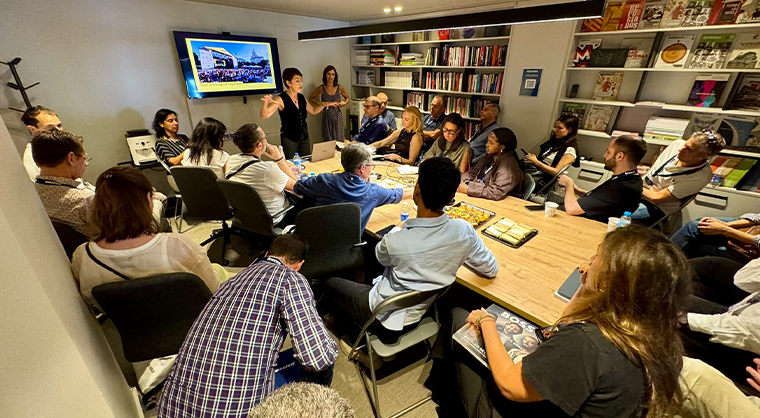
At an INMA Media Innovation Week study tour stop in Madrid, elDiario.es walked 25 delegates through a revenue model assembled in an unusual order — community first, membership second, and a paywall only once both were working.
The overwhelming majority of what elDiario.es publishes is free to read. Its paying members, then, are not buying access. They are paying for a newsroom nobody else owns.
That distinction sits at the centre of the revenue model the Spanish digital native laid out for INMA Media Innovation Week study tour delegates at its offices on Madrid’s Gran Vía, and nearly every commercial decision the company has made follows from it.
Reader revenue funds close to half of company income, elDiario.es executives told delegates. That share peaked during the COVID-19 pandemic and has eased back slightly since. Advertising and other income supply the rest.
Independence, written into a charter
elDiario.es was founded in June 2012 by journalists who had left heavily indebted legacy newspapers after Spain’s financial crisis and the May 15 Indignados protests, said Rosalía Lloret, strategic advisor to the president and member of the board at elDiario.es.
They pooled savings and redundancy payouts, and built two rules into the company: The team would own it, and it would not depend on digital advertising.
Most shares are still held by people who work there, with Editor-in-Chief and Founder Ignacio Escolar the largest shareholder. A founding charter, published in Spanish and English, caps the share of revenue any single advertiser or funder may supply — including government and European Union grants — and the annual budget is built to that ceiling. Lloret described the cap as company law, the mechanism that keeps elDiario.es from ever depending on any one backer.
The company has published its financial accounts every year since its first, and has been profitable since its early years.
Engagement first, paywall later
With most of the journalism free, conversion has to come from relationship rather than restriction.
elDiario.es has spent its whole existence building formats that put its journalists in front of readers with no algorithm in between: a large slate of author newsletters with open rates well above industry norms, a daily podcast that leads its category in Spain, local editions in every Spanish region plus a set of hyperlocal sites, and a heavy schedule of live events.
Only after all of that did a paywall appear. Esther Alonso, general director of marketing, product, and technology at elDiario.es, said the company folded paywall technology into its acquisition strategy several years into the membership model, moving from a deliberately generous metered wall to a dynamic one, and now to a combination of dynamic and premium.
The premium tier covers the op-ed section, selected stories, everything written by the editor in chief, and members-only newsletters republished on the site.
The paywall arrived alongside propensity models built in house, running on a CRM also built in house. There are two models, one for anonymous readers and one for registered users. The registered model is the more accurate of the two, Alonso said, because the signals are better — and those readers convert better as well.
Newsletter behaviour turned out to matter more than the team expected. Lloret said the early models leaned on on-site behaviour before the team realised that newsletter opens and reading were powerful signals in their own right, in part because the newsletters are written to be read in the inbox, with no need to click through.
The paywall now supplies a meaningful share of new members each month, Alonso said, with e-mail marketing and organic sign-ups accounting for the balance in roughly equal measure. Open newsletters on their own convert a small but steady trickle.
Pricing carried its own lesson. Alonso said a reader stopped by a paywall behaves less like a prospective member and more like someone making a micro payment — an urge to read one article rather than an interest in joining anything. The company responded by cutting the paywall price and now offers a reduced introductory monthly rate before the standard fee applies.
What members get, what they give back
The loyalty pack is built as thanks rather than as access, Alonso said, because members are paying for something they could have for free.
Membership includes unlimited and premium content, an ad-free Web site, a nightly e-mail previewing the next day’s top stories, members-only newsletters, event invitations, a members-only comments section, extra functionality in the app, and a quarterly printed monographic magazine sold nowhere else.
Members can also pay more than they owe. Thousands top up their fee to support their local edition, with that money transferred to the local newsroom, and patrons voluntarily raise their contribution. One-off payments are offered to members only.
The other side of the ledger
Events generate a substantial share of advertising income, executives said, and fall into three categories: evening community events for readers and members, a large annual summer festival running since 2022, and morning B2B events built on sponsorship.
Sustainability, sustainable mobility, health, artificial intelligence, and the circular economy are the territories where reader interest and advertiser interest overlap, Lloret said. The balance of advertising is display and branded content. Members see no advertising on the Web site, though sponsors appear at events and in the magazine.
The newsroom is part of the machinery rather than a beneficiary of it. Journalists write letters to readers asking for support, newsletter authors make the case in their own voice, and conversion numbers go back to them afterwards. When a member cancels for editorial reasons, an alert reaches the editor in chief, who often answers personally — sometimes by phone.
Related Articles
-

At Mediacorp’s CNA, loyalty means giving audiences a reason to ...
20 August 2026 -

Tribun Network turns print “dots” into AI-powered insight
20 August 2026 -

Nation Media Group focuses editorial strategy on stories that m...
4 August 2026 -

Economist launches subscription tier targeting younger audience...
20 July 2026 -

Grupo RBS builds social-first video operation to expand audienc...
20 July 2026 -

Inside Denník N’s successful subscription strategy
15 July 2026 -

AI adoption in newsrooms should move from experiment to strateg...
12 July 2026 -

Why are audiences going to AI answer engines for news?
30 June 2026
Upcoming Events
-

Subscriber Acquisition Master Class
10-17 November 2026
-

Media Advertising Summit
New York, United States
07-10 December 2026
-

AI-Native News Product Master Class
18-25 February 2027
-

Media Subscriptions Summit
Oslo, Norway
08-12 March 2027
-

World Congress of News Media
New York, United States
25-30 April 2027
-

Branded Content & Partnerships Master Class
20-27 May 2027
-

Subscriber Retention Master Class
17-24 June 2027
-

Conferencia Latinoamericana
15-16 July 2027
-

South Asia News Media Festival
New Delhi, India
19-22 July 2027
-

Asia/Pacific News Media Summit
19-20 August 2027
-

CEO Roundtable at Kilkenny
Kilkenny, Ireland
24-26 August 2027
-

Media Innovation Week
Amsterdam, The Netherlands
27 September - 01 October 2027








