

Trust was already being priced in Delhi, in forms nobody counts
Conference Blog | 28 July 2026

A local scholar walked into the offices of Amar Ujala and asked the newspaper to write an editorial piece about him. Ashok Sharma, the company’s head of revenue strategy and planning, said no. “I cannot endorse you there.”
What he offered instead was a Kavi Sammelan — a live poetry gathering, staged by the newspaper, with the city’s readers in the room and the scholar on the platform.
The newspaper was paid. The editorial page stayed shut. And the transaction, from the industry’s point of view, did not happen. It appears in no advertising forecast, no CPM benchmark, no share-of-spend chart.
That exchange is the week in miniature. Across four days at the INMA South Asia News Media Festival — two days inside Delhi and Noida newsrooms, two of conference sessions — the question everybody returned to was what a trusted news brand is worth and whether anyone will pay for it. The sessions treated that as unresolved. The newsroom visits suggested it had been resolved several times over, in forms nobody is counting.
Why the answer stays invisible
The measurement problem follows from where publishers have spent decades selling.
Shubhranshu Singh, a global board member of the Effie Lions Foundation and former chief marketing officer at Tata Motors Commercial Vehicles, described an advertising market that has stopped rewarding what publishers are best at.
Global advertising revenue outside China passed US$1 trillion last year, he said, of which roughly US$700 billion went to Google, Meta, Amazon, and TikTok. India mirrors it: of some ₹1,11,000 crore, around ₹70,000 crore flows to the Google and Meta ecosystems: “Everybody else is celebrating Holi, Diwali with the balance 30,000 crores.”
The mechanism is procurement. At Hindustan Unilever, he said, the head of media was for years a chartered accountant buying at the lowest unit price. Once cheapness becomes the mode of evaluation, anything unmeasurable leaves the conversation. His verdict: “The surrender, I think, has happened faster than the challenge.”
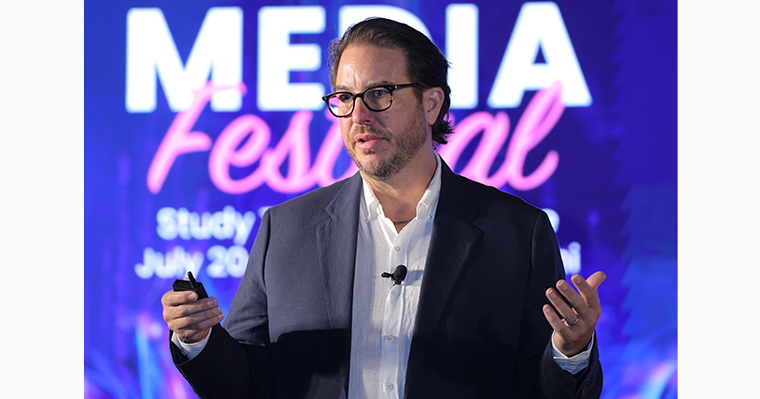
Gabriel Dorosz, INMA’s Advertising Initiative lead, gave the structural version: advertising runs at 0.41% of Indian GDP against roughly 1% in the U.S. and Europe. The money exists. Little of the growth arrives through the channels publishers built their businesses around.
What makes that a mispricing rather than a market correction is the audience data, and Prasun Basu brought the first serious attempt to gather it — a study by Inteliphyle, where he is co-founder and CEO, covering roughly half of India’s population, across 10 cities from Bhagalpur to Delhi, on a 12,000 sample.
Measured against the last Indian Readership Survey in 2019, print reach fell about six points — while population growth pushed the absolute number of newspaper readers from 16 million to 18 million.
Nor is consumption zero-sum: Respondents used around three platforms in a single day, and between 87% and 90% used traditional and digital media both. On a strict definition of affluence, newspapers index at 77 against 56 for the mainstream, while digital indexes roughly the same for both.
“The audiences have not left us,” Basu said. What left was the money.
So the industry’s instrument for measuring its own worth is calibrated to a market that is no longer buying — which is why the conversions happening in plain sight all week barely registered.
Five forms of conversion
1. Trust converted into a transaction. At HT Digital, executives walked the study tour through a content-to-commerce operation built over roughly three years.
In personal finance: 10 million users acquired in a year, three million applying for credit, ₹1,500 crore disbursed over 12 months through more than 10 lending partners. Shopping has generated ₹1,000 crore in gross merchandise value. Auto produces 1.5 to 2 lakh interested users a month, of whom at least one lakh bought a vehicle.
This only works if the journalism is real — hands-on testing, stated methodology, the willingness to say a product is bad. Trust is not a wrapper on the transaction; it is the mechanism that produces it.
2. Trust converted into a room. Sharma’s other client was Vartika Jewellers in Bulandshahr, whose next generation rebuilt the showroom to national-brand standard and came asking for advertising. What they wanted was something else. “This is a business which simply doesn’t work on eyeballs,” the client told him. “Everybody knows me in the city, so I want to engage with them.”
Amar Ujala built seminars, talks and a fashion show for the city’s elite. The jeweller now competes with Tanishq, Kalyan, and Malabar.
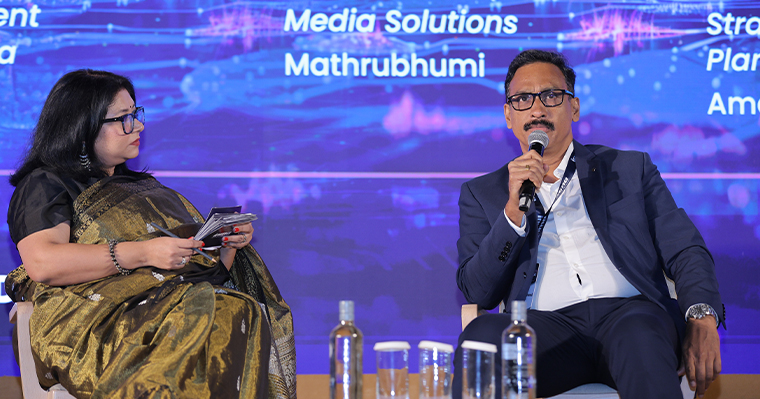
Sudeep Kumar, vice president for media solutions at Mathrubhumi, described the same shape in Calicut: an overseas education consultancy that arrived when studying abroad was still unusual in Kerala, and which after five years of co-branded seminars became the second-largest of its kind in South India.
What the publisher sold was not space. It was the standing to convene.
3. Trust converted into a guarantee. Kumar gave the most direct answer anyone offered on pricing. An advertiser buying programmatically does not know where its message lands. A publisher can promise placement only alongside news that has been reported and verified, matched to the product. No exchange can manufacture that.
Mohit Jain, chief operating officer for publishing and a board member at Bennett Coleman & Co., named it from the other end. A billboard sells opportunity-to-see, priced by where it stands; print advertisers are buying not a location but an environment that has been vouched for. “The medium does the work of credibility for the advertisers,” Jain said.
4. Trust converted into a service sold to others. What gives verification its price is that it has become expensive precisely as fabrication has become free.
Daniel Funke, head of digital investigations for APAC at AFP, described the shift. A fabricator once needed a website, some ads and the appearance of an editorial operation. Now they need a prompt and a few seconds. AFP runs the largest fact-checking operation in the world — around 150 journalists in 26 languages — and has long since been outrun by the volume, so it triages toward whichever misinformation is most harmful.
Detection tools will always trail models with billions of dollars behind them, so AFP treats a verdict as one signal among several. What settles it is older: calling the person in the video, or a photographer on the ground during the Delhi protests. “A detection tool is great,” Funke said, “but it’s not as good as using your own eyes.”
That capacity — people, languages, phone calls, time — is a cost publishers already carry editorially. Bharat Gupta, founder of ToBe Online and former CEO of Jagran New Media, described the inversion that turns it into revenue. India has more than four million creators, and an advertiser running a brief across 10,000 of them cannot check whether it survived.
His system screens 500 videos in 100 minutes for script drift and brand-integration failures. Verification capacity nobody pays publishers for becomes a compliance service someone else does.
5. Trust converted into frequency. Underneath all of it sits the metric both halves of the week arrived at independently, and it is not audience size.
NDTV has made total time spent on its app the north star, with day-30 retention for organic installs around 60% — NDTV Chief Product Officer Rohan Tyagi noted the figure is high partly because new installs are low. The Indian Express tracks next-day retention, a harder test than daily actives because political spikes deliver readers who never come back.
Return frequency is the leading indicator for everything else here. Nobody applies for credit, attends a seminar, or renews anything on a single visit.
What the conversions have in common
The first is that each is measured end-to-end. The recurring complaint on the study tour was that publishers hand a user to an advertiser and lose sight of them — the journey stops at the click, so the value cannot be proven.
Every news company above closes that loop.
Medhavi Singh, Criteo’s country head for India, put it from the buy side: publishers sold attention and retailers sold products, and now everyone is trying to sell intent — and publishers see more of it than they realise, because they know what a reader was researching before deciding.
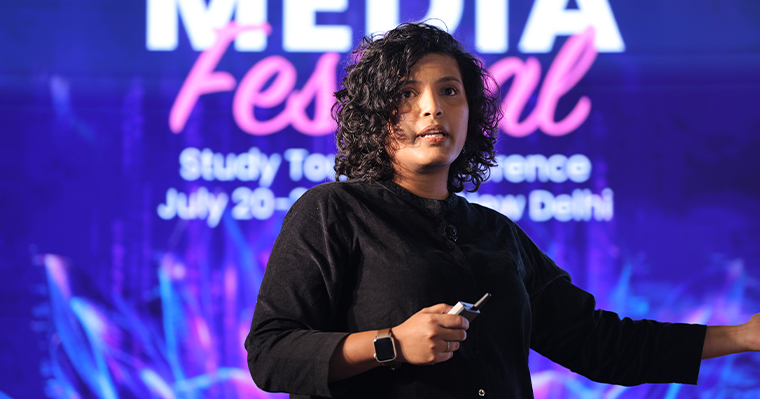
The second is cost discipline, which is what makes these businesses profitable rather than merely interesting. Sannuta Raghu, head of AI product at Scroll, runs small models on a device on her desk because commercial pricing across a 500,000-article archive was never going to clear. NDTV’s three-person AI team built its own retrieval approach for the same reason.
The third is that each required the publisher to refuse something. Sharma declined to write an editorial about a paying client. Scroll, in a reader workspace built on its own archive, declined to claim comprehensiveness it does not have, showing readers a coverage map of the newsroom’s gaps instead. Publishers building their own infrastructure declined the newest model because they did not need it.
The restraint is not adjacent to the revenue. It is the reason the revenue exists, because what is sold in each case is a judgment the buyer cannot make alone.
The counting problem
None of this closes the gap Shubhranshu Singh described. Advertising remains the largest pool of money in the industry, publishers’ share of it keeps falling, and the conversions above are, for now, much smaller.
Nor does the industry agree on what to do about it. Jain argues that trust is what makes the fourth pillar different from the other three — the press is granted its authority by readers, and has it renewed every 24 hours — but concedes the instruments do not exist. The Indian Readership Survey is being rebuilt to reach past readership into brand strength and trust; on the part that creates legacy rather than a transaction, Jain doubts the industry can measure anything at all.
The closing session turned that into an argument. L.V. Navaneeth, CEO of The Hindu Group, said publishers should stop sending advertisers a bare reach number and attach an impact or trust score alongside it.
Sameer Singh, CEO and managing director of HT Media, interrupted to disagree. He does not accept that trust sits above the market and cannot be valued by it. Where trust and engagement come together, he argued, you find value, and it is measurable — not as reach or readership, but as the return on every rupee an advertiser commits. Measured that way print scores very high, for an unsentimental reason: readers give it time, with intent, because they believe in it.
Both men think trust converts. They differ on whether the industry should build the metric or wait for buyers to find it — a disagreement about how much time publishers have.
But the week suggests both may be asking a slightly wrong question.
“What is trust worth?” invites a search for a premium — a higher CPM, a better rate card, an accreditation that makes advertisers pay more for credible surroundings. Four days in Delhi produced almost no evidence such a premium is coming.
What they produced instead was a list of things trust can be exchanged for once you stop selling it by the impression: a loan application, a jeweller’s guest list, a room full of parents in Calicut, a compliance report, a reader who comes back tomorrow.
In a market where willingness to pay is low — still the biggest obstacle with Indian readers, as Pundi Sriram, product head at The Hindu, noted — the publishers making money from trust found something other than attention to charge for.
The Kavi Sammelan will not appear in any advertising forecast this year. It should probably appear somewhere.
Related Articles
-

Why publishers are blocking bots by default to starve the black...
28 October 2026 -

What makes an AI choose your news brand?
14 October 2026 -

Licensing won’t save media, but authentication might
13 October 2026 -

AI is now media’s operating environment
28 September 2026 -

5 lessons from the INMA Young Audiences Summit
28 September 2026 -

Agents, liquid content, vibe coding raise questions for news me...
9 September 2026 -

What I told 40 CEOs (and won’t gatekeep from you)
30 August 2026 -

Dow Jones turns complex B2B data into “prosumer” content with c...
13 July 2026
Upcoming Events
-

Subscriber Acquisition Master Class
10-17 November 2026
-

Media Advertising Summit
New York, United States
07-10 December 2026
-

AI-Native News Product Master Class
18-25 February 2027
-

Media Subscriptions Summit
Oslo, Norway
08-12 March 2027
-

World Congress of News Media
New York, United States
25-30 April 2027
-

Branded Content & Partnerships Master Class
20-27 May 2027
-

Subscriber Retention Master Class
17-24 June 2027
-

Conferencia Latinoamericana
15-16 July 2027
-

South Asia News Media Festival
New Delhi, India
19-22 July 2027
-

Asia/Pacific News Media Summit
19-20 August 2027
-

CEO Roundtable at Kilkenny
Kilkenny, Ireland
24-26 August 2027
-

Media Innovation Week
Amsterdam, The Netherlands
27 September - 01 October 2027








