

Why Salesforce says AI is a revolution in coordination
Conference Blog | 20 October 2026

For Salesforce, coordination is no longer optional.
Consumers expect a company to already know them, and that only works when a business’s systems are connected, Salesforce executives told the 31 INMA study tour members at Salesforce Tower in San Francisco on the second day of Media Tech & AI Week.
Salesforce wants to be that connecting layer: the operating system for agentic transformation, built on the customer data companies already hold in its CRM.
Why build agents on the CRM
Chinmayi Bettadapur, vice president and general manager for media and entertainment at Salesforce, said a customer had asked why it still needs a CRM when Claude can find data anywhere.
“How much are you willing to spend in tokens on all of that?” Bettadapur said. “If you replace everything with AI, it is going to be extremely expensive.”
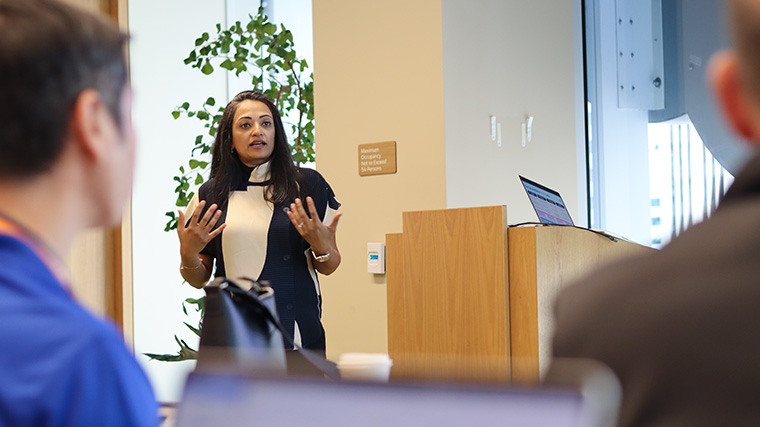
Answers grounded in the system where data and its relationships already live are less likely to be hallucinations, she said, and that system of record keeps the enterprise auditable. Salesforce also comes with many automations already built.
One operating layer
Salesforce’s pitch is to replace disconnected point solutions with connected agentic systems built in four layers:
-
Context: unified customer, subscriber, and advertiser data, connecting to platforms such as Snowflake without copying it.
-
Work: business rules, pricing, rate cards, inventory, and workflows.
-
Agents: specialised AI agents that carry out the work.
-
Engagement: wherever people already work (Slack, Microsoft Teams, Claude, or ChatGPT), without logging in to Salesforce.
It’s modular, so companies can start with their biggest pain point.
Publishers also face new competition for ad revenue from retailers, banks, and travel and car companies launching their own ad networks. “Media companies shouldn’t just be looking at other media companies as their competitors,” Bettadapur said.
An agent-to-agent ad deal
Salesforce demonstrated the agentic ad sales pilot it unveiled at Dreamforce, with Nine on the sell side and Dentsu on the buy side. Nine is represented on the study tour.
A buyer working in Claude submitted a campaign brief. A publisher agent created an opportunity, checked inventory across the seller’s ad systems, and built a priced proposal with its reasoning shown. The buyer’s agent proposed changes, and the seller approved them in Slack before the deal was booked in Salesforce.
The system is “headless”: People work in whatever tool they like, and Salesforce sits behind it. Every agent action is traceable, and a human approves before anything is booked.
Not utopia or dystopia, but mundane
Mark Escobosa, vice president of Salesforce Futures, said AI will become mundane, like electricity: dangerous if misused, but something no business runs without.
Agents behave differently from people, he said. They don’t make small talk or take turns. “They drop an anvil on the conversation,” he said. They arrive with every requirement at once.
Where AI can and can’t be trusted
Salesforce sorts tasks by two questions: Can the answer be checked against a clear test, and did the model see relevant data in training?
Where both answers are yes, as in coding and math, AI does well. But much valuable data is secret, proprietary, or never written down, and without it, models guess. That private, tacit data is a company’s competitive advantage, Escobosa said.
AI falls short in strategy and creative work, where there is no single right answer. Escobosa cited a Harvard Business Review study in which top models given business cases offered strikingly similar advice that barely shifted when the prompts changed.
Humans remain essential for judgment calls such as editorial bets, brand voice, and ethical dilemmas. “The headlines that try to tell you this is a humanless future have no idea what they’re talking about,” he said.
Rethinking the organisation
“The AI revolution is going to be a revolution in coordination,” Escobosa said. Today’s departments trace back to early 20th-century railroads and post-war command structures, which trap data and people in silos.
For decades, jobs have asked people to act like predictable software. “Most knowledge work jobs are just a human sitting in a chair, ruining their hips to do purple work, and then complaining about it,” he said. “Purple work” is his term for the rule-based work agents can now take on.
Handing that work to agents frees people for judgment and accountability. It also opens the door to cross-functional teams, a shared vocabulary across teams and agents, and new approaches to old jobs.
The result, he said, is that customers will expect coordination as standard: You should know me, and it should just work.
Why it matters for news companies
Most publishers still run subscriptions, ad sales, and audience data in separate systems. Salesforce’s case is that agents only pay off once those are connected and grounded in customer data, and publishers will hear the same pitch from other platforms.
Agentic ad trading is already in pilot, with a study tour participant’s company involved.
Escobosa’s framework also offers a useful filter:
-
Automate what can be checked.
-
Ground models in private data.
-
Keep humans on the judgment calls, including editorial ones.
The study tour continues tomorrow with visits to LiveRamp, Hearst, Cloudflare, and AWS.
Related Articles
-

Marketers should outsource tasks, not thinking
25 October 2026 -

AI is now media’s operating environment
28 September 2026 -

The 3 editorial pillars of Chile’s first streaming news channel
23 September 2026 -

AI’s effect on super user math
15 September 2026 -

At Mediacorp’s CNA, loyalty means giving audiences a reason to ...
20 August 2026 -

Tribun Network turns print “dots” into AI-powered insight
20 August 2026 -

Nation Media Group focuses editorial strategy on stories that m...
4 August 2026 -

Briefly News empowers journalists with AI tool suite Nova
4 August 2026
Upcoming Events
-

Subscriber Acquisition Master Class
10-17 November 2026
-

Media Advertising Summit
New York, United States
07-10 December 2026
-

AI-Native News Product Master Class
18-25 February 2027
-

Media Subscriptions Summit
Oslo, Norway
08-12 March 2027
-

World Congress of News Media
New York, United States
25-30 April 2027
-

Branded Content & Partnerships Master Class
20-27 May 2027
-

Subscriber Retention Master Class
17-24 June 2027
-

Conferencia Latinoamericana
15-16 July 2027
-

South Asia News Media Festival
New Delhi, India
19-22 July 2027
-

Asia/Pacific News Media Summit
19-20 August 2027
-

CEO Roundtable at Kilkenny
Kilkenny, Ireland
24-26 August 2027
-

Media Innovation Week
Amsterdam, The Netherlands
27 September - 01 October 2027








