We all love the idea of newsroom innovation. But how do we actually make it happen? Why is it often so hard?
Too many layers between an idea and a decision is one reason, but the ultimate energy killer is workshops that lead nowhere, according to Hanne Louise Akernes, who works at Schibsted’s Bergens Tidende as innovation project manager.
How can one create a culture of innovation?
“News moves fast. A new need can arise in seconds,” she told the INMA Media Innovation Week conference attendees. “So, you need a culture where people create quickly, launch, learn; if it fails, you improve, and you just learn along the way.
“Moving fast also lowers the stakes. If something doesn’t work, it’s easier to say, ‘Well, that didn’t work. Let’s try again’ when you haven’t spent months or years on it. It’s also easier to get a yes from your boss and especially when the budgets are tighter.”
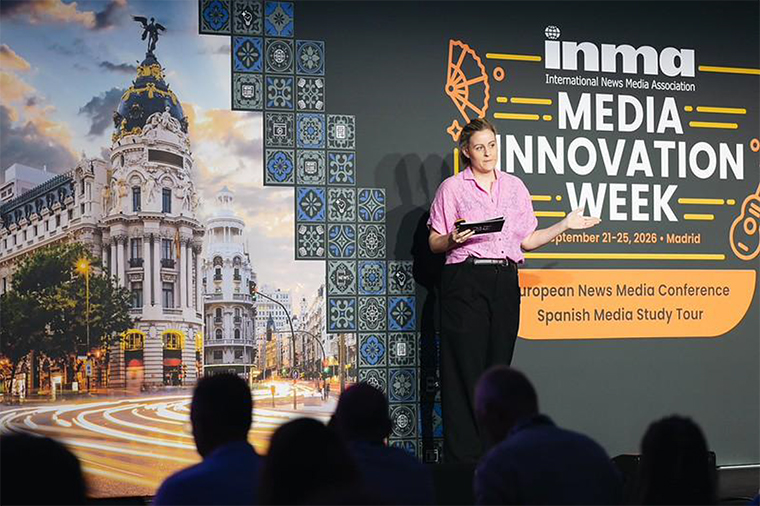
Hanne Louise Akernes, innovation project manager at Bergens Tidende, at INMA Media Innovation Week in Madrid.
Here are some of Akernes’ tips on smoothing the path for innovation:
Never pitch an idea unless it supports what the company is trying to achieve, whether it is hitting a subscriptions goal or reaching a particular target group. “If you have the answers to those questions when you pitch, you very often get a ‘yes,’” she said.
Start at the finish line. What will it look like when it finishes? “When I start a project, I always start by thinking about what needs to be in place when this is launching, even if it’s just in three hours,” Akernes said. “Because you can’t do everything step by step. That’s not fast. If you want to innovate quickly, you need to have all these processes happening at the same time: What will it look like on the front page? What about marketing, social media? What about user testing?”
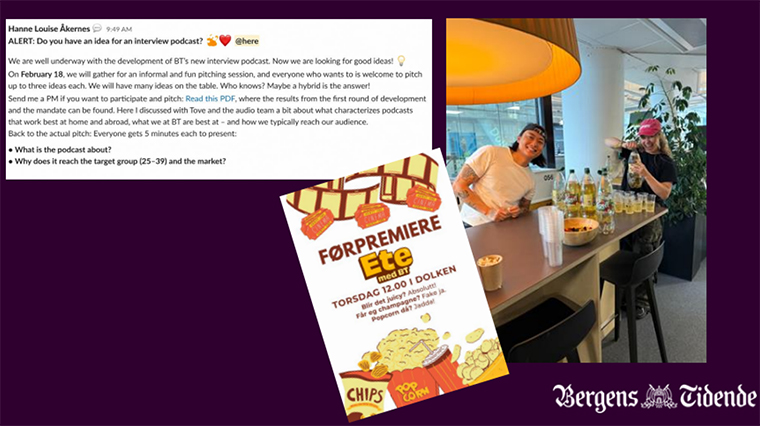
Build ownership from the start. Make buy-in happen at the beginning of the process rather than creating something nobody wants and then begging colleagues to show it some love. For example, to create a podcast, Akernes invited the entire company — editorial, content marketing, product, and others — to pitch their ideas. She ended up with 16 ideas, and the final product was a mix of many of them.
“A lot of people feel ownership of this podcast,” she said. “Invite yourself to the morning meeting in your company. Hold a competition to make the coolest name,” she suggested. “Share what you’re working on along the way. Don’t keep it in a corner as a secret.”
Slide presented by Hanne Louise Akernes, innovation project manager at Bergens Tidende.
Draw inspiration from data and a wide range of sources. Look at trends and learn about the people you’re going to reach. “How do they behave, and how do they live their life? And don’t just look at what other media companies are doing. Look at gaming, social media, marketing, culture, design, TV streaming …” One example that worked for her was microdramas on TV, which use interesting storytelling techniques to keep viewers hooked.
If you don’t get resources, do it yourself. For example, she created a space at Norwegian festivals where readers could make exchange bracelets, inspired by Swifties and creative studios popping up across the country.
“Because we wrote the text, we gave the designers some sketches, and we took care of the practical stuff, we were able to make this in a few hours, and then we got to sit with hundreds of young people talking to us about Bergens Tidende during a festival. We need a culture where people are not locked to one field to get the time and trust to learn new things. It might not be perfect, but you get the project out there, and people don’t get offended when you step into their field — my experience is the opposite. They’re very happy that you’re interested, and they’ll give you a few tricks.”
Energy creates momentum. “It’s all the small things: getting excited about other people’s ideas, loving your job, the extra positive emoji on Slack, and being physically present,” she said. “The worst feeling is feeling that you’re alone in a project” because that creates fear, which slows innovation down. Any criticism is directed at the entire team, not individuals, because each project is a team effort. You need to make people feel safe.
Use your audience. Your user testing doesn’t have to be perfect and you will still learn a lot. For example, to gather feedback on Bergens Tidende’s popular football podcast, Akernes created “pod circles,” which are like a book club for the podcast. Someone in one of them pointed out that the hosts never introduce themselves. “How am I supposed to know who they are? They never say it.”
Keep the idea moving. “If you don’t get help, learn it yourself. Not sure if it is working? Ask your audience,” she said. “Innovation doesn’t have to start with a big strategy, a perfect process, or a big team. Sometimes you just have to start.”
If you’d like to subscribe to my bi-weekly newsletter, INMA members can do so here.
Banner photo: Adobe stock image by Adobe stock image by Designermetin.