

Readers understand content partnerships, younger readers want more of them
Print Innovations | 01 September 2026

Surrounded by bits of the Sunday newspaper, a reader flicks through one of the supplements and happens upon an interesting article. It’s a celebration of the long weekend: scenic routes to city breaks, picnics in parks, lazy days in the garden knowing work is one more day away than it should be.
Another is scrolling through TikTok on the way to work. They’ve been stopped in their tracks: a video full of holiday hacks to optimise their packing before their next getaway. They mentally file a few of those tips for later.

Then they notice a brand’s logo in the corner. It’s not usual news brand editorial — this is a paid-for brand partnership.
That instinctively feels like the end of the story. The reader realises the whole thing is just advertising masquerading as something deeper. If a brand is behind this content, surely there’s an ulterior motive. Surely the publisher is compromising their editorial integrity the moment the narrative isn’t theirs.
Except 90% of readers we surveyed agree it’s clear that a content partnership is sponsored by a brand. They know what they’re looking at, and they know what to expect. What’s more, more than half would still consider that brand, while three in four people 35 and younger want more of this content style. Readers value what content partnerships bring.
And what do they bring? For advertisers, content partnerships represent a key opportunity to develop a brand’s narrative well beyond what simple display can do. The readers we asked said such content not only engages them, but it also says more about a brand than more traditional forms of advertising can.
Case study: Boots and Reach
A case in point is Boots pharmacy’s partnership with Reach titles for its “NHS Pharmacy First” campaign.
Adorned with a clear “advertising feature” label up top, the series of articles demonstrated readers could go straight to their local chemist for a range of ailments for which they would usually make a doctor’s appointment.
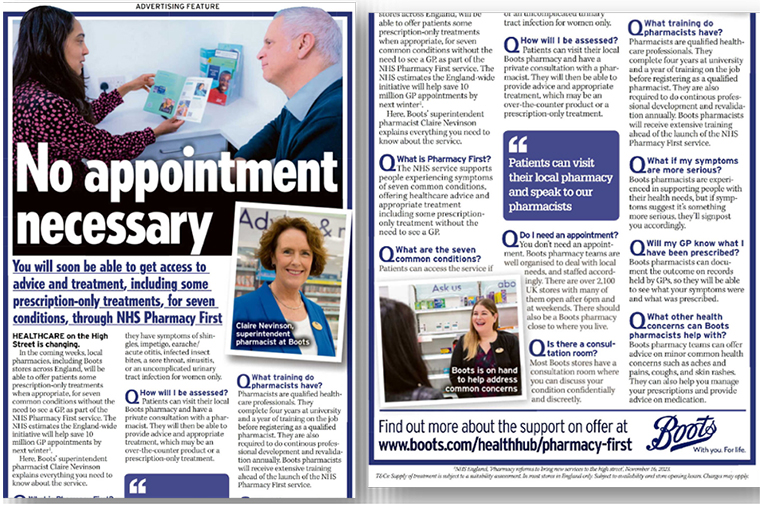
With room to explain properly how Boots could help, the campaign was highly successful with readers. More than two-thirds felt the content contained new information, and 64% said the content made them feel positively toward the advertiser (up 12 points on the print average).
Most importantly, it inspired action: 48% said it encouraged them to find out more — double the print average.
Case study: Jet2Holidays and Mail on Sunday
It’s one thing for a brand such as Boots to encourage readers to make looking after their health easier by swapping surgeries with pharmacies; it’s another for more product-focused consumer brands to avoid coming across as compromised advisors. Yet these sorts of campaigns provide some of the most convincing proof of partnerships’ effectiveness.

One such sector is travel — an area infamously governed by an operator’s strength or a hotel’s reputation. A review feature fronted by the brand itself should theoretically raise an eyebrow.
However, content created for Jet2Holidays’ partnership with the Mail on Sunday’s You magazine, which showcased five luxury resorts, made it easier for readers to cut the wheat from the hotel chaff. The content landed with more than six in 10 readers, who found it both interesting and easy to understand.
Case study: Bobbi Brown and The Sunday Times
Skincare is another part of life in which recommendations rule. If a brand stands behind its own recommendations, it’s tempting to treat that advice with suspicion.
Bobbi Brown’s partnership with The Sunday Times’ Style magazine — in which journalist Roisin Kelly gave a glimpse into her everyday routine across print, digital, and video — went down particularly well with younger consumers. Almost seven in 10 females younger than 35 in our survey said they enjoyed it.

Instead of diluting editorial integrity, these three examples prove the opposite. News brands don’t merely hand over their name and reputation to brands for some easy PR; they lend their trusted voice to tell a story they know will align with readers.
That Sunday supplement reader or that TikTok scroller? They didn’t need to be fooled to engage with the content. They knew what they were looking at. They kept reading.
Banner image: Adobe stock by Vitalii Vodolazskyi.
Related Articles
-

Collective Newsroom is rethinking its approach to young audienc...
28 October 2026 -

African publishers show the world where audience development is...
8 October 2026 -

Every loyal reader was a stranger first
8 October 2026 -

What’s really defensible in the age of AI?
30 August 2026 -

Latin American publishers must rewrite ad strategies around out...
20 July 2026 -

27% of people get their news from a creator
6 July 2026 -

Audiences are reading less fact-based content yet newsrooms con...
25 May 2026 -

Research: Readers increasingly believe AI is used to write arti...
21 May 2026
Upcoming Events
-

Subscriber Acquisition Master Class
10-17 November 2026
-

Media Advertising Summit
New York, United States
07-10 December 2026
-

AI-Native News Product Master Class
18-25 February 2027
-

Media Subscriptions Summit
Oslo, Norway
08-12 March 2027
-

World Congress of News Media
New York, United States
25-30 April 2027
-

Branded Content & Partnerships Master Class
20-27 May 2027
-

Subscriber Retention Master Class
17-24 June 2027
-

Conferencia Latinoamericana
15-16 July 2027
-

South Asia News Media Festival
New Delhi, India
19-22 July 2027
-

Asia/Pacific News Media Summit
19-20 August 2027
-

CEO Roundtable at Kilkenny
Kilkenny, Ireland
24-26 August 2027
-

Media Innovation Week
Amsterdam, The Netherlands
27 September - 01 October 2027








