

African publishers show the world where audience development is heading
Conference Blog | 08 October 2026




When Greg Piechota looks at how audiences around the world find news today, he sees African publishers ahead of the curve.
“The north is becoming more like the south,” Piechota, lead of INMA’s Readers First Initiative and its Researcher-in-Residence, told attendees of the recent INMA Africa Audience Development Summit, sponsored by WordPress VIP and Parse.ly. “You are showing us how publishers might actually live in the future of news consumption.”
Historically, audiences in the global south relied more heavily on social platforms for news, while those in Europe and North America went directly to Web sites and apps. That distinction is disappearing, Piechota said.
The summit’s African speakers showed what living with it looks like in practice. Audiences move fluidly across radio, television, social media, and their phones. Loyalty has to be earned. Brands must go where their readers are, online and off.
Demand isn’t the problem; access is
“Most people access news via a side door,” Piechota said. That means aggregators, social media, and video platforms, while direct traffic shrinks.
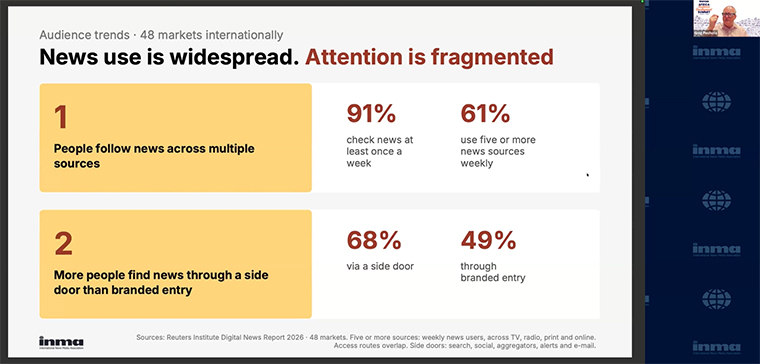
Data from hundreds of publishers worldwide, including several in South Africa, showed the median news Web site lost 14% of its reach in Q2 2026 compared with the 2024 average. Heavy users held steady. What publishers are losing are casual audiences with little brand preference.
Maggie Ireri, CEO of TIFA Research-Africa, described what that side door looks like in Africa. Audiences may first encounter a story on TikTok, YouTube, or through a content creator, then go to an established news outlet to verify it. Kenyan trust data she presented showed television and radio attracting greater trust, while Facebook and TikTok recorded higher levels of mistrust.
That gives each platform a different job, Ireri said. Social media delivers speed, reach, and engagement. Radio and television deliver trust and depth.
The reality is hybrid
If the north is becoming more like the south, Ireri’s research showed the south is not simply social-first. African audiences combine traditional and digital media rather than abandoning one for the other.
Afrobarometer data across 38 African countries in 2024/25 showed 59% of respondents got news from radio every day or a few times a week.
“The reality is hybrid,” Ireri said. “It is not an issue of talking about whether it’s traditional media or digital. It’s actually saying it’s a combination of traditional media and digital media.”
Radio’s staying power comes partly from geography. Social media regularly reached 65% of urban audiences but only 34% of rural audiences, while radio reached 59% and 60% respectively. Radio sets are cheaper than televisions and can run on batteries where electricity is unreliable. Internet access depends on data bundles, which can limit consumption, especially of video.
“Don’t write off radio,” Ireri said. “Use radio and digital together, and then plan by audience.”
Nor is digital only for the young. Among respondents aged 56 and older, 74% used the Internet every day or a few times a week. Ireri recalled meeting four men in their 70s in rural Kenya who had stopped buying newspapers because they got their news online. “Digital is no longer a youth channel,” she said.
Know who you are really serving
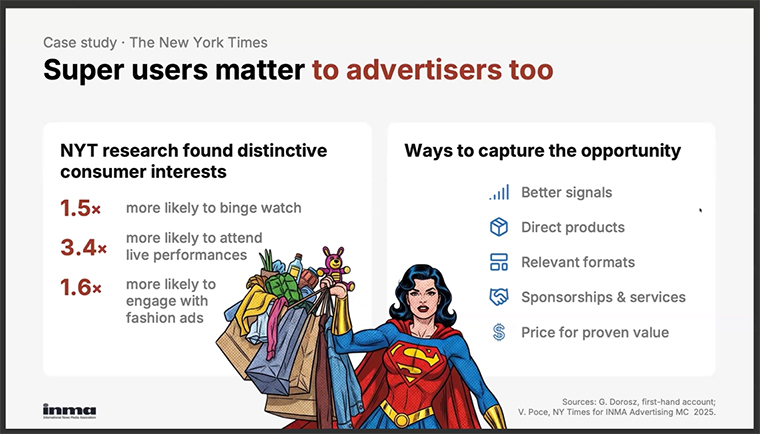
With casual reach eroding, Piechota urged publishers to focus on the audiences who stay. INMA calls them super users: The top 1% to 5% of a publisher’s audience who visit frequently, read widely, and stay subscribed for years.
Across markets, the 1% of users who subscribe generate 27% of all pageviews. The top 10% of heavy users generate more than 60%. That small group often produces 70% to 80% of total revenue.
Arena Holdings in South Africa has reached a similar conclusion from a different direction. “If you had asked me probably a year or so ago what makes this business tick, I probably would have said very proudly that we reach millions of people,” said Nwabisa Makunga of Arena Holdings.
Now, she said, Arena is asking what its audiences actually value, across a portfolio that includes the Sunday Times, TimesLIVE, Business Day, and Sowetan. Mass distribution no longer guarantees meaningful consumption.
“I’ve been an editor and editors will tell you, ‘I think I know best what my audience is,’ but do you really?” Makunga said.
At Sowetan, research revealed a growing appetite for utility journalism: money, jobs, side hustles, and consumer affairs. Looking at the questions people ask outside Arena’s own platforms helped uncover those needs.
One month, a top search query was where to buy an illegal gun in South Africa. Arena treated it as a signal of a deeper concern about safety, and asked what journalism could help people keep themselves safe.
Open more doors, online and off
If audiences won’t come through the front door, publishers must open more doors, Piechota said. In other words, they must behave more like African publishers. That means being present in AI search, on social platforms, in newsletters, podcasts, events, and on WhatsApp.
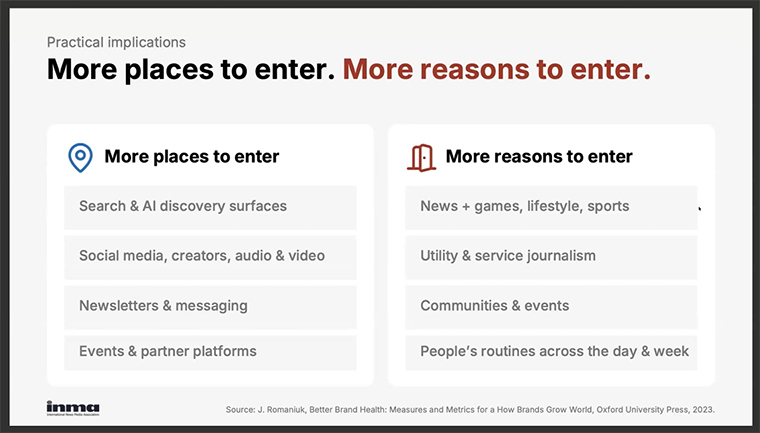
“We cannot wait for them only to come to our sites,” he said. “We also need to go to them.”
He offered a framework for doing so:
- Build: newsletters, apps, festivals, or new products.
- Buy: collaborations with telecoms, paid social promotion, or business partnerships.
- Borrow: platforms such as TikTok, YouTube, Spotify, or Apple News, gaining scale but accepting platform risk.
Nation Media Group Uganda tested that idea under extreme conditions. When its operations were shut down for 37 days, affecting print, television, and radio, NMG Uganda kept reaching audiences through whatever doors remained open. Remote work, offsite digital production, livestreams on YouTube, and an e-paper that returned before physical distribution all helped.
The physical door mattered just as much. When NMG returned, staff went onto the streets and sold newspapers themselves.
“So that was also proof to the country that we were honestly back,” said Hajara Batuuka, head of marketing at Nation Media Group Uganda. “Physical presence in Uganda still matters.”
Loyalty is built before it is tested
The shutdown gave NMG an unusual view of its audience’s loyalty. Messages arrived from people saying they missed NTV and were waiting for its return.
“It’s because we’ve built trust over time as Nation Media Group,” Batuuka said.
Still, NMG did not assume restoring its platforms would restore old habits. It communicated its return in phases. It enlisted on-air talent to tell followers on their own social media accounts that they were back. It promoted popular shows to draw audiences back into familiar routines.
“Consistency and routine does matter as we are building loyalty,” Batuuka said.
Ireri said earning that routine depends on value, not volume. One East African study found some respondents were taking breaks from social media because they felt overwhelmed. “Audiences do not need more content,” she said. “They need content that is worth their attention.”
What it adds up to
Piechota closed with three takeaways, and the summit’s African speakers supplied evidence for each:
Understand valuable users. They drive most revenue, and Arena’s shift from reach to relevance shows what that looks like in practice.
Earn new attention. Be present where people are, whether that’s radio, YouTube, WhatsApp, or a street corner selling newspapers.
Give people more reasons to return. That can be through journalism, utility, and even games.
Related Articles
-

WSJ executive councils show how publishers build communities th...
19 October 2026 -

There is no subscription ceiling — there is a Web site ceiling
4 October 2026 -

What a week in Madrid taught publishers about young audiences
27 September 2026 -

Challenging 3 myths about audience engagement
21 September 2026 -

AI’s effect on super user math
15 September 2026 -

10 years later, user needs must be twinned with content formats...
1 July 2026 -

Why are audiences going to AI answer engines for news?
30 June 2026 -

News companies should stop chasing clicks, start competing for ...
28 June 2026
Upcoming Events
-

Subscriber Acquisition Master Class
10-17 November 2026
-

Media Advertising Summit
New York, United States
07-10 December 2026
-

AI-Native News Product Master Class
18-25 February 2027
-

Media Subscriptions Summit
Oslo, Norway
08-12 March 2027
-

World Congress of News Media
New York, United States
25-30 April 2027
-

Branded Content & Partnerships Master Class
20-27 May 2027
-

Subscriber Retention Master Class
17-24 June 2027
-

Conferencia Latinoamericana
15-16 July 2027
-

South Asia News Media Festival
New Delhi, India
19-22 July 2027
-

Asia/Pacific News Media Summit
19-20 August 2027
-

CEO Roundtable at Kilkenny
Kilkenny, Ireland
24-26 August 2027
-

Media Innovation Week
Amsterdam, The Netherlands
27 September - 01 October 2027








