

There is no subscription ceiling — there is a Web site ceiling
Readers First Initiative Blog | 04 October 2026

Alejandro Laso, chief operating officer of El Confidencial, put a funnel slide in front of a room of visiting publishers in Madrid: “We are not in the traffic business. We are in the returning-reader business.”
Of 14 million monthly unique users to this Spanish digital native news Web site, most “arrive from a platform, read one story, and leave.”
One million users come back month after month. Together, they make 70% of the company’s €27 million annual revenue. This 1 million users watch and click most ads on the Web site, and pay for subscriptions or for events.
(At INMA, we call those people “super users,” and we see a similar pattern across hundreds of news Web sites we are benchmarking.)
Industry priorities
Every publisher we visited in Madrid during INMA Media Innovation Week — ABC, El Diario, El Mundo, El Pais, and others — told a version of that story.
As referrals from aggregators, search, and social media decline, priorities shift towards direct traffic, audience engagement, subscriber retention, and pricing.
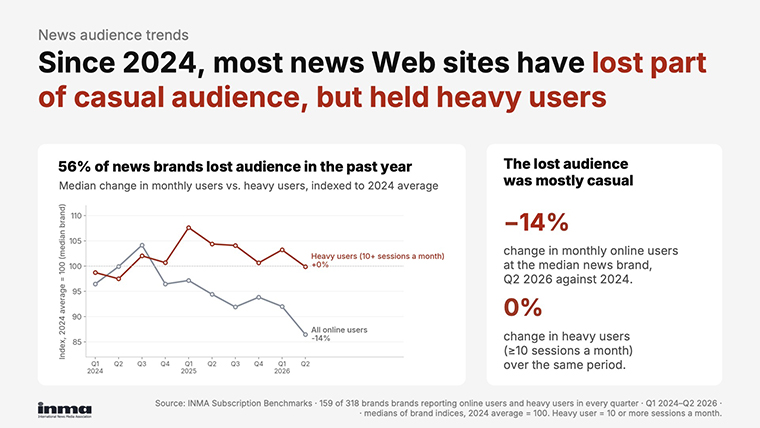
Internationally, according to the INMA Subscription Benchmarks, the median brand lost 14% of online users in the past two years, but it kept heavy users: people with 10 or more sessions a month.
That looks like proof that a smaller, more loyal audience is possible, and explains the common perception that the best strategy today is to work harder on loyalty.
In a new FT Strategies and WAN-IFRA survey, 73% newsroom leaders named audience engagement their top goal for 2026.
Evaluating publishers’ responses
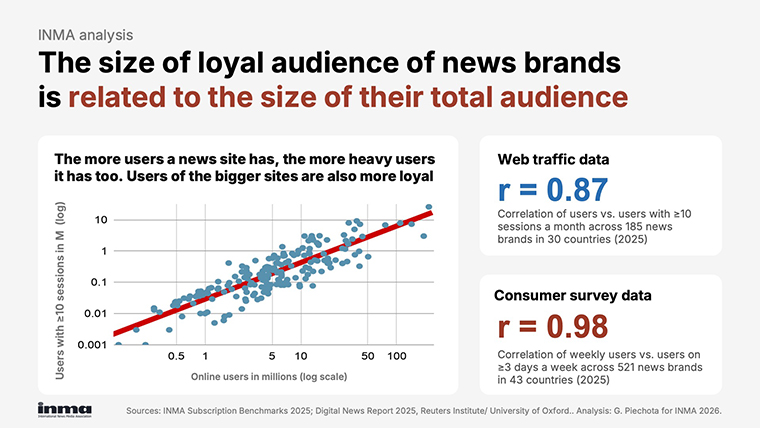
Firstly, I checked whether the size of loyal audience is independent from the size of the total audience.
I used the Web traffic data shared by 185 news brands in 30 countries and consumer surveys in 43 countries asking about 521 news brands.
I found a strong correlation between the two — the more users a news site has, the more heavy users it has, too. Users of the bigger sites are also slightly more loyal.
While intuition tells us to grow a loyal audience despite shrinking reach, the evidence suggests such outcome is rare and likely hard to achieve.
Secondly, I checked what increasing retention and prices would do to the subscription revenue of a typical news brand.
Assuming the audience is constant, we lift retention from the median to the top quartile of publishers, which translates into 25% fewer early cancellations. We also raise prices for tenured subscribers (12 months or longer) and effectively get ARPU up 5% a year. In year three, the total revenue is up 19%.
Then, I compared this approach with alternatives, such as converting aggressively, which would drag ARPU and retention rates down.
When we lifted conversion to the top quarter (effectively 72% more new starts monthly), with each new subscriber worth less due to discounts and churn drag, our model showed 42% higher revenue in year three.
This modeling shows the focus on superior retention and pricing offers slower revenue growth potential for the median news brand than superior conversion.
(Of course, combining all three levers together would push revenue up even more, but there are few brands that sit in the upper quartile with all three metrics. If it’s rare, it is likely difficult.)
The subscription ceiling question
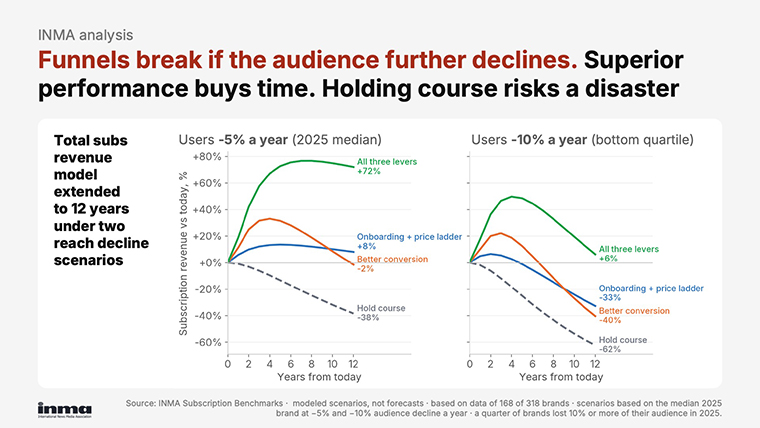
When we let the audience fall the way it has been falling for most news brands, at 5% a year, every strategy peaks within four to eight years.
At 10% decline a year, the 2025 rate in the bottom quarter of brands, every strategy is below today’s revenue within five to seven years.
Holding course loses money in every scenario, from the first year. When the audience declines, the normal funnel performance is no longer enough.
“So, is there a subscription ceiling?” a chief executive asked me at INMA’s CEO Roundtable in Vail this August. In my opinion, there is not.
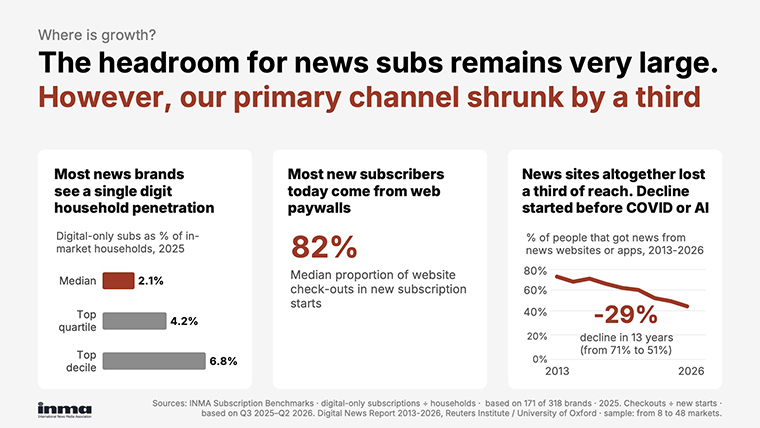
The median publisher sells digital-only subscriptions to about 2% of the households in its market. The top quarter reaches 4%, the top 10th 7%. The highest known case in the world, Estonia’s Delfi, reaches 25% of households.
Meanwhile, 92% of Europeans checked a news source last week, and two-thirds used five or more sources, per Reuters Institute’s surveys. Demand for news is stable and broad.
So, why do most publishers grow more slowly than in the past?
The ceiling is in the channel
Today, four in five subscriptions are still completed in the checkout on the publisher’s own Web site, after a paywall. Fewer than 30% of a median site’s users ever see that paywall.
And Web sites and apps, as a category of news sources, were used less and less every year well before AI Overviews. This steady decline was tracked, for example, by Reuters Institute’s surveys since 2013.
The culprit is increased competition from other news sources, such as social and video apps. AI chatbots promise to accelerate the shift away from Web sites. The decline news publishers see from the inside is really a fragmentation when viewed from the outside.
In a nutshell, the news industry built a single door, placed its entire sales operation behind it, and is now watching the street outside empty.
Based on evidence I presented in Madrid and in this analysis, the industry’s shift of priorities from reach to loyalty or from acquisition to retention is likely to disappoint in the long term.
The correlation between reach and loyalty I discovered in news suggests publishers cannot shrink themselves into audience success.
My revenue simulations for INMA suggest that growing through milking a declining subscriber base brings less revenue than aggressively acquiring new subscribers.
The better strategic response to this disruption is opening more doors to our house. From one channel, one funnel, one format to many.
Apple sells about 15% of its iPhones in Apple Stores, and the store in Madrid is where the company makes the best case to the people who spend the most.
It is no different than publishers investing in their Web sites and apps as destinations where they can best serve their super users.
But Apple does not stop selling through Amazon or Telefónica mobile stores across Spain. Why would they abandon 85% of their customers? Why would publishers do this?
Greg’s Readers First newsletter is a public face of a revenue and media subscriptions initiative by INMA, outlined here. INMA members can subscribe here.
Banner photo: Adobe Stock by Alexandr Peers.
Related Articles
-

WSJ executive councils show how publishers build communities th...
19 October 2026 -

Bundling is a pricing decision, rebundling is an organisational...
18 October 2026 -

Challenging 3 myths about audience engagement
21 September 2026 -

AI’s effect on super user math
15 September 2026 -

At Mediacorp’s CNA, loyalty means giving audiences a reason to ...
20 August 2026 -

Indian Express builds a video-first future around trusted journ...
20 July 2026 -

Economist launches subscription tier targeting younger audience...
20 July 2026 -

10 years later, user needs must be twinned with content formats...
1 July 2026
Upcoming Events
-

Subscriber Acquisition Master Class
10-17 November 2026
-

Media Advertising Summit
New York, United States
07-10 December 2026
-

AI-Native News Product Master Class
18-25 February 2027
-

Media Subscriptions Summit
Oslo, Norway
08-12 March 2027
-

World Congress of News Media
New York, United States
25-30 April 2027
-

Branded Content & Partnerships Master Class
20-27 May 2027
-

Subscriber Retention Master Class
17-24 June 2027
-

Conferencia Latinoamericana
15-16 July 2027
-

South Asia News Media Festival
New Delhi, India
19-22 July 2027
-

Asia/Pacific News Media Summit
19-20 August 2027
-

CEO Roundtable at Kilkenny
Kilkenny, Ireland
24-26 August 2027
-

Media Innovation Week
Amsterdam, The Netherlands
27 September - 01 October 2027








