

Challenging 3 myths about audience engagement
Readers First Initiative Blog | 21 September 2026

Many news publishers currently aim at owning relationships with their loyal audiences. They try to change people’s habits. And faced with fragmenting funnels, they retreat to their own Web sites and apps.
These goals seem desirable, strategies rational, and beliefs intuitive. I hear them over and over this year when meeting audience managers and industry analysts.
Getting the facts straight matters, as audiences are facing an unlimited supply of online news and other media content, and publishers see fierce competition for people’s attention.
Audience engagement is the top priority in hundreds of newsrooms surveyed by FT Strategies and WAN-IFRA.
The first myth bust: loyalty
You do not own the loyal audience, but neither does anyone else.
We see an average online user spending three minutes and 14 seconds during one of their three monthly visits to our news Web site (the global median per INMA Benchmarks).
We miss the remaining 23 hours from her day because we have no first-party data available. We have to use other data, for example, surveys.
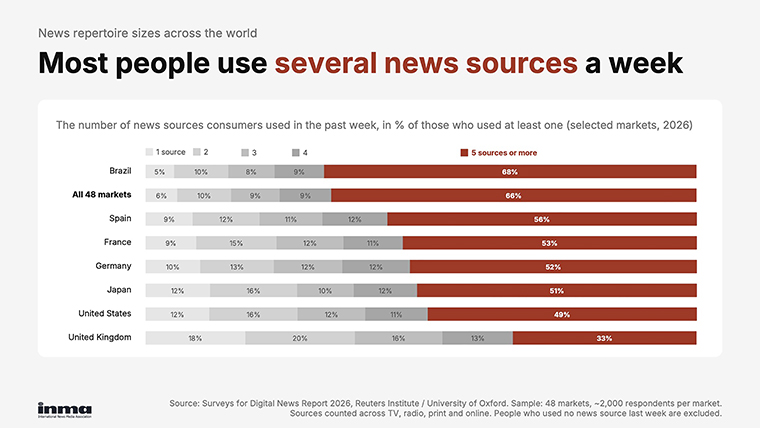
Across the 48 markets in Reuters Institute of Oxford’s 2026 survey, 66% of people who used any news last week said they used five or more sources. This is rising to 74% among those who checked the news several times a day.
The people worth the most to news brands are also the ones with the broadest repertoires and sampling the most competitors.
The implications? We are competing for a place in someone’s repertoire, not for an exclusive relationship.
Consider targeting. Finding new subscriber prospects using lookalike audiences only partly works. Our heavy users are likely category heavy users, so they are visible in our data. But the user who gave us only 5% of their attention looks casual, and our lookalike models miss her.
Ways to go around it? Target the competitors’ followers through interest-matching on social media and other advertising tools. Use the correlations: For example, according to Oxford data, by far the strongest predictor for heavy usage is interest in news and politics (a 47-point spread), against five to seven points for gender, education, or income.
You can also get access to someone else’s heavy users through subscription bundles or distribution partnerships, for example, The New York Times signs deals with news brands across the world.
The second myth bust: habits
You can hardly impose a new routine on people, but you cannot be locked out of theirs either.
A 2024 meta-analysis of 20 habit-formation studies found the time to reach new routines ranged from 59 to 66 days (medians) and from 106 to 154 (means), with large individual differences. Some people needed just four days of repetition, others needed 335 days.
Frequency, motivation, enjoyment, and the stability of the routine context (place, accompanying activities, time) influenced the habit strength.
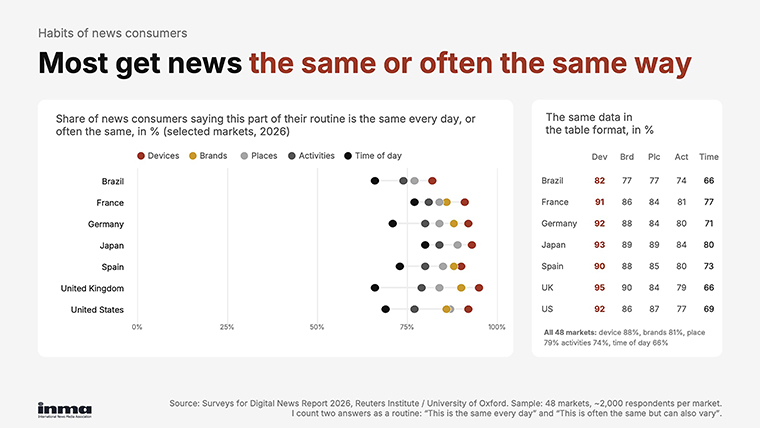
News audiences are creatures of habit, too, and Oxford survey data show that most habits are already established and do not vary often:
For 88% of people globally, the device on which they consume news is the same or often the same.
For 79%, the physical space where they do it is the same or often the same.
For 74%, the accompanying activities — such as breakfast, commute to work, coffee break, evening leisure time — are the same or often the same.
For 66%, the time of the day is the same or often the same.
(Note on method: The survey’s middle option — “This is often the same but can also vary” — can be read either way. I count it as routine on the grounds that a pattern holding most days is one a publisher can plan against. The Reuters Institute’s own summary reads it as variation.)
Most consumers (81%) also use the same or often the same repertoire of news sources every day. According to repertoire studies, the routines break during high-uncertainty events, such as a war, an election, a disaster, and that is when people alter their day and add a source.
First people need to know what happened, then why it matters. Breaking news gets a brand into the repertoire; having something to say afterwards keeps it there. A 2026 Cardiff-BBC study on user needs found only “Update me” and “Give me perspective” reliably predicted how often people consumed news.
The rest of the year, join a routine rather than proposing a new one. If you have resources to invest in one routine only, start with e-mail.
This is the largest single opportunity for your news to arrive inside a routine that runs every day and takes up a quarter of Americans’ online time, according to a 2026 Northeastern study.
Per Oxford data, so far only 20% of Americans get news via an e-mail alert or newsletter.
The third myth bust: direct relationships
You do not need to own the funnels end to end, but you cannot grow without the acquisition layer, nor survive without the monetisation layer.
While a few most engaged users, which we at INMA call “super users,” generate most of the revenue from subscriptions and advertising for most news brands, their number is greatly correlated with the number of all users they reach.
The inconvenient truth is mass-market consumer news publishers simply need reach for growth, and for their journalism to make any impact, and they cannot shrink themselves into sustainability or relevance.
The spaces for which we control access, data, and price, as explained by the top media CEOs, such as the Financial Times or The New York Times, become our monetisation layer because we can provide our super users with the best experience.
These spaces though cannot be our acquisition layers. They reach only the few by design. Acquisition requires broadening distribution beyond the controlled spaces.
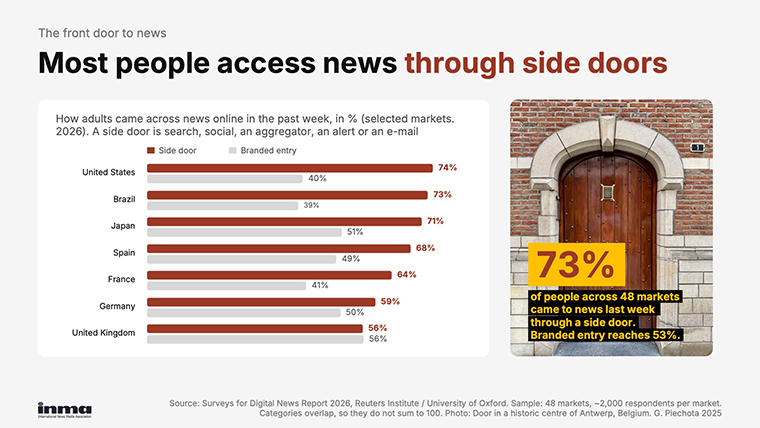
This is where consumers are. Across 48 media markets, 73% of people came across news last week through a side door, such as a video or social platform, an aggregator, a search engine, or an AI chatbot.
Many publishers hesitate to invest in the side doors for a good reason. They fear renting an audience does not translate into dollars, which they learned the hard way in the past.
Case studies of BuzzFeed and Nike
In a 2023 book Traffic, a former BuzzFeed News Editor Ben Smith documented the rise and fall of the traffic era leading innovators. They nailed audience acquisition in the pursuit of scale, but they never figured out the direct monetisation layer.
They had a sort of “magical thinking,” per Smith, that Meta and other platforms would feel obliged to support them, and they had not. When social platforms cut referrals, BuzzFeed found itself without an audience, neither rented nor direct, to monetise.
If BuzzFeed is the warning against reach without monetisation, let me offer Nike as the warning against monetisation without reach. Shoes are not media, but their distribution faces similar tradeoffs.
From 2017, the sports shoe brand cut supply to multi-brand retailers such as DSW, Foot Locker and Macy’s, later also Amazon, turning to its own stores, Web shops and apps.
Direct sales indeed increased, but the loss of broad distribution had a greater impact on the brand presence and total sales plunged. Getting back the shelves was hard: Nike’s competitors had already taken them over.
Marketing professors warned in Harvard Business Review that “few brands can rely only on their own channels.”
Advice to audience engagement leaders
You have more games to play than you might think.
A funnel — this useful but simplistic analogy for messy consumer decision-making — makes some believe it is a single contest, won or lost at one door.
In practice, a repertoire is a set of doors — from newsletters to podcasts to video feeds — and each has a different set of competitors trying to get their feet in.
A news brand can lose many of these contests and still win others, and grow the overall audience and the business this way. See Germany’s Die Zeit for inspiration.
More games available doesn’t mean you need to enter all. Pick the few you can fund and win.
How to get into people’s repertoires? Join me next week in Madrid for the INMA Media Innovation Week. I am preparing a guide for audience managers about the new rules of engagement. Register now.
Greg’s Readers First newsletter is a public face of a revenue and media subscriptions initiative by INMA, outlined here. INMA members can subscribe here.
Banner photo: Adobe Stock by Buy My Stuff.
Related Articles
-

WSJ executive councils show how publishers build communities th...
19 October 2026 -

Bundling is a pricing decision, rebundling is an organisational...
18 October 2026 -

There is no subscription ceiling — there is a Web site ceiling
4 October 2026 -

AI’s effect on super user math
15 September 2026 -

At Mediacorp’s CNA, loyalty means giving audiences a reason to ...
20 August 2026 -

Indian Express builds a video-first future around trusted journ...
20 July 2026 -

Economist launches subscription tier targeting younger audience...
20 July 2026 -

10 years later, user needs must be twinned with content formats...
1 July 2026
Upcoming Events
-

Subscriber Acquisition Master Class
10-17 November 2026
-

Media Advertising Summit
New York, United States
07-10 December 2026
-

AI-Native News Product Master Class
18-25 February 2027
-

Media Subscriptions Summit
Oslo, Norway
08-12 March 2027
-

World Congress of News Media
New York, United States
25-30 April 2027
-

Branded Content & Partnerships Master Class
20-27 May 2027
-

Subscriber Retention Master Class
17-24 June 2027
-

Conferencia Latinoamericana
15-16 July 2027
-

South Asia News Media Festival
New Delhi, India
19-22 July 2027
-

Asia/Pacific News Media Summit
19-20 August 2027
-

CEO Roundtable at Kilkenny
Kilkenny, Ireland
24-26 August 2027
-

Media Innovation Week
Amsterdam, The Netherlands
27 September - 01 October 2027








