

Reach feeds loyalty and subscription growth for news publishers
Readers First Initiative Blog | 07 June 2026

Faced with traffic disruptions, some news publishers have been trading scale for depth, accepting smaller but more committed audiences. New INMA research suggests this trade-off is an illusion: Reach is the key to loyalty and revenue.
Behavioural data from INMA members, validated with consumer surveys in major markets, shows the more users a news Web site or app has overall, the more loyal users it has too.
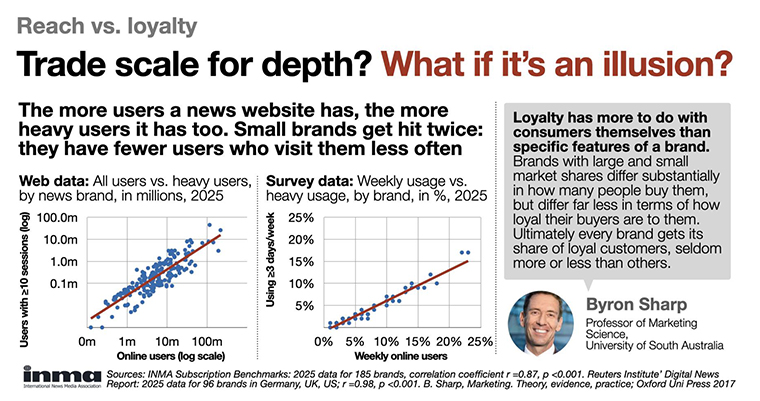
Smaller sites seem to suffer a double penalty: fewer users overall and proportionally fewer loyal ones among them. Marketers have a name for this pattern: the Double Jeopardy Law. And our data fits it closely.
In the INMA data set of 185 news brands, the relationship in 2025 between the size of the total online audience and the heavy-user base (at least 10 sessions a month) was nearly linear (Pearson’s r = 0.87, p < 0.001).
We matched this result against Reuters Institute’s 2025 survey data, covering 96 news brands across Germany, the U.K., and the U.S., and found a similarly linear relationship between weekly users and people using a brand three or more days a week (r = 0.98, p < 0.001).
We presented this analysis first to executives benchmarking with INMA and then publicly at the INMA World Congress of News Media in Berlin in May 2026.
The link between reach and subscription growth
Our previous research showed reach and engagement directly fed demand for digital subscriptions and drove revenue in 2025.
Large publishers (with at least 20,000 digital subscribers) that grew subscription volume fastest also grew subscription revenue fastest.
The fast growers did not achieve this by shrinking toward loyal audiences. They maintained or grew total reach, which created more paywall stops, more checkout starts, and more paid conversions.
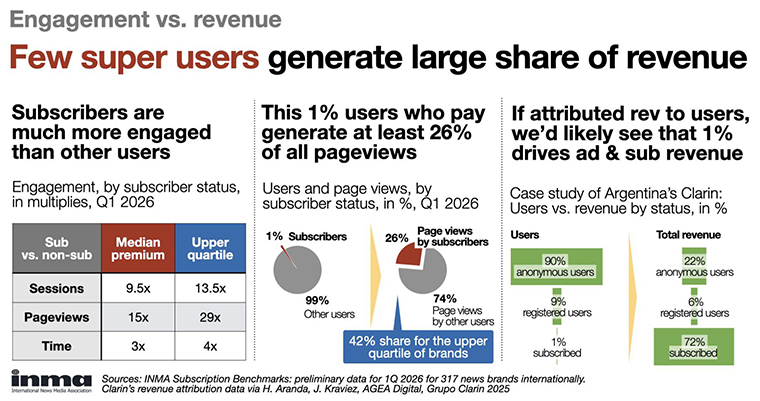
In general, engagement with news sites is concentrated among a few loyal users: the heavy, high-value readers we call super users.
For the median publisher, per the INMA Benchmarks, subscribers — who make up roughly 1% of users — generated 26% of all pageviews in the first quarter of 2026. For the top quartile, that concentration exceeded 40%.
This is because subscribers are more loyal. They generate roughly nine times more sessions than non-subscribers, 15 times more pageviews, and spend about three times more time.
Had we been able to attribute conversions, renewals, and advertising inventory to users by their loyalty or subscription status, we would likely see a high concentration of revenue, too.
At a private benchmarking meet-up alongside the INMA World Congress in Berlin last month, a European executive shared an internal analysis for a large national news brand: Subscribers, about 1% of users, generated 81% of combined subscription and advertising revenue in 2025.
The link between reach and loyalty
When publishers ask how to create more of these super users, the instinctive answer is to focus more narrowly on the already-engaged.
Our research suggests the opposite: Those users came from having a large audience in the first place.
This pattern mirrors what Australian academic Byron Sharp and others documented for consumer goods and services: Loyalty is largely a byproduct of market penetration, not a substitute for it.
“Loyalty has more to do with consumers themselves than specific features of a brand,” Professor Sharp wrote in Marketing: Theory, Evidence, Practice.
“Brands with large and small market shares differ substantially in how many people buy them, but differ far less in terms of how loyal their buyers are to them. Ultimately every brand gets its share of loyal customers, seldom more or less than others.”
Indeed, consumer surveys show news consumers, too, are rarely exclusive to a single brand or platform.

Redefining reach for an era of fragmented funnels
Social media, aggregators, podcasting apps, and AI surfaces are increasingly where users first encounter news brands.
The attribution systems that make these channels appear low-value for news publishers measure the wrong thing: traffic or session-level conversions rather than long-cycle brand familiarity.
At an INMA town hall in 2025, Le Monde CEO Louis Dreyfus described the logic for redefining what reach is in the era of fragmented funnels: Investments in Snapchat five years ago are now visible in the proportion of new subscribers under 30.
Greg’s Readers First newsletter is a public face of a revenue and media subscriptions initiative by INMA, outlined here. INMA members can subscribe here.
Related Articles
-

Every loyal reader was a stranger first
8 October 2026 -

There is no subscription ceiling — there is a Web site ceiling
4 October 2026 -

Challenging 3 myths about audience engagement
21 September 2026 -

The inbox deserves more investment from publishers in the AI er...
26 July 2026 -

News companies should stop chasing clicks, start competing for ...
28 June 2026 -

News publishers leverage audience insights to build deeper rela...
23 June 2026 -

Subscription benchmarks reveal dynamic strategies set top news ...
15 June 2026 -

Research: Some consumers are willing to pay, unwilling to commi...
14 June 2026
Upcoming Events
-

Subscriber Acquisition Master Class
10-17 November 2026
-

Media Advertising Summit
New York, United States
07-10 December 2026
-

AI-Native News Product Master Class
18-25 February 2027
-

Media Subscriptions Summit
Oslo, Norway
08-12 March 2027
-

World Congress of News Media
New York, United States
25-30 April 2027
-

Branded Content & Partnerships Master Class
20-27 May 2027
-

Subscriber Retention Master Class
17-24 June 2027
-

Conferencia Latinoamericana
15-16 July 2027
-

South Asia News Media Festival
New Delhi, India
19-22 July 2027
-

Asia/Pacific News Media Summit
19-20 August 2027
-

CEO Roundtable at Kilkenny
Kilkenny, Ireland
24-26 August 2027
-

Media Innovation Week
Amsterdam, The Netherlands
27 September - 01 October 2027








