

Research: Some consumers are willing to pay, unwilling to commit
Readers First Initiative Blog | 14 June 2026

Willingness to pay is not willingness to commit. New experiments at one European and one American publisher suggest that distinction could help the news executives expand the market for paid news.
Today only about one in five online users pays or accesses paid-for online news across 20 major media markets, per Reuters Institute. Growing the penetration has been the industry’s central project for years through paywalls, premium content, and bundles.
Most of these efforts rest on an assumption: Willingness to subscribe is the same as willingness to pay.
What if it’s not?
“The subscription model is not wrong; it’s incomplete. There’s a growing gap between willingness to pay and willingness to commit,” Anjali Iyer, global head of subscriptions at The Washington Post, told audiences at the INMA World Congress Berlin last month. She is the author of INMA’s latest report.
Willingness to pay is a judgment about value: Is this journalism worth the money? Willingness to commit is a judgment about risk: A subscription asks the reader to bet on her own future demand. She may be ready to pay but balk at the risk of committing.
Two recent experiments attack that gap from opposite ends:
A European newspaper, working with academics from HEC Paris, tested an auto-renewing trial in place of one that simply expires and found it drew sharply fewer subscribers: More commitment means more risk and lower take-up.
The Washington Post offered passes and single articles beside the subscription and drew sharply more paying readers: Less commitment means less risk and higher take-up.
What commitment costs
There are good reasons auto-renewing subscriptions became the default. Publishers’ common wisdom and academic literature says it works: For example, gym members on rolling monthly contracts stay longer and overpay relative to what they use.
Across digital subscriptions, inertia under auto-renewal can roughly double revenue, with cancellations spiking only when a lapsed payment card forces an active choice. People stay because leaving takes an action they never quite get to.
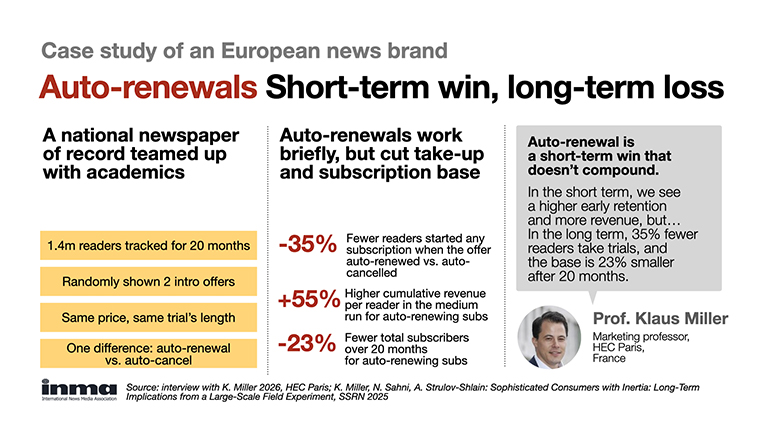
So the result of the European experiment was a surprise. A major quality daily randomly served some readers an auto-renewing trial and other readers one that expired unless renewed. The auto-renewing version aimed at maximising retention, which it did, but it also cut initial take-up by 35% and left the publisher with 23% fewer subscribers over the following two years.
Professor Klaus Miller of HEC Paris explained why: The older studies looked only at people who had already subscribed and missed the take-up decision. Watch that decision instead and the picture flips. “Most consumers are not naive. They anticipate and account for their inertia,” Miller said in a call.
Auto-renewal’s revenue boost is bought by holding on to people who would rather leave, while turning away the larger number who never sign up at all.
Consumers also learned a new tactic: They buy a trial and immediately cancel — 40% of all new subscribers who cancel switch off auto-renew within the first two months, Piano research found; 13% do so on the very first day, clearly rejecting the commitment, not the idea of paying for news.
Unlocking new demand
Look closer at who already pays for online news, and the reduced-commitment reader is already there.
In the U.S., one-fifth of payers declared in a Reuters Institute’s survey they made a one-off payment for a single article or edition, or donated to a news organisation. Ask non-payers what would bring them in, though, and the stated appetite looks thin: Just 7% say more flexible payments would encourage them, against 13% who want a multi-title bundle.
Taken at face value, readers say they prefer all-you-can-eat, and a 2023 Danish study concluded the same. But an abstract question — “Would more flexible payments encourage you to pay?” — is different from showing a flexible option to a reader of a particular brand.
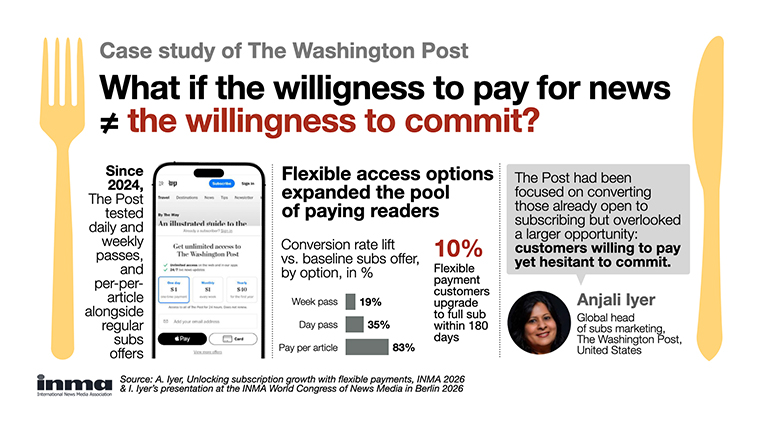
Since 2024, The Washington Post has experimented with a week pass, a day pass, and a pay-per-article option beside its subscription.
The less commitment The Post asked for, the more readers paid: The week pass lifted paid conversion by 19%, the day pass by 35%, and pay-per-article by 83% — all measured against the baseline auto-renewing subscription offer.
Coincidentally or not, The Post’s day pass recovered almost exactly as much demand as their European peer found auto-renewal destroyed.
Does flexible access cannibalise subscriptions?
“Trust me, I asked this question every day, morning and night, all of last year while I was doing this,” The Post’s Iyer said.
“The answer is no, because flexible access is really not a replacement for subscriptions. It’s attracting that middle funnel.”
Priced correctly, the flexible option rarely wins; it anchors. A US$4 day pass beside a US$4 four-week introductory subscription makes the subscription look like the obvious buy, so most readers who pay at all still subscribe.
The Post also found that roughly one in 10 pass buyers converted to a regular subscription within 180 days — without any prompt.
The flexible access buyers tend to arrive through lifestyle, food, and culture coverage, widening the brand’s appeal beyond the politics and investigations that convert core subscribers.
For years, publishers measured the market for subscriptions. The new experiments suggest the more important question may be the market for paid relationships.
Greg’s Readers First newsletter is a public face of a revenue and media subscriptions initiative by INMA, outlined here. INMA members can subscribe here.
Related Articles
-

Every loyal reader was a stranger first
8 October 2026 -

There is no subscription ceiling — there is a Web site ceiling
4 October 2026 -

Challenging 3 myths about audience engagement
21 September 2026 -

The inbox deserves more investment from publishers in the AI er...
26 July 2026 -

News companies should stop chasing clicks, start competing for ...
28 June 2026 -

News publishers leverage audience insights to build deeper rela...
23 June 2026 -

Subscription benchmarks reveal dynamic strategies set top news ...
15 June 2026 -

To expand news repertoires, focus on unmet needs, unclaimed hab...
9 June 2026
Upcoming Events
-

Subscriber Acquisition Master Class
10-17 November 2026
-

Media Advertising Summit
New York, United States
07-10 December 2026
-

AI-Native News Product Master Class
18-25 February 2027
-

Media Subscriptions Summit
Oslo, Norway
08-12 March 2027
-

World Congress of News Media
New York, United States
25-30 April 2027
-

Branded Content & Partnerships Master Class
20-27 May 2027
-

Subscriber Retention Master Class
17-24 June 2027
-

Conferencia Latinoamericana
15-16 July 2027
-

South Asia News Media Festival
New Delhi, India
19-22 July 2027
-

Asia/Pacific News Media Summit
19-20 August 2027
-

CEO Roundtable at Kilkenny
Kilkenny, Ireland
24-26 August 2027
-

Media Innovation Week
Amsterdam, The Netherlands
27 September - 01 October 2027








