

To expand news repertoires, focus on unmet needs, unclaimed habits, and breaking news
Readers First Initiative Blog | 09 June 2026

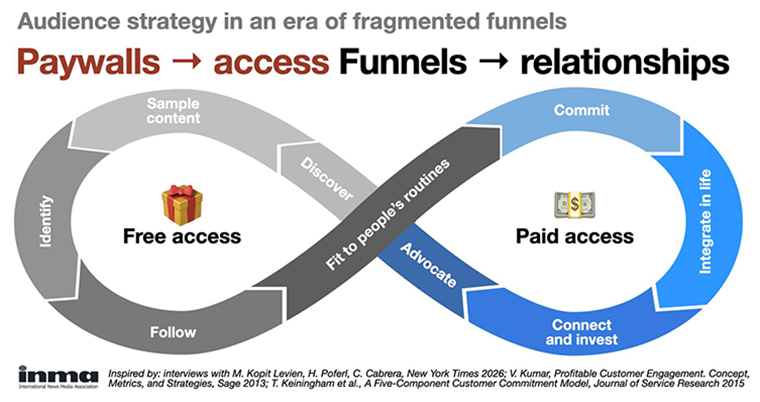
If a durable position in users’ routines is the goal, the practical question is how to earn it.
Academic research suggests you need to satisfy unmet needs and fit unclaimed moments of target audiences’ day.
What the research says
New formats, products, and distribution channels do not acquire audiences abstractly. Understanding how publishers can earn that position is where a growing body of academic research becomes practically useful.
Studies find people add sources, platforms, and formats to their repertoires for a handful of reasons. The most common is a desire for a fuller picture.
Users who feel their existing sources are insufficient seek additional ones to compare narratives and verify claims.
Interest in politics and public affairs pushes users into broader, more diverse consumption. Some even deliberately seek out sources that challenge their views.
Complementarity — filling perceived gaps in someone’s repertoire (my daily crossword, my football app) — is a reliable driver, as are relative advantages (faster, richer, cheaper).
Practical fit matters: New sources enter a routine when they match an existing moment in the day.
Think of a newsletter that arrives before breakfast, a mobile game that works on a commute, a podcast that fits a morning run, or a video feed that helps someone relax late at night.
The investment logic of newsletters, mobile apps, and podcasts becomes clearer through the lens of user needs. New products that ignore the fit with user needs and existing routines are unlikely to stick.
It takes, on average, 66 days of repetition to adopt a new daily habit. Yet most news Web sites see 70% of users visit only once a month. If a habit needs repetition and most users never repeat, a new habit never forms.
Winning breaking news
Research also finds that big news events — elections, economic shocks, and major sporting events — reliably expand repertoires.
Major events push people to seek more information and turn to additional sources, often the best-known and most accessible brands they had not previously used regularly.
This helps explain the repeated traffic surges publishers observe during high-news periods. The COVID outbreak, the U.S. elections, and Russia’s attack on Ukraine are all clearly visible in the online traffic of INMA members across the world.
The window for winning inclusion opens during moments of high need. Whether that inclusion endures depends on what happens next.
Publishers who have built a reputation for breaking news coverage are most likely to capture a spike in traffic. Those who have built follow mechanisms and onboarding for new followers are best positioned to translate a spike into long-term relationships.
Greg’s Readers First newsletter is a public face of a revenue and media subscriptions initiative by INMA, outlined here. INMA members can subscribe here.
Banner photo: Adobe Stock By Andrey Popov.
Related Articles
-

Every loyal reader was a stranger first
8 October 2026 -

There is no subscription ceiling — there is a Web site ceiling
4 October 2026 -

Challenging 3 myths about audience engagement
21 September 2026 -

The inbox deserves more investment from publishers in the AI er...
26 July 2026 -

News companies should stop chasing clicks, start competing for ...
28 June 2026 -

News publishers leverage audience insights to build deeper rela...
23 June 2026 -

Subscription benchmarks reveal dynamic strategies set top news ...
15 June 2026 -

Research: Some consumers are willing to pay, unwilling to commi...
14 June 2026
Upcoming Events
-

Subscriber Acquisition Master Class
10-17 November 2026
-

Media Advertising Summit
New York, United States
07-10 December 2026
-

AI-Native News Product Master Class
18-25 February 2027
-

Media Subscriptions Summit
Oslo, Norway
08-12 March 2027
-

World Congress of News Media
New York, United States
25-30 April 2027
-

Branded Content & Partnerships Master Class
20-27 May 2027
-

Subscriber Retention Master Class
17-24 June 2027
-

Conferencia Latinoamericana
15-16 July 2027
-

South Asia News Media Festival
New Delhi, India
19-22 July 2027
-

Asia/Pacific News Media Summit
19-20 August 2027
-

CEO Roundtable at Kilkenny
Kilkenny, Ireland
24-26 August 2027
-

Media Innovation Week
Amsterdam, The Netherlands
27 September - 01 October 2027








