

News companies should stop chasing clicks, start competing for routines
Readers First Initiative Blog | 28 June 2026

While reach is one of the strongest predictors of subscription growth INMA sees in the data, traffic is becoming one of the least reliable ways to measure it. Where will the next subscribers come from?
For example, at Die Zeit in Germany, search traffic is falling, and the total online traffic looks stable only because Google Discover, a content aggregator on Android devices, has grown fast enough to mask the decline.
“If you only look at top-line traffic,” Publisher Christian Röpke put it bluntly, “you are making yourself stupid.”
At a global level, the total volume of Google-referred pageviews on media sites tracked by Chartbeat declined in 2025, with search falling at double the year-on-year rate (34%) of Discover (16%). The declines were smaller for larger Web sites.
The total volume of pageviews declined 6% year-on-year in the Chartbeat cohort, and this is similar to a median 4% decline observed by 317 news brands benchmarking with INMA.
What looks like decline in traffic data is really a sign of fragmenting funnels. The new 2026 Digital News Report, a global survey of consumers by Oxford’s Reuters Institute, showed social media becoming for the first time the main source of news for 54% consumers across 48 countries, ahead of television (52%), and news Web sites and apps (51%).
As funnels are fragmenting, publishers may need to redefine reach
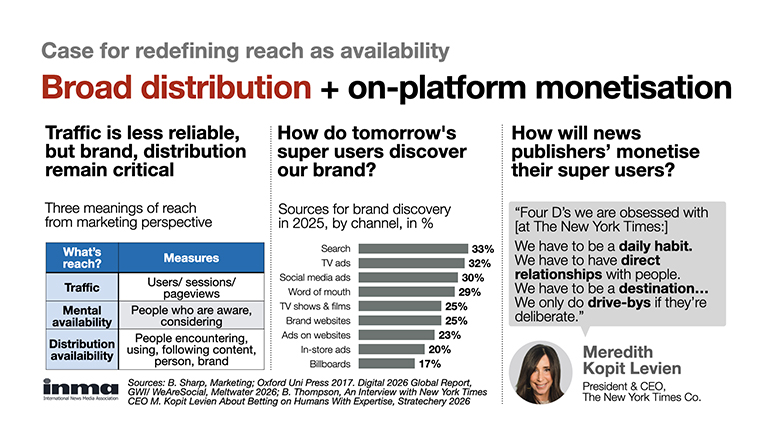
Based on academic literature, I can think of reach as having three meanings, and only the first is on most dashboards.
The first is “traffic — users, sessions, pageviews.
The second is “mental availability” — whether your brand comes to mind when a need arises.
The third is “distribution availability” — whether you are present where people already choose to spend their time.
Traffic still counts but is becoming less reliable as platforms’ priorities shift. Mental and distribution availability increasingly decide whether you enter someone’s life at all, and they are the dimensions we measure worst.
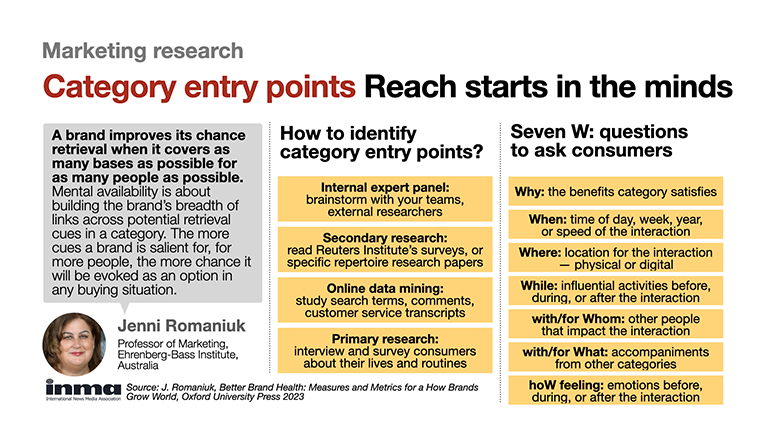
The reason they matter is something that frustrates a lot of publishers: The most valuable news consumers refuse to be loyal to one source. The opposite is true.
In Reuters Institute’s data, 49% of U.S. news consumers used five or more sources in a week; among super users — people who checked news several times a day — that rose to 64%.
Loyalty, it turns out, has more to do with the consumer than with anything clever we do. The heavier someone’s appetite for news, the wider their repertoire.
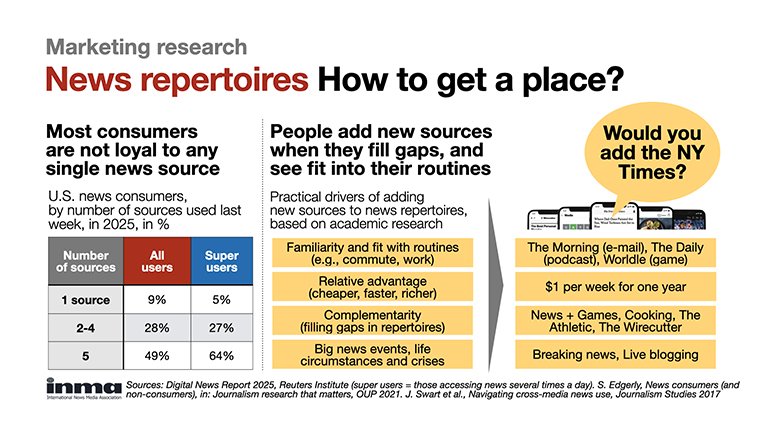
The work of Professor Jenni Romaniuk of Ehrenberg-Bass Institute in Australia explains why.
Category entry points
People do not think about brands first; they think about situations first. A need appears, a routine is triggered, and only then does a brand or several come to mind.
Nobody perhaps wakes up thinking about The New York Times. Many wake up wondering what happened overnight. They commute and want something to listen to. They hear colleagues arguing about an immigration crisis and want context. They worry about mortgage rates amid the Iran conflict. They follow the FIFA World Cup. They are thinking of a new barbecue for their garden. They have a spare few minutes and want to decompress with a puzzle.
Those situations are the entry points to the news media category. The repertoire forms because no single publisher owns all of them: One brand owns politics, another sport, a third games, a fourth the local.
In her book, “Better Brand Health Book” (Oxford University Press 2023), Professor Romaniuk reveals a framework for marketers searching for the entry points. It sounds a bit like the 5W framework journalists use (Who? What? When? Where? Why?), but here it’s actually 7Ws:
- Why: the benefits the category satisfies (an equivalent of Christensen’s Jobs to Be Done or Katz’ media gratifications).
- When: timing of the interaction, such as time of day, week, or speed (quick vs. slow).
- Where: location for typical interaction, which might be a physical place, e.g., a car, or digital, e.g., e-mail box.
- While: influential activities that occur prior, during, or after, e.g., something to fill a quick break.
- with/for Whom: other people that impact the interaction, e.g., connect with someone famous or have something to talk about with a friend.
- with/for What: accompaniments to other product categories, e.g., when I enjoy my morning cup of tea.
- hoW feeling: emotions before, during or after, e.g., to relieve boredom, or share excitement.
New definition for reach in an era of fragmented discovery
Seen through the lens of repertoires and routines, reach is not really a count of people. It is a count of situations you show up for.
A brand present in more Category Entry Points, as defined by Professor Romaniuk, naturally appears in more repertoires, and a brand that owns the *recurring* ones — the morning briefing, the puzzle, the markets check — becomes a destination where publishers control access, price and collect data, which makes monetisation viable.
The destination is the outcome. Ownership of recurring entry points are the levers.
Across the INMA membership, we observe a lot of investment past the home page: in newsletters, podcasts, YouTube, TikTok, WhatsApp, events, games. We usually file these under diversification of audiences, channels, formats.
We can file them under presence: attempts to participate in more routines, early, before anyone is ready to head to the publisher’s destination Web site or app, and pay or view ads.
The new strategic questions every news marketer needs to ask are:
Which category entry points are large and recurring?
Which entry points are growing?
Which are owned by competitors?
Which are underserved?
Explainer: What is the role of reach in a news business?
If Web site traffic is a poor proxy, why insist that reach still matters? Because the evidence for its role in advertising and subscription growth has actually become stronger.
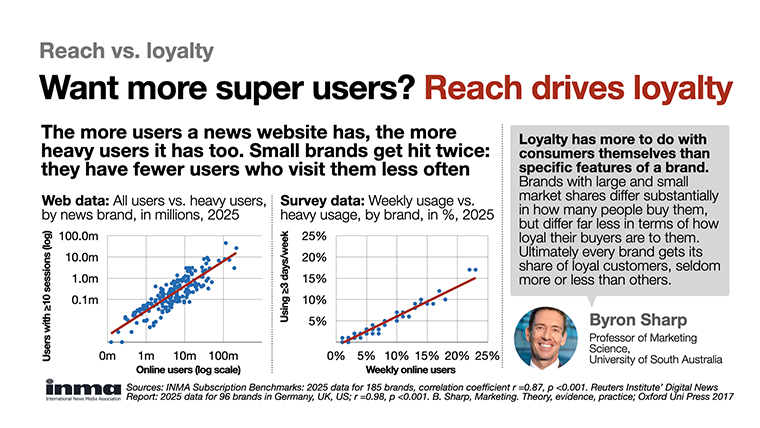
The pattern Professor Byron Sharp and the Ehrenberg-Bass Institute in Australia documented across consumer goods — bigger brands have more buyers and more loyal buyers — holds in news.
In the INMA analysis using data shared by news publishers and survey data from Reuters Institute, the correlations between the brands’ total audience and their number of heavy users was near perfect.
We see another proof for the Double Jeopardy Law, observed in retail, and it is unkind to small news brands: They are punished twice, with fewer users who also visit less often.
The strategy of “stop chasing reach and cultivate a smaller, more loyal core” is intuitive, widely repeated in blogs or at conferences, but it is not supported by the empirical data.
This matters because of where the money actually comes from. INMA Benchmarks showed a small share of heavy users generates a large share of engagement, which translates into most of revenue from both advertising and subscriptions.
The super users are the whole game. And the proven way to get more of them is not to engineer loyalty in a smaller pool but to have more users overall.
Greg’s Readers First newsletter is a public face of a revenue and media subscriptions initiative by INMA, outlined here. INMA members can subscribe here.
Banner image: Adobe Stock by vittaya.
Related Articles
-

WSJ executive councils show how publishers build communities th...
19 October 2026 -

Bundling is a pricing decision, rebundling is an organisational...
18 October 2026 -

There is no subscription ceiling — there is a Web site ceiling
4 October 2026 -

Challenging 3 myths about audience engagement
21 September 2026 -

AI’s effect on super user math
15 September 2026 -

At Mediacorp’s CNA, loyalty means giving audiences a reason to ...
20 August 2026 -

Indian Express builds a video-first future around trusted journ...
20 July 2026 -

Economist launches subscription tier targeting younger audience...
20 July 2026
Upcoming Events
-

Subscriber Acquisition Master Class
10-17 November 2026
-

Media Advertising Summit
New York, United States
07-10 December 2026
-

AI-Native News Product Master Class
18-25 February 2027
-

Media Subscriptions Summit
Oslo, Norway
08-12 March 2027
-

World Congress of News Media
New York, United States
25-30 April 2027
-

Branded Content & Partnerships Master Class
20-27 May 2027
-

Subscriber Retention Master Class
17-24 June 2027
-

Conferencia Latinoamericana
15-16 July 2027
-

South Asia News Media Festival
New Delhi, India
19-22 July 2027
-

Asia/Pacific News Media Summit
19-20 August 2027
-

CEO Roundtable at Kilkenny
Kilkenny, Ireland
24-26 August 2027
-

Media Innovation Week
Amsterdam, The Netherlands
27 September - 01 October 2027








