

News brands are competing for repertoire share, not exclusive relationships
Readers First Initiative Blog | 08 June 2026

If reach builds loyalty, the next question is how that loyalty actually forms. Publishers are not competing for exclusive audiences but for a role in their repertoires.
Those who believe their most valuable users are uniquely theirs are likely misreading the data. The news industry’s analytics are limited to what happens on publishers’ owned platforms.
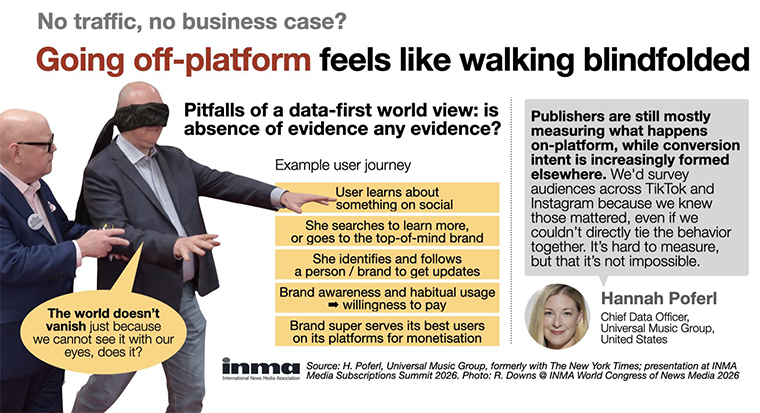
As social platforms increasingly hold on to audiences, and AI provides direct answers to search queries, publishers miss the clicks and no longer account for repeated, fragmented exposure.
They do not see the social posts seen, the search prompts entered, the aggregator scrolls, the podcasts heard, the newsletters and links forwarded.
This creates a specific attribution failure. A social referral that converts poorly during the session itself may still generate brand familiarity that drives a direct-visit subscription six months later.
“Publishers are still mostly measuring what happens on-platform while conversion intent is increasingly formed elsewhere,” said Hannah Poferl, chief data officer at Universal Music Group, formerly with The New York Times.
Publishers consistently undervalue distributed reach partly because their analytics systems were built for simpler, more linear audience behaviour. But is absence of evidence really evidence of absence?
At the recent INMA Media Subscriptions Summit in Toronto, Poferl described how The Times searched for it: “We’d survey audiences across TikTok and Instagram because we knew those mattered, even if we couldn’t directly tie the behaviour together. It’s hard to measure, but it’s not impossible.”
The repertoires of news audiences
Academic research on news audiences consistently finds most users maintain broad informational repertoires, with individual brands occupying one position within them.
And the users most worth competing for — the news category’s super users — tend to have the largest repertoires of sources.
According to Reuters Institute’s 2025 survey, 91% of U.S. consumers used at least two news sources, 66% used at least three, and 49% used five or more.
The most frequent users — those accessing news several times a day — used many more sources: 64% used five or more. Surveys in other markets, such as Germany and the U.K., show similar patterns.
These super users consume news across multiple channels, using social platforms, aggregators and news sites, and engaging with several news brands, creators, and formats simultaneously.
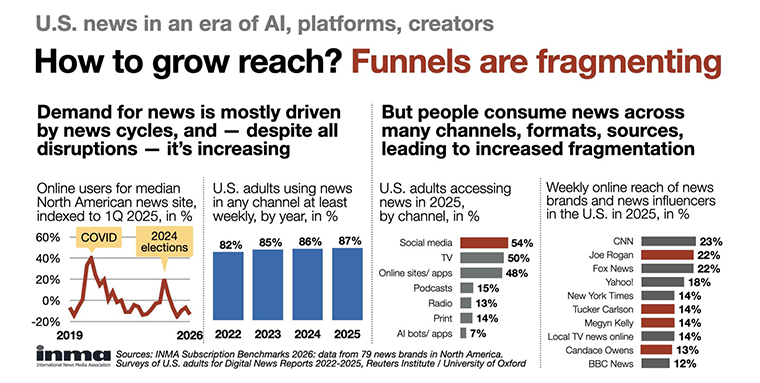
Digital media expanded choice for consumers and with it their repertoires. In 2025, per surveys, more Americans accessed news online than through traditional channels (76% vs. 75%).
And more people used social media for news (54%) than TV (50%) or publishers’ own Web sites (48%). Thanks to social media, individual creators now rival major institutional publishers in weekly reach.
For example, 22% of Americans came across podcaster Joe Rogan discussing or commenting on news in the previous week — a similar proportion to those who reported accessing CNN (23%) or Fox News (22%).
What are the strategic implications? The goal for publishers’ audience strategy should not be an exclusive relationship, which is rare and unlikely for the most valuable super users.
The goal should be a durable position inside users' information routines, which — as INMA research found — is a function of maintaining broad distribution.
How brands grow
Academic research shows that in fragmented, high-choice environments, strong brands function as cognitive shortcuts.
In news, people associate brands with specific forms of utility: one source for orientation, another for explanation, another for entertainment or identity.
The brands that survive in individuals’ routines are those whose utility has been rehearsed across enough contextual moments: e.g., a morning briefing, a commute, a lunch break, a breaking news event.
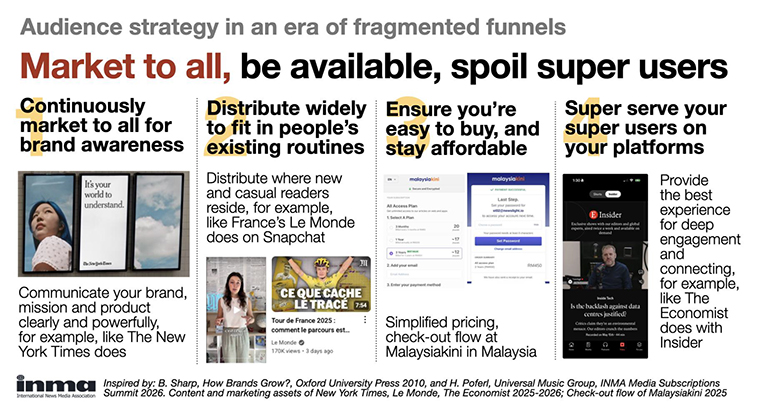
Marketing continuously for brand awareness and distributing widely to fit people’s routines is key to building an audience, but it is not enough for monetisation.
Ultimately, super users need to land on publishers’ platforms, where publishers control access and prices for users and advertisers.
Becoming a destination is not a destiny. Beyond brand awareness and consideration, it requires investing in a distinctive user experience and a diverse bundle of content and features that super-serve the super users.
Greg’s Readers First newsletter is a public face of a revenue and media subscriptions initiative by INMA, outlined here. INMA members can subscribe here.
Banner photo: Adobe Stock By Andrey Popov.
Related Articles
-

Every loyal reader was a stranger first
8 October 2026 -

There is no subscription ceiling — there is a Web site ceiling
4 October 2026 -

Challenging 3 myths about audience engagement
21 September 2026 -

The inbox deserves more investment from publishers in the AI er...
26 July 2026 -

News companies should stop chasing clicks, start competing for ...
28 June 2026 -

News publishers leverage audience insights to build deeper rela...
23 June 2026 -

Subscription benchmarks reveal dynamic strategies set top news ...
15 June 2026 -

Research: Some consumers are willing to pay, unwilling to commi...
14 June 2026
Upcoming Events
-

Subscriber Acquisition Master Class
10-17 November 2026
-

Media Advertising Summit
New York, United States
07-10 December 2026
-

AI-Native News Product Master Class
18-25 February 2027
-

Media Subscriptions Summit
Oslo, Norway
08-12 March 2027
-

World Congress of News Media
New York, United States
25-30 April 2027
-

Branded Content & Partnerships Master Class
20-27 May 2027
-

Subscriber Retention Master Class
17-24 June 2027
-

Conferencia Latinoamericana
15-16 July 2027
-

South Asia News Media Festival
New Delhi, India
19-22 July 2027
-

Asia/Pacific News Media Summit
19-20 August 2027
-

CEO Roundtable at Kilkenny
Kilkenny, Ireland
24-26 August 2027
-

Media Innovation Week
Amsterdam, The Netherlands
27 September - 01 October 2027








