

The inbox deserves more investment from publishers in the AI era
Readers First Initiative Blog | 26 July 2026

Amid the rise of social media and AI search, news publishers are searching for the next distribution breakthrough. Yet they may be underinvesting in one of the oldest and most enduring digital habits: e-mail.
Northeastern University tracked independently the desktop browsing of 4,608 U.S. adults between June 2024 and December 2025, and it found e-mail absorbed 24.9% of their online time, neck-and-neck with social media (25.3%), and nearly 10 times more than news Web sites (2.5%).
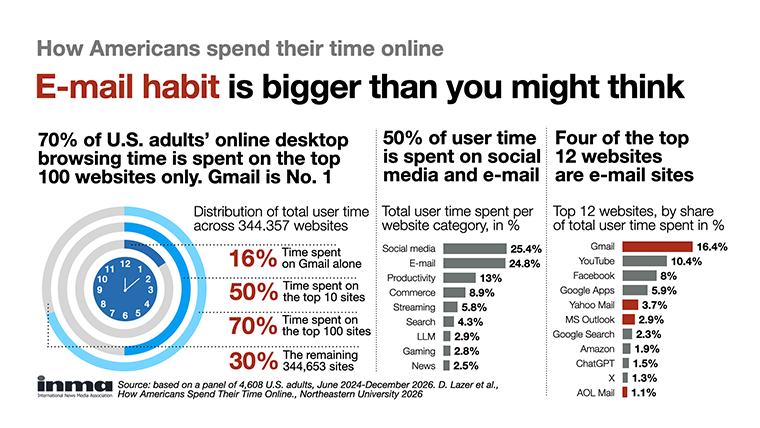
People in the panel visited a total of 344,653 unique Web sites, but their attention was very concentrated. Gmail alone was No. 1 destination and accounted for 16.4% of all browsing time. The average person spent more time on Gmail than on the bottom 300,000 Web sites combined!
The top 10 Web sites together captured nearly half of all browsing time, and the top 100 — close to 70%. Interestingly, four of the top 12 Internet destinations are inboxes: Gmail, Yahoo Mail, Microsoft Outlook, and AOL Mail.
The study has limitations: It captured personal desktop behaviour rather than work computers or mobile devices or connected TVs. Yet, it also measured attention more rigorously than most studies, as it recorded only the time a browser tab was actively foregrounded by the user, even if many other tabs were open.
This unique method revealed a much larger role of e-mail than commercial panels measuring primarily visits to Web sites, such as from GWI, Semrush, or SimilarWeb. They usually estimate time spent based on two interactions on the same page (views or clicks) or model session duration using AI based on a sample of server logs.
Internet’s top habit
There is more evidence the inbox is one of the largest attention pools and recurring entry points to people’s digital life, and not only in the United States.
Of the 6.12 billion people using the Internet worldwide, about 4.7 billion use e-mail, according to Statista. Unlike news publishers’ Web sites or apps, e-mail asks audiences to adopt no new behaviour.
The habit already exists at an extraordinary scale: Depending on a survey, between 88% and 99% of e-mail users check it every day, and 58% do so first thing in the morning.
The challenge is not persuading people to check their inboxes but earning a place within that routine by arriving at the right time, with enough relevance and consistency to become part of readers’ daily lives.
Who controls e-mail
Compared with social and search platforms, the inbox has proved remarkably resilient. In general, publishers own the subscriber list, retain first-party data, and reach audiences without depending on ranking algorithms that rule visibility on social feeds and search results.
That does not mean the inbox is free of algorithms. E-mail providers increasingly use AI to filter spam, categorise messages into tabs such as “primary” or “promotions,” prioritise important messages, and, more recently, generate AI summaries.
Yet readers retain much greater control over these systems than they typically do over social or aggregator feeds: They can choose which senders to follow, create filters, move messages between categories, and train inboxes to reflect their own preferences.
Looking at providers — where people’s mailboxes are hosted — Gmail is by far the largest service, with an estimated 1.8 billion users globally, ahead of Apple’s iCloud Mail (about 950 million), Outlook (about 400 million), and Yahoo Mail (about 225 million).
Looking instead at e-mail clients, the Web sites or apps people actually use to read messages on desktop or in mobile: Apple Mail app accounts for about 46% of opens, Gmail 24%, and Outlook 6%.
What is the growth opportunity
The behavioural evidence is compelling. A fresh members-only report from INMA Subscription Benchmarking Service adds a robust relationship of e-mail and subscriptions, and reveals substantial headroom for scaling newsletters.
Across 317 brands benchmarking with INMA, newsletter penetration — recipients as a share of in-market households — correlates with digital subscription penetration across every cohort we tested. The more newsletter recipients one has, the more digital subscriptions one has as well.
Correlation is not causation. Newsletters may feed subscriptions, subscriptions may feed newsletters, or strong brands may simply generate more of both. One fact, however, makes the acquisition interpretation plausible.
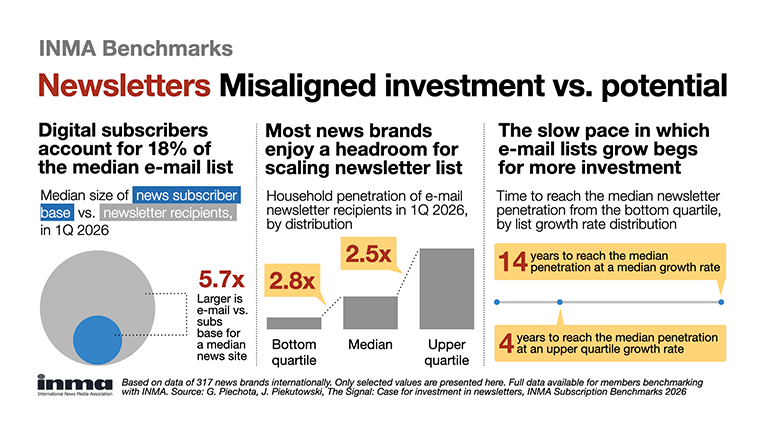
The median newsletter audience is about six times larger than the digital subscription base. Even if every subscriber also received a newsletter, subscribers would account for only about 18% of the median list.
That suggests newsletters typically operate much higher up the acquisition funnel than subscriptions themselves.
A brand at the bottom quartile of newsletter penetration would need to grow its list 2.8x to reach the median, which is the expected size of the list for most brands as half of their peers had achieved that scale already.
And the median brand would then need to grow another 2.5x to reach the top quartile or the world’s best performers.
The challenge is the slow pace in which publishers’ newsletter lists grow, which begs for more investment:
At the current pace, a bottom-quartile publisher would need more than 14 years to reach today’s median penetration.
Brands growing at the top-quartile rate would cover the same distance in less than four years.
If newsletters remain one of the few scalable, direct relationships publishers truly own, investment levels and growth ambitions appear badly misaligned.
Greg’s Readers First newsletter is a public face of a revenue and media subscriptions initiative by INMA, outlined here. INMA members can subscribe here.
Banner photo: Adobe Stock By onephoto.
Related Articles
-

Bundling is a pricing decision, rebundling is an organisational...
18 October 2026 -

AI’s effect on super user math
15 September 2026 -

What I told 40 CEOs (and won’t gatekeep from you)
30 August 2026 -

Nation Media Group focuses editorial strategy on stories that m...
4 August 2026 -

Economist launches subscription tier targeting younger audience...
20 July 2026 -

Grupo RBS builds social-first video operation to expand audienc...
20 July 2026 -

AI adoption in newsrooms should move from experiment to strateg...
12 July 2026 -

Why are audiences going to AI answer engines for news?
30 June 2026
Upcoming Events
-

Subscriber Acquisition Master Class
10-17 November 2026
-

Media Advertising Summit
New York, United States
07-10 December 2026
-

AI-Native News Product Master Class
18-25 February 2027
-

Media Subscriptions Summit
Oslo, Norway
08-12 March 2027
-

World Congress of News Media
New York, United States
25-30 April 2027
-

Branded Content & Partnerships Master Class
20-27 May 2027
-

Subscriber Retention Master Class
17-24 June 2027
-

Conferencia Latinoamericana
15-16 July 2027
-

South Asia News Media Festival
New Delhi, India
19-22 July 2027
-

Asia/Pacific News Media Summit
19-20 August 2027
-

CEO Roundtable at Kilkenny
Kilkenny, Ireland
24-26 August 2027
-

Media Innovation Week
Amsterdam, The Netherlands
27 September - 01 October 2027








