

27% of people get their news from a creator
Young Audiences Initiative Blog | 06 July 2026

Every year, the Reuters Institute publishes what is probably the closest thing journalism has to a shared reality check. The question at the core: How do people actually consume news?
This year’s answer is uncomfortable for most newsrooms. For the first time ever, platforms have overtaken both TV and news Web sites as the primary source of news globally. And the people doing the work on those platforms are more and more creators — some with journalistic background others without.
Nic Newman is something of a godfather when it comes to data in our industry. For over 14 years, he shaped the Digital News Report as lead author — cited endlessly, interviewed constantly, the name behind the numbers every journalism conference slides into its decks. This year, he handed that role to Jim Egan. What Newman chose to focus on instead: creators.
I invited Newman onto my podcast, No One’s Reading This. The full conversation is here. What follows is what I took away from it.
This year, the Digital News Report asked directly for the first time: Do you get news from individual creators? The answer: 27% of respondents across all markets say yes, every week.
“The 27% felt quite a lot to me,” Newman says in our conversation, “particularly in some countries outside Europe, where you see up to 50% in countries like Thailand, Peru, Morocco, Indonesia saying that they get news from creators. In a lot of countries where there is less trust in traditional media, where there’s greater use of social media, we’re seeing even higher figures.”
The inverse is equally telling. In Northern Europe — markets with strong legacy brands and lower social media penetration — the figures drop sharply.
This isn’t a monolithic global shift. It’s a map of trust, of platform dependence, and of how well or badly traditional media has served its audiences.
One number gets less attention: When the Digital News Report asked how many people get most or all of their news from creators, the figure falls significantly. Creators are, for now, supplementary. They sit alongside traditional media, not replacing it. That could be reassuring, but I think it could also be a baseline that’s about to move fast.
Four ecosystems, not one creator economy
One of the report’s most useful contributions is refusing to treat “the creator economy” as a single thing. Newman mapped four distinct systems, and I’ve visualised them because they’re worth sitting with before we go further.
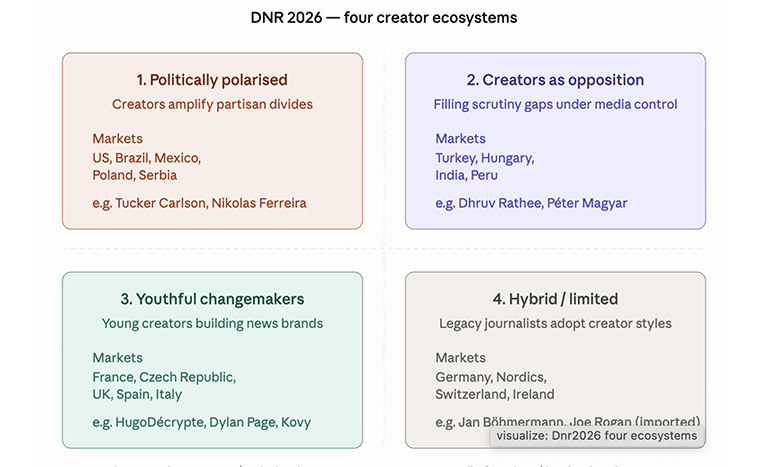
The one that tells the clearest story for this audience: France.
The top six news creators there, Newman noted in our conversation, “are all young people essentially either explaining the news, or specialising in the environment, or in comedy, or in music — and that shows that traditional media is really not connecting with that particular group.”
Hugo Travers, also know as HugoDécrypte, now reaches 28% of under-35s in France. More than Le Monde or TF1. He employs over a dozen people. He’s not a bedroom creator anymore; he’s a media company that happened to start on YouTube.
Newman calls it the new phase: individuals that become brands. It’s a useful corrective to how most legacy newsrooms still think about creators — as a tactic, not a model.
The trust paradox
The Digital News Report 2026 asked, for the first time, how audiences compare creators and traditional media on specific attributes. Newman calls it one of the most interesting data points in the entire report.
The general population’s verdict: Creators are more entertaining, easier to understand, more relatable — and in some cases more knowledgeable — than traditional media. But less trustworthy and less impartial. A trade-off, in other words. You gain accessibility, you sacrifice credibility.
Except that’s not what the data shows when you look closer.
Among people who actually use creators regularly — that 27% — creators score more highly on every single attribute tested. Including trust and including impartiality. The trade-off disappears the moment someone has actual experience with creators rather than just an assumption about them.
Newman’s explanation goes straight to the structural: “When you have an individual, there’s nobody hiding behind that. What you see is what you get. Increasingly, when people think about trust, they worry about hidden agendas, they worry about what might be lying behind an individual who works for an institution. That individual trust, I think, is really critical.”
This points to something news organisations consistently get backward: Trust isn’t built through institutional authority. It’s built through personal accountability, the correspondent you know by name, whose reasoning you can follow, who shows their work.
“Some people would find it quite surprising that people say they trust creators more than journalists,” Newman adds. “But it really goes back to that sense of the individual and that accountability.”
Which raises the harder question: If that’s what builds trust, why are most publishers still hiding their journalists behind a masthead?
The bridge model is broken
Another important fact of this year’s report: 48% of 18- 24-year-olds now say social and video networks are their main source of news. Add AI, and that number rises to 52%. News Web sites are cited as the main source by just one in five young people — the number is shrinking.
The oft-heard counter-argument — that people will grow into legacy formats as they age — Newman dismisses directly.
“I just don’t think that’s going to happen,” he says. “There will always be a small minority of young people who read a newspaper or magazine, and that will continue. But the vast majority on average are voting for convenience, they’re voting for platform access. None of that is to say that they’re not interested in things. It’s just that it feels more convenient, it feels more relevant, and it feels easier to understand.”
And yet the dominant strategy in most newsrooms is still the bridge model: Post on platforms, tease content, hope audiences convert to subscribers on owned properties.
Newman is unsparing — particularly about commercial publishers: “It’s really hard to see where the return is by just putting content out for free,” he says. “There’s virtually very little evidence to show that if you put a lot of TikToks out there that young people will convert into subscribers. It’s a genuinely difficult problem.”
The alternative isn’t abandoning owned products. It’s rethinking what investment means. The Web-site-and-app model is declining in almost all cases. Growth is in shows, talent, personality-led approaches — podcasts, video, newsletters — not as add-ons to the core product but as the core product, with monetisation logic and editorial investment built around them from the start, not bolted on after the fact.
If you’d like to subscribe to my bi-weekly newsletter, INMA members can do so here.
Banner photo: Adobe Stock by snowing12.
Related Articles
-

AI’s effect on super user math
15 September 2026 -

What I told 40 CEOs (and won’t gatekeep from you)
30 August 2026 -

Nation Media Group focuses editorial strategy on stories that m...
4 August 2026 -

Economist launches subscription tier targeting younger audience...
20 July 2026 -

Grupo RBS builds social-first video operation to expand audienc...
20 July 2026 -

AI adoption in newsrooms should move from experiment to strateg...
12 July 2026 -

Why are audiences going to AI answer engines for news?
30 June 2026 -

With The B‑Side, Boston Globe scored an A+ with young audiences
10 June 2026
Upcoming Events
-

Subscriber Acquisition Master Class
10-17 November 2026
-

Media Advertising Summit
New York, United States
07-10 December 2026
-

AI-Native News Product Master Class
18-25 February 2027
-

Media Subscriptions Summit
Oslo, Norway
08-12 March 2027
-

World Congress of News Media
New York, United States
25-30 April 2027
-

Branded Content & Partnerships Master Class
20-27 May 2027
-

Subscriber Retention Master Class
17-24 June 2027
-

Conferencia Latinoamericana
15-16 July 2027
-

South Asia News Media Festival
New Delhi, India
19-22 July 2027
-

Asia/Pacific News Media Summit
19-20 August 2027
-

CEO Roundtable at Kilkenny
Kilkenny, Ireland
24-26 August 2027
-

Media Innovation Week
Amsterdam, The Netherlands
27 September - 01 October 2027








