

Here’s why I changed my mind about liquid content
Product & Tech Initiative Blog | 18 August 2026

Back in April, I argued news organisations should be prioritising liquid content, content that could be broken apart, recombined, and delivered in different formats for different audiences. I still believe that.
But over the last few months, my thinking has evolved.
A colleague on the INMA Product & Tech Advisory Council challenged me with a deceptively simple question: “Do we really want to personalise everything? Isn’t that better left to the platforms?”
It’s a fair challenge. Because when we talk about AI, there’s an assumption that every article should become infinitely personalised.
I don’t think that’s what we want.
If every story changes depending on who’s reading it, eventually we lose the storyteller. We lose the journalist. We lose the editorial judgment that makes one publication feel different from another. That’s exactly what readers are paying for.
What we do want is for AI to help deliver the right journalism, to the right person, with the right context, in the right format, at the right time.
Notice the difference. I’m no longer talking about personalisation. I’m talking about adaptation.
The journalism stays the same. The experience changes. That’s the middle ground I think our industry should be aiming for.
So how do we get there?
Recently I spoke with Joe Croney, former CTO of Arc XP, the CMS developed at The Washington Post, and now founder of HyperContent.ai.
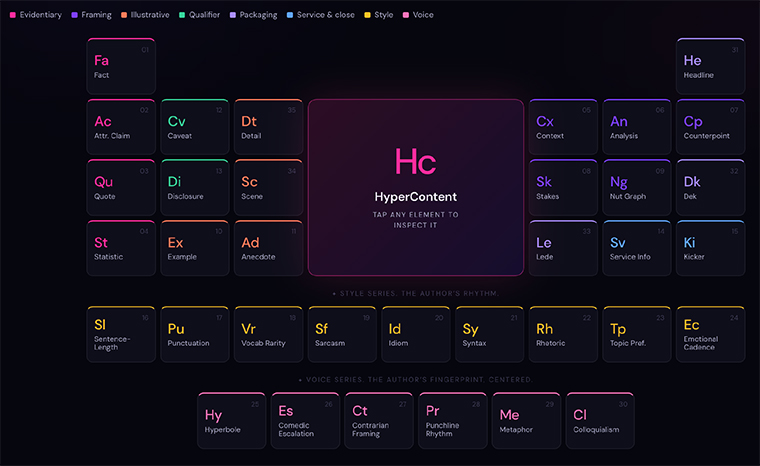
He showed me what he describes as a periodic table of content, a way of thinking about journalism as a collection of reusable building blocks rather than a fixed Web page. It immediately reminded me of Sannuta Raghu’s concept of the news atom but took the idea a step further.
Rather than simply breaking an article into components, it starts identifying what those components actually are.
Evidence.
Context.
Framing.
Qualifiers.
Analysis.
Style.
Voice.
That distinction matters. This isn’t simply metadata describing an article. It’s describing the journalism itself.
Instead of viewing a story as one long block of text, it becomes a series of editorial decisions that can be intelligently reassembled for different experiences without changing the reporting.
Don’t lose the journalist or the brand
The part that resonated most with me wasn’t the technical structure. It was seeing style and voice recognised as content atoms, too.
That’s something AI discussions often overlook. Every journalist has a unique way of telling stories: Some build suspense. Some explain patiently. Some use humour. Some rely on conversational language. Some naturally frame issues from a contrarian perspective.
Likewise, every news organisation develops its own editorial voice over decades. Those aren’t things to optimise away. They’re part of the product.
If AI strips out personality in pursuit of efficiency, we’ll all end up producing technically perfect but emotionally interchangeable journalism. That isn’t progress.
Structured journalism, not generic journalism
This is why structured journalism matters so much. Not because AI likes structured data. Because structured journalism gives us the flexibility to distribute reporting wherever audiences are consuming it: a voice assistant, a chatbot, a newsletter, a push notification, a wearable, an AI search result, or products we haven’t imagined yet.
The reporting remains intact. The storytelling remains intact. Only the presentation adapts.
That’s a very different philosophy from simply generating multiple versions of the same article. It’s editorial adaptation.
AI shouldn’t replace editorial judgment. It should amplify it. If we get the architecture right, AI won’t make journalism more generic. It might finally allow great journalism to reach people in the format they need while preserving the voice that made them trust it in the first place.
If you’d like to subscribe to my bi-weekly newsletter, INMA members can do so here.
Banner photo: Adobe stock image by 天下 独孤.
Related Articles
-

Marketers should outsource tasks, not thinking
25 October 2026 -

AI’s effect on super user math
15 September 2026 -

At Mediacorp’s CNA, loyalty means giving audiences a reason to ...
20 August 2026 -

Tribun Network turns print “dots” into AI-powered insight
20 August 2026 -

Nation Media Group focuses editorial strategy on stories that m...
4 August 2026 -

Briefly News empowers journalists with AI tool suite Nova
4 August 2026 -

Grupo RBS builds social-first video operation to expand audienc...
20 July 2026 -

AI adoption in newsrooms should move from experiment to strateg...
12 July 2026
Upcoming Events
-

Subscriber Acquisition Master Class
10-17 November 2026
-

Media Advertising Summit
New York, United States
07-10 December 2026
-

AI-Native News Product Master Class
18-25 February 2027
-

Media Subscriptions Summit
Oslo, Norway
08-12 March 2027
-

World Congress of News Media
New York, United States
25-30 April 2027
-

Branded Content & Partnerships Master Class
20-27 May 2027
-

Subscriber Retention Master Class
17-24 June 2027
-

Conferencia Latinoamericana
15-16 July 2027
-

South Asia News Media Festival
New Delhi, India
19-22 July 2027
-

Asia/Pacific News Media Summit
19-20 August 2027
-

CEO Roundtable at Kilkenny
Kilkenny, Ireland
24-26 August 2027
-

Media Innovation Week
Amsterdam, The Netherlands
27 September - 01 October 2027








