

Key points from Benedict Evans’ spring presentation: “AI eats the world”
Product & Tech Initiative Blog | 23 June 2026

Twice per year, Benedict Evans produces a big presentation exploring macro and strategic trends in the tech industry called AI eats the world. It’s a hefty 79-page deck. I read through everything and pulled out the key points for media.
Ready? Let’s go.
If you read this newsletter, I doubt you need a reminder that AI is big. But did you know that there’s officially more spending in data centers than new office space in the United States?
Four key points about AI as a whole before we dive into the media specific:
AI is becoming a platform shift, not a feature. Benedict puts Generative AI alongside PCs, the Web, and smartphones. And every major platform shift resets who wins, where value accrues, and how companies are built.
The industry is in an unprecedented infrastructure buildout. Microsoft, Meta, Alphabet, and Amazon are planning roughly US$700 billion in AI-related capex. This is bigger than many historic technology investment cycles.
Compute has become the new oil. GPUs, chips, power, and data centers are the bottlenecks. The challenge is no longer inventing AI but deploying enough infrastructure to run it.
Demand is growing faster than supply. AI usage is exploding, while infrastructure, power grids, and semiconductor supply chains struggle to keep up. Today’s economics are temporary because the market is still out of equilibrium.
“Models seem to be commoditised,” as Benedict says, in that there are not that many differences for most users.
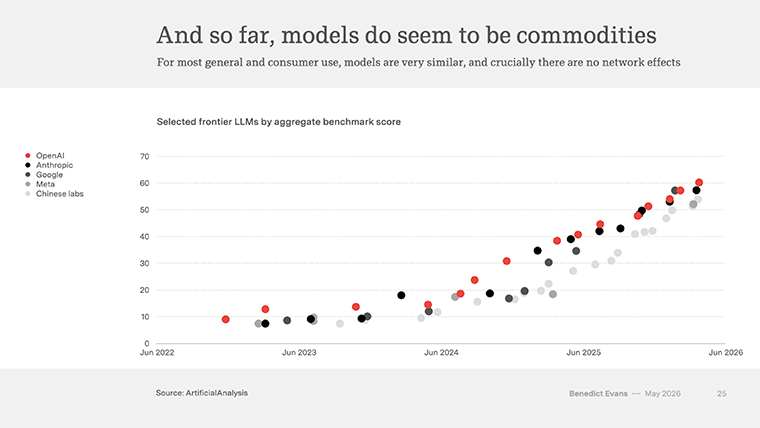
Benedict also mentions “everyone is already using this.” This is huge for our industry as it pertains not only to distribution for news media but consumer expectations for products and services on our sites.
Let’s look at the numbers.
Over 900 million weekly users on ChatGPT (according to OpenAI). That’s 2.5 billion views per day. And Google’s AI overviews reportedly get 8.2 billion per day.
That’s a lot. But is this actually part of a daily routine?
Twenty percent of ChatGPT users sent over 1,000 messages in a year. That’s roughly three per day, so yes, this is routine. In November 2025, 15% of U.S. consumers were using it daily (increasing to circa 27% in the 14- to 17-year age group, according to Pew) and almost 50 weekly (according to Bick et al). See chart below.

All this means we should assume our customers are getting used to chat as a function. They are getting used to quick, personalised answers to specific questions.
And then there is internal use of AI. The chart below breaks down AI usage by industry from June 2023 to December 2025.
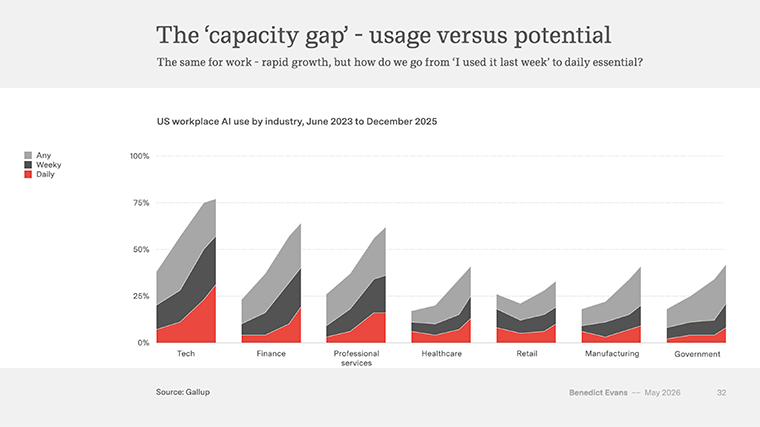
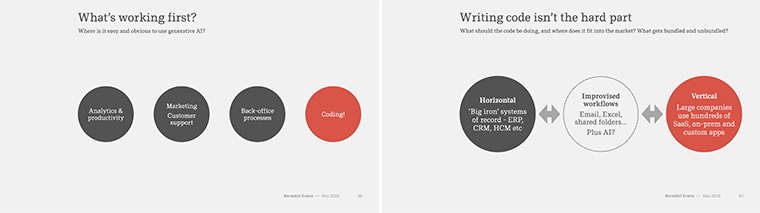
There are very clear answers as to “what works first” (see below). In most companies, there are obvious use cases for automation. But results can take time. And innovation takes even more time.

And since late last year, coding now becomes a big area for improvement. Coding no longer takes long training and a detailed skillset,;vibe coding is natural language — literally anyone can do it.
But, as Benedict points out, writing code isn’t the hard part. Integration is. Also, usage-based pricing can be an issue for some as budgets can be blown quickly.
Now, on to my favourite part: What do we actually need to do about this?
We need to redefine the questions we are asking. That’s the piece we are working through now as an industry.
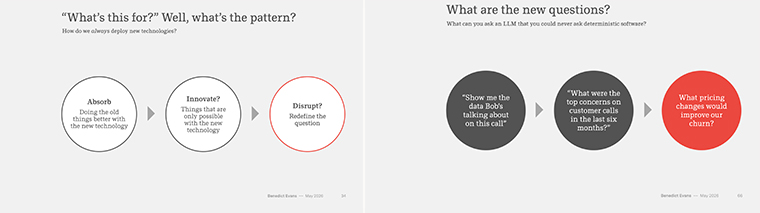
But ultimately we are all guessing. We don’t know how this will actually play out. The early winners did not always last in previous platform shifts.
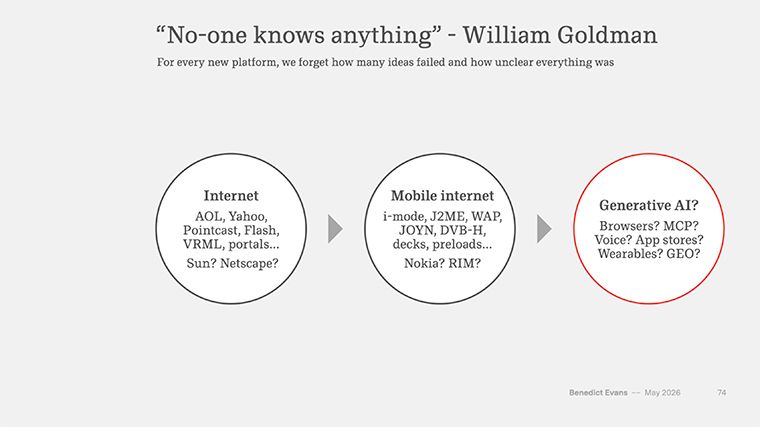
My advice off the back of this? Scenario plan. Leadership — across all departments — should be looking at different outcomes, maybe even weighting them, and then revisiting every quarter to see if the strategies are on track or if tactical shifts are needed towards a different outcome.
If you’d like to subscribe to my bi-weekly newsletter, INMA members can do so here.
Related Articles
-

Readers’ agents are becoming customers, and most publishers can...
28 October 2026 -

Why publishers are blocking bots by default to starve the black...
28 October 2026 -

What makes an AI choose your news brand?
14 October 2026 -

Licensing won’t save media, but authentication might
13 October 2026 -

INMA report: AI’s dependence on journalism gives publishers new...
30 September 2026 -

When the agent — not the app — becomes the interface
30 September 2026 -

AI is now media’s operating environment
28 September 2026 -

INMA spends 5 days in Madrid learning what actually works
20 September 2026
Upcoming Events
-

Subscriber Acquisition Master Class
10-17 November 2026
-

Media Advertising Summit
New York, United States
07-10 December 2026
-

AI-Native News Product Master Class
18-25 February 2027
-

Media Subscriptions Summit
Oslo, Norway
08-12 March 2027
-

World Congress of News Media
New York, United States
25-30 April 2027
-

Branded Content & Partnerships Master Class
20-27 May 2027
-

Subscriber Retention Master Class
17-24 June 2027
-

Conferencia Latinoamericana
15-16 July 2027
-

South Asia News Media Festival
New Delhi, India
19-22 July 2027
-

Asia/Pacific News Media Summit
19-20 August 2027
-

CEO Roundtable at Kilkenny
Kilkenny, Ireland
24-26 August 2027
-

Media Innovation Week
Amsterdam, The Netherlands
27 September - 01 October 2027








