

The first ChatGPT-native media product has arrived
Product & Tech Initiative Blog | 09 June 2026

I’ve been waiting for the first media use case of ChatGPT apps and last week it arrived by way of The Economist, specifically their graphs.
It’s taken a while for something to launch and that’s because it can’t be text based. ChatGPT does that well without the need for an app. As we discussed in October, it needed something visual, which is why The Economist launched with examples such as the Zillow real estate app.
The launch focuses on a single dataset: The Economist’s Trump approval tracker, which is already in front of the paywall. Users can connect the app inside ChatGPT, ask questions in natural language, and receive AI-generated responses supported by The Economist’s polling data and visualisations.
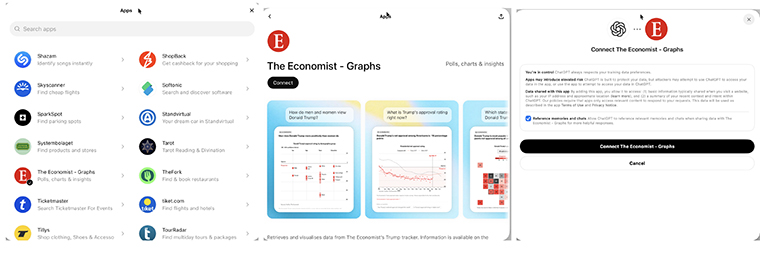
I love the concept that users can interrogate data directly inside ChatGPT rather than navigating to a publisher Web site or app. There will be huge benefits here, especially if branding is done well. And even more so if users can activate subscriptions within ChatGPT — but that now seems a way off.
The user calls The Economist (@TheEconomist) and needs to ask specifically around the approval ratings for it to work.
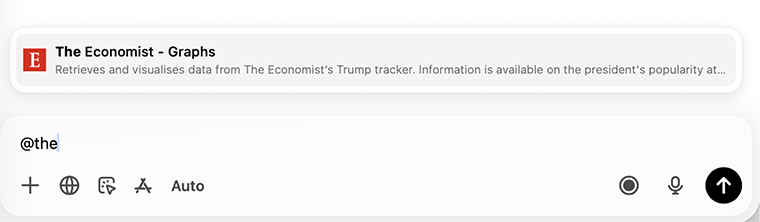
I struggle to see this as a real use case because a consumer has to ask a very specific question to get a graph. But that’s not the point. This is a trusted brand running an experiment, not a wide scaled launch of all content going into an answer engine.
This is what I discovered.
My first attempt brought up a text answer with a link out to the tracker. Possibly good for The Economist as it points back to owned and operated, but in reality the consumer has already requested the brand so it feels clunky.
I asked a follow-up question, hoping that would be more successful, but that brought up regular chat.
My third attempt was more specific, and the response combined AI-generated explanation with trusted publisher data and a visualisation. Bingo, the chart becomes part of the conversation rather than a stand-alone destination.
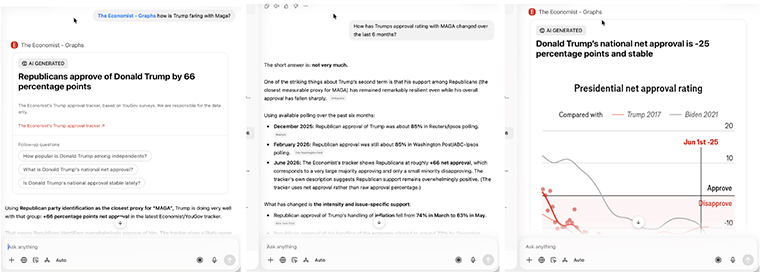
It’s a good step towards a multimedia response that is genuinely helpful to a consumer. The lesson here isn’t about Trump approval ratings. It’s that publishers are beginning to treat AI platforms as a product channel, not just a distribution channel.
If you’d like to subscribe to my bi-weekly newsletter, INMA members can do so here.
Related Articles
-

Marketers should outsource tasks, not thinking
25 October 2026 -

AI’s effect on super user math
15 September 2026 -

The front door is gone — and Asia-Pacific publishers are rebuil...
26 August 2026 -

At Mediacorp’s CNA, loyalty means giving audiences a reason to ...
20 August 2026 -

Tribun Network turns print “dots” into AI-powered insight
20 August 2026 -

Nation Media Group focuses editorial strategy on stories that m...
4 August 2026 -

Briefly News empowers journalists with AI tool suite Nova
4 August 2026 -

NDTV looks beyond AI novelty to build products that deliver rea...
21 July 2026
Upcoming Events
-

Subscriber Acquisition Master Class
10-17 November 2026
-

Media Advertising Summit
New York, United States
07-10 December 2026
-

AI-Native News Product Master Class
18-25 February 2027
-

Media Subscriptions Summit
Oslo, Norway
08-12 March 2027
-

World Congress of News Media
New York, United States
25-30 April 2027
-

Branded Content & Partnerships Master Class
20-27 May 2027
-

Subscriber Retention Master Class
17-24 June 2027
-

Conferencia Latinoamericana
15-16 July 2027
-

South Asia News Media Festival
New Delhi, India
19-22 July 2027
-

Asia/Pacific News Media Summit
19-20 August 2027
-

CEO Roundtable at Kilkenny
Kilkenny, Ireland
24-26 August 2027
-

Media Innovation Week
Amsterdam, The Netherlands
27 September - 01 October 2027








